
The Senate has once again rejected a Democratic push to limit President Trump’s authority to use force against Iran, marking the fourth failed attempt by Democrats to curb war powers in the upper chamber. This piece looks at the votes, the political motive behind repeated resolutions, and why these efforts keep collapsing despite Democratic urgency. It also preserves the key statements from senators and the clear split along party lines that defined the latest showdown. Below I lay out the sequence and implications from a Republican viewpoint that favors decisive leadership on national security.
Four attempts. That is the count Democrats have racked up trying to rein in the commander in chief’s ability to act against Iran. The most recent vote on Wednesday failed, continuing a pattern where Senate Republicans block these measures and Democrats push symbolic proposals that have no path to becoming law. The partisan split in the chamber is bone-deep, and the tally reflected it.
Here’s the exact description that accompanied coverage of the vote:
Senate Republicans on Wednesday blocked a resolution to limit President Trump’s war authority in Iran for the fourth time as the conflict inches closer to the 60-day limit laid out in the War Powers Act.
The vote was 47-52, mostly along party lines, with Sen. Rand Paul (R-Ky.) voting with Democrats in favor of the bill and Sen. John Fetterman (D-Pa.) opposing it. Their votes have remained the same since the Senate’s first Iran war powers vote in March. Sen. Jim Justice (R-W.Va.) did not vote.
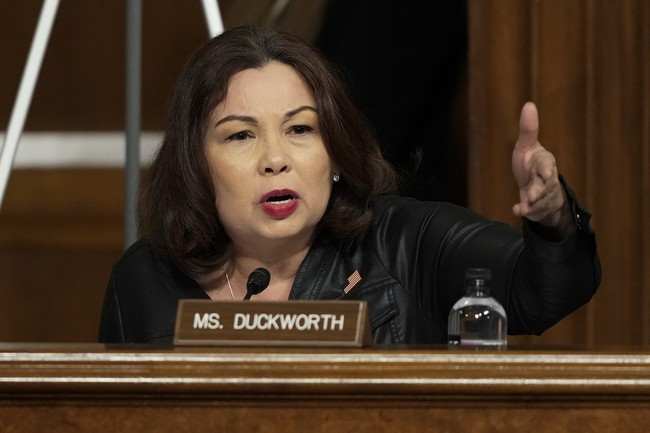
The resolution was introduced on the Senate floor by Senator Tammy Duckworth, who the urgent reason on her X account in a post that emphasized the need to halt what she framed as an unnecessary conflict. Democrats argued the public does not want rising costs and chaos tied to military action, and they insisted the Senate must step in. That rhetoric frames every vote as a defense of taxpayers and oversight, even when the practical effect is negligible.
https://x.com/SenDuckworth/status/2044459208972845079
Senator Duckworth’s message was posted plainly in her social media statement, and it said this:
Today, I’m forcing a vote on my War Powers Resolution to end Trump’s needless and expensive war of choice against Iran.
The American people do not want higher costs, rampant lies and chaos. The Senate must act.
Republicans see these repeated Democratic maneuvers as political theater aimed at scoring points before the next election rather than serious governance. The bills demand explicit congressional authorization to remove U.S. forces from hostilities “within or against Iran, unless explicitly authorized by a declaration of war or a specific authorization for use of military force.” That kind of blanket language would tie the hands of the president in fluid battlefield situations.
The reality on Capitol Hill is that even if such a resolution passed the House and Senate, a presidential veto would be the next step. That dynamic makes these votes symbolic by design, an exercise in messaging meant to rally a base rather than change policy. Opposition from the White House and the GOP majority ensures these measures cannot pass into law without a supermajority few expect Democrats to secure.
The sequence of efforts stretches back beyond the March vote tied to Operation Epic Fury. Earlier attempts targeted different theaters and moments, including a push in November that aimed at limiting action related to Venezuela. Those efforts sometimes picked up bipartisan support but still failed to produce lasting constraints. The throughline is clear: Democrats keep reintroducing war powers resolutions as a way to appear tough on military oversight while knowing the outcome.
From a conservative perspective, this pattern underlines a broader truth about national security debates: presidential flexibility matters when threats are imminent. Democratic proposals often prioritize constraints and oversight over immediate action, which can delay or hobble responses to adversaries. Republicans who back the president argue that decisive action against Iran’s destabilizing behavior is necessary to protect Americans and regional partners.
Critics of the administration label these operations “wars of choice,” but supporters point to decades of threats and provocations that justify forceful measures. The debate is not just legalism about the War Powers Act, it is a clash of strategy: restraint and procedural checks versus swift, unilateral action to degrade threats. That clash plays out every time a vote like Wednesday’s lands on the Senate calendar.
Expect more of the same as Democrats continue to highlight the vote totals and make the case for oversight from the floor. Republicans will continue to defend the president’s authority to act when intelligence and national security demands it. Until the political math in the Senate changes, those Democratic resolutions will remain symbolic votes that expose the division over how to keep the country safe.
Editor’s Note: For decades, former presidents have been all talk and no action. Now, Donald Trump is eliminating the threat from Iran once and for all.


Add comment