
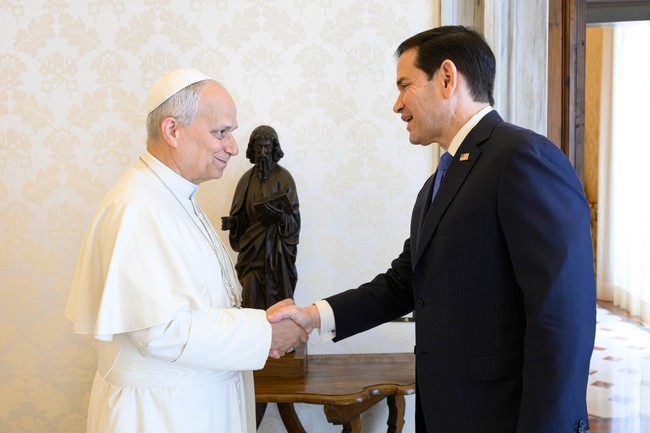
Secretary of State Marco Rubio pushed back hard against Pope Leo XIV’s plea for restraint on military action toward Iran, arguing that faith guides personal morals but national security is the government’s top duty. Rubio laid out why decades of diplomacy have failed to curb Iran’s nuclear ambitions and warned that some threats cannot be solved by talks alone. His remarks framed a larger debate about the role of religious leaders in foreign policy and whether moral counsel should outweigh the responsibility to protect citizens. The exchange sparked sharp responses from President Trump and others, highlighting a partisan split over how to balance peace preaching with practical defense.
Marco Rubio made his case plainly and without theatrical flourish in the interview with Sean Hannity, insisting our first obligation is keeping Americans safe. He acknowledged faith as a moral compass yet pushed back on the idea that prayer alone can neutralize clear and present dangers. When diplomacy has been exhausted, he argued, leaders must be prepared to act decisively to prevent catastrophic outcomes. That argument resonates with voters who want security prioritized over symbolic gestures.
Rubio pointed to the long record of trying to restrain Iran through negotiations and said those efforts have produced no reliable barriers to a weapons program. He stressed the need to judge results, not intentions, noting that repeated concessions yielded no lasting change in Tehran’s behavior. For many conservatives, that record justifies stronger measures when deterrence and containment fail. The message was blunt: good intentions are not enough when regimes openly pursue regional dominance.
“I agree. We wouldn’t want wars either. We’re not – I don’t think we’re in favor of war. But for a nation-state … there are threats to your security and to the well-being of your people that have to be addressed,” he said. “Ideally through a diplomatic means, but there are conflicts, and there are issues in the world that cannot be solved diplomatically, no matter how hard you try.”
Rubio invoked history as a warning, asking whether appeasement has ever worked against determined aggressors. He used a stark analogy many will immediately recognize to stress that some conflicts must be met with force when diplomacy fails. “What was the diplomatic solution for an Adolf Hitler, as an example? There probably – there was none, right? And it unfortunately led to a war,” he said, placing the Iran debate in a context of hard lessons learned. That comparison is meant to shake complacency and argue that waiting for goodwill from bad actors is reckless.
“We are obviously guided by our faith, and we’re instructed by our faith. That’s the compass by which we live our lives,” Rubio explained. “We also have an obligation to the national security of our country, and that has to be taken into account. That’s our primary job, is to keep Americans safe. And that’s why we’re involved in Iran. That’s why we’re involved in anything we do around the world.”
Not everyone saw the Pope’s comments as harmless spiritual guidance. The Vatican’s public call for patient dialogue over military action touched a raw nerve in Washington, where voices across the conservative spectrum insist that words must match hard realities. Rubio’s stance reflects a mainstream Republican view: moral leadership is important, but it cannot replace the practical measures needed to stop nuclear proliferation and state-sponsored terror. That perspective drives support for robust deterrence strategies.
President Trump responded with forceful criticism, turning the dispute into a headline-grabbing exchange that underscored the political stakes. His reaction framed the Pope as out of step with tough-minded national defense priorities and questioned whether such remarks help adversaries. The president’s blunt language amplified the debate, making it clear this is not just a theoretical disagreement but a flashpoint in broader culture wars over leadership and security.
Pope Leo wrote about the moral costs of conflict and urged dialogue as the path to lasting peace, saying, “God does not bless any conflict. Anyone who is a disciple of Christ, the Prince of Peace, is never on the side of those who once wielded the sword and today drop bombs,” and added, “Military action will not create space for freedom or times of #Peace, which comes only from the patient promotion of coexistence and dialogue among peoples.” Those words reflect a pastoral concern for human life and suffering, but they clash with a security-first view that some regimes will only respond to credible force.
Rubio’s measured tone contrasted with the president’s bluntness, yet both men made the same point: faith matters, but it cannot be an excuse for ignoring imminent threats. Conservatives who prioritize American safety welcomed Rubio’s clear-eyed approach, arguing that moral leadership and defense are not mutually exclusive. The debate will likely continue as events in the region unfold, with policymakers weighing the consequences of action versus restraint. For now, Rubio’s message is simple—protect the nation first, counsel from faith leaders second when lives are at stake.
The public back-and-forth has broadened the conversation beyond diplomacy to include who gets to shape foreign policy: elected leaders sworn to defend the country, or spiritual leaders offering moral guidance. Onlookers from across the political spectrum will be watching to see whether appeals to conscience alter a strategy many see as firmly grounded in national interest. Rubio’s remarks ensure the Republican case for a security-first posture remains front and center in that debate.


I quote here: “good intentions are not enough when regimes openly pursue regional dominance.”
And better said is the following adage:”The Road to Hell Is Paved with Good Intentions,” which has been proven time and time again throughout history!
Then there is this blunt assessment of my own that I posted elsewhere on this site today!
“officials praised the Iranian embassy’s activities in advancing peaceful coexistence, wisdom, tolerance, and interfaith dialogue,”
peaceful coexistence??? Massacres of Christians in Africa and elsewhere by Muslim Islamist’s, burning them alive and chopping off heads and this Fake Pope, Bergoglio 2.0 pats them on the back!
What the hell is this Fake Pope doing getting immersed in Global Politics and Political Affairs in the first place!
Oh right he is serving the Globalist Cabal New World Order Just like his predecessor did daily or in other words paving the way for the Antichrist!
I see too much WOKE and DEI BS being peddled everywhere on the planet which is meant to hypnotize and mesmerize the masses!