
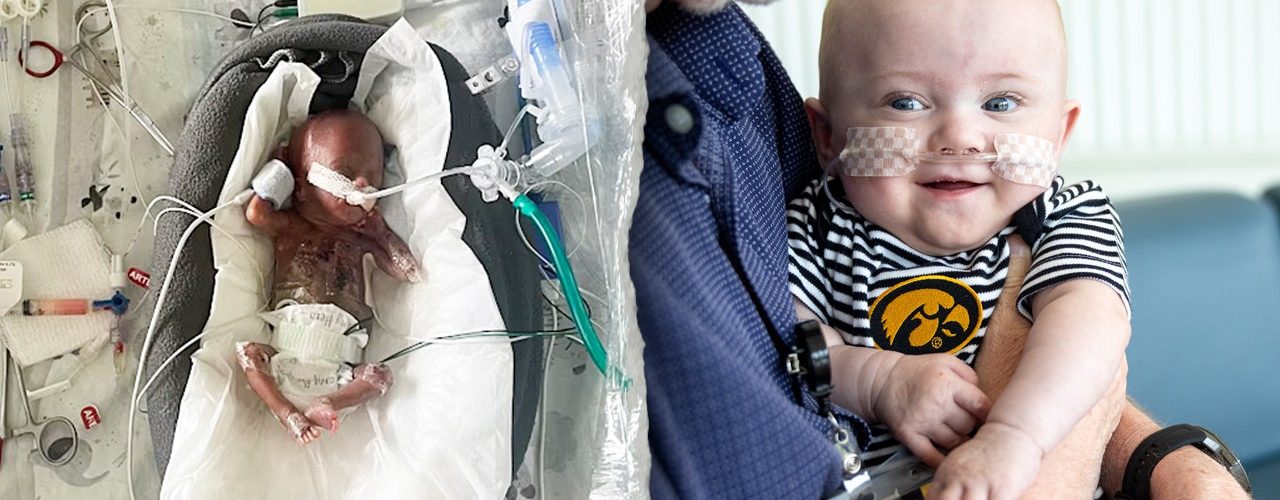
The Keen family from Iowa recently experienced a heartwarming milestone with their son, Nash Keen. Born on July 5, 2024, Nash arrived 133 days early, at just 21 weeks gestation, earning him the title of the world’s most premature baby to survive, according to Guinness World Records. Nicknamed “Nash Potato,” he just celebrated his first birthday, a miracle many thought wouldn’t happen.
Nash was delivered at the University of Iowa Health Care Stead Family Children’s Hospital, weighing only 285 grams—less than a grapefruit—and measuring a mere 24 centimeters. The Keen family had endured heartbreak before with the loss of their daughter, McKinley, at 18 weeks due to Mollie Keen’s incompetent cervix. This condition causes the cervix to open too soon during pregnancy, adding to the family’s challenges.
In addition to the cervical issue, Mollie also battles polycystic ovary syndrome (PCOS), a hormonal disorder that complicates fertility. Despite these hurdles, the couple was thrilled to discover they were expecting again just six months after their loss. But their joy turned to concern during a routine scan when Mollie was found to be 2 centimeters dilated at 20 weeks.
Mollie was then put on bed rest as contractions began, a moment filled with fear of repeating their past loss. The Stead Family Children’s Hospital’s NICU specializes in the care of babies as young as 21 weeks, offering a glimmer of hope. Amazingly, the medical team managed to delay labor just enough for Nash to pass the 21-week threshold.
Dr. Malinda Schaefer, the high-risk obstetrician who delivered Nash, explained the uncertainties surrounding such premature births, noting most survival rates are low with high risks of complications. However, Nash was given medicine to aid organ development immediately after birth, a crucial step in his survival.
Neonatologist Amy Stanford shared how Nash’s initial condition was critical, with lifesaving measures like placing a breathing tube stabilizing his heart rate and oxygen levels. Nash’s survival was extraordinary, as no baby that young had previously lived. Before Nash, Curtis Zy-Keith Means held the record, having been born at 21 weeks and 1 day.
Dr. Patrick McNamara, the division director of neonatology, emphasized the importance of honesty with parents while maintaining hope. Stanford recalled the shift from mere survival to hope for Nash’s future around the one-month mark, as his condition stabilized. This brought a sense of long-term optimism among the team.
Throughout his 198-day hospital stay, Nash received extensive care, including surgery for a perforated bowel, a procedure with significant risk. His father, Randall Keen, expressed gratitude for the medical team’s honesty and dedication, acknowledging their role in Nash’s survival.
In January 2025, after more than six months in the hospital, Nash finally went home. Though he continues to face health challenges such as a minor heart defect and reliance on a feeding tube and hearing aids, he is making remarkable progress. His ongoing therapy sessions are helping him become more interactive and stronger, a testament to both his resilience and the unwavering support of his family and medical team.
Add comment