
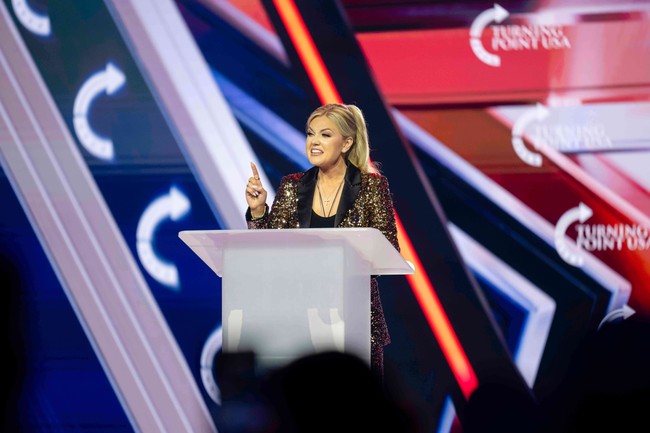
Turning Point USA held a Women’s Leadership Conference in San Antonio this weekend and the gathering drew loud protests from radical left activists, who confronted attendees, targeted individual speakers by name, and clashed with police before officers restored order.
TPUSA brought together conservative female leaders, including Erika Kirk and Riley Gaines, for panels and networking meant to amplify conservative women. The event’s purpose was straightforward: spotlight conservative voices in politics and culture at a time when public debate is heated. Organizers expected attention, but the intensity of the outside disruption was sharper than many anticipated.
The protestors arrived carrying aggressive messaging and familiar symbols, and they made clear they believed the conference “actively harms feminist movements.” That line came straight from a post shared by the protesters: “HAPPENING NOW: Far-left activists are preparing to march towards the San Antonio Marriott Rivercenter to protest @TPUSA and @MrsErikaKirk .Organizers have been plotting this for months — ever since TPUSA announced the Women’s Leadership Summit. They claim the event “actively harms feminist movements” and insist “hateful obstructions to feminism” are not welcome in San Antonio.”
The crowd’s tactics included chanting at specific attendees and using graphic signage to escalate tensions. Protesters screamed for speakers to “get out” and taunted participants by name, creating a hostile environment outside the hotel. Several observers described the mood as deliberately confrontational, aimed at disrupting the event rather than engaging in debate.
https://x.com/FrontlinesTPUSA/status/2063286730342445321
Video and witness reports show protestors carrying a banner emblazoned with a hammer and sickle and waving signs with slogans like “Que tenemos nada, que queremos todos (We who have nothing, want everything).” That iconography and rhetoric made clear that parts of the demonstration were driven by extremist sympathies and class-based agitation, not mild disagreement. In that context, a political rally that focuses on women’s leadership was met with more than protest language; it was met with spectacle.
As protesters neared the hotel, their chants escalated into personal attacks aimed at attendees and their families. One widely reported refrain singled out Erika Kirk, while others jeered at Riley Gaines with cruel taunts. The confrontational tone crossed from political protest into harassment, and it raised questions about where peaceful assembly ends and intimidation begins.
Protestors used noisemakers and obscene gestures to rile attendees and disrupt any attempt at normal movement into the venue. Some activists mocked a widow in attendance, referencing her late husband in a way that many found beyond the bounds of decency. That kind of behavior turned an already heated scene into something resembling a targeted mob rather than a protest grounded in civil disagreement.
The protesters repeatedly accused conferencegoers of being “Nazis” while simultaneously shouting them down and trying to prevent them from entering. That irony was palpable to many who watched: labels of extremism tossed around freely while the crowd engaged in tactics that mirrored historical suppression of speech. Meanwhile, questions surfaced about selective outrage, when some on the left defend or ignore figures with troubling associations within their own ranks.
Eventually the situation drew a firm response from local law enforcement after tensions with officers grew. Protestors got in the faces of police and attempted to impede their work, prompting a coordinated effort by San Antonio police to regain control of the scene. The officers moved in and took custody of those who crossed the line from protest to obstruction.
Inside the hotel, conference programming continued, but the shadow of the outside chaos lingered. Attendees reported heightened security, disrupted travel paths, and a sense that the environment had shifted from robust debate to an atmosphere of intimidation. Organizers repeatedly emphasized their right to hold events without fear of physical interference or targeted harassment.
The episode raises broader concerns about political tolerance and the limits of protest in a free society. When demonstrations target individuals with threats and obscene taunts, it stops being a legitimate exercise of free speech and becomes an attempt to silence opposing viewpoints. That pattern undercuts civic discourse and puts ordinary citizens who show up for public events at risk of harassment.
For conservatives organizing public events, the lesson is clear: expect opposition, prepare for disruption, and insist that law enforcement protect the right to assemble. The San Antonio response showed that police will act when protests cross into obstruction, but it also highlighted the need for event planners to anticipate and mitigate targeted harassment. Ultimately, healthy politics depends on the ability to dissent without shutting down others by force or intimidation.
Add comment