
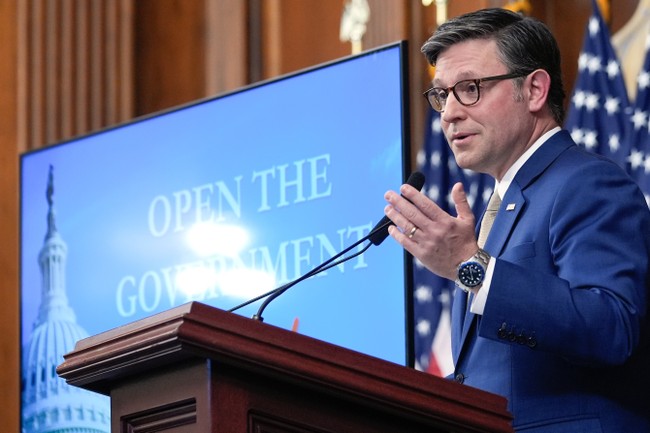
Checklist: report the House vote and Speaker Johnson’s remarks; explain how the shutdown began and who voted to end it; preserve key quotes and official statements; include the embedded media tokens in their original places. This piece covers the vote that moved to reopen government, Mike Johnson’s public response, the party dynamics that produced the shutdown, and the official GOP statement on responsibility and consequences.
House Speaker Mike Johnson has been the public face of the Republican position throughout the shutdown fight, repeatedly blaming Democrats for the mess and reminding Americans that the shutdown was their doing. Johnson framed the crisis as a self-inflicted wound by Democrats, saying they were using the situation as “leverage” to satisfy the party’s far-left wing. His position was consistent: Republicans had offered a straightforward continuing resolution designed to keep government operating while negotiations continued through regular congressional processes.
On Wednesday night the House voted 222-209 to take the next-to-last step toward reopening the government, with six Democrats joining Republicans and two Republicans voting against the measure. That roll call followed a handful of Senate Democrats finally advancing funding in the upper chamber, a move that set up the House action. The vote count underscored how few lawmakers broke with their parties and how deeply partisan the standoff had become.
Johnson told reporters that the shutdown never had to happen because House Republicans had passed a clean continuing resolution back on September 19 that contained no Republican priorities and was explicitly meant to keep the lights on. That resolution, he emphasized, was intended to preserve normal legislative channels so both GOP and Democratic priorities could be debated in committee and on the floor. From his vantage point, the shutdown was a Democratic choice, not an inevitability.
“After this weekend’s ‘Hate America’ rallies co-sponsored by the Communist Party, I thought [Sen. Minority Leader Chuck Schumer (D-NY) would] finally do the right thing. But he’s still too terrified of his radical base — even admitting he’ll keep the government shut down while hardworking Americans suffer,” Johnson said at the time, on day 23 of the Schumer Shutdown. That line captured the tone Johnson used throughout the crisis: sharp, accusatory, and aimed at party leaders who he says put political theater ahead of governing.
That argument was echoed in the formal release from House GOP leadership, which detailed the party’s view of accountability and consequences. The leadership statement blamed Democrats for “millions of American families going hungry,” travelers stranded in airports, and uncertainty for service members waiting on paychecks. The document framed the shutdown as a repeated Democratic decision, saying the party had voted 15 times to keep the government closed and sought political advantage at the public’s expense.
“The Democrat Shutdown is finally over thanks to House and Senate Republicans. There is absolutely no question now that Democrats are responsible for millions of American families going hungry, millions of travelers left stranded in airports, and our troops left wondering if they would receive their next paycheck. It was the Democrat Party that voted 15 times to keep the government closed and force the longest shutdown in U.S. history.
“All of it was pointless and utterly foolish. Democrats admitted they used the American people as ‘leverage’ and hurt their constituents on purpose — but they got nothing for their selfish political stunt. Voters will remember which party played political games in an attempt to ‘look tough’ to their base, while real people suffered.
“Now that Republicans have succeeded in ending the Democrat Shutdown, we look forward to continuing our important legislative work delivering results for the American people.”
That formal language is meant to make the political point crystal clear: Republicans say they offered a noncontroversial fix while Democrats opted for brinkmanship. Johnson and other GOP leaders argued that voters will judge the party that chose pain over compromise. The messaging was designed to contrast Republican process-oriented proposals with what they call Democratic grandstanding.
The House vote included cross-party movement worth noting: a small number of Democrats broke with leadership to support reopening, and a couple of Republicans opposed the final package. Those deviations illustrate the pressure members on both sides faced from constituents and from party factions who favored different strategic approaches. Lawmakers who crossed lines did so amid intense public scrutiny and media coverage of the shutdown’s human and economic toll.
Placed next to his remarks, the embedded materials offer the original clips and documents that shaped the public narrative and the floor debate. Johnson’s public comments, the official GOP release, and the roll-call realities combine to show why Republican leaders say the responsibility is clear. The political fallout will be a campaign-year storyline tied to claims of competence, priorities, and who voters hold accountable.
President Trump is scheduled to sign the bill shortly, and Republicans expect the narrative advantage of having forced a reopening to play into upcoming messaging. The party will continue to press the point that a clean short-term funding measure was available early and that Democrats chose a different path. For now, House GOP leaders are emphasizing the end of the shutdown as a moment to return to regular lawmaking and to press their legislative agenda.
The months-long dispute left tangible consequences for everyday Americans, and Republicans want voters to remember the choices that produced those consequences. Johnson’s public posture since the shutdown began has been unapologetic and pointed, aimed at drawing a contrast that GOP strategists believe will resonate at the ballot box. How voters respond remains to be seen, but the debate over responsibility will be a recurring theme in the weeks ahead.



Add comment