
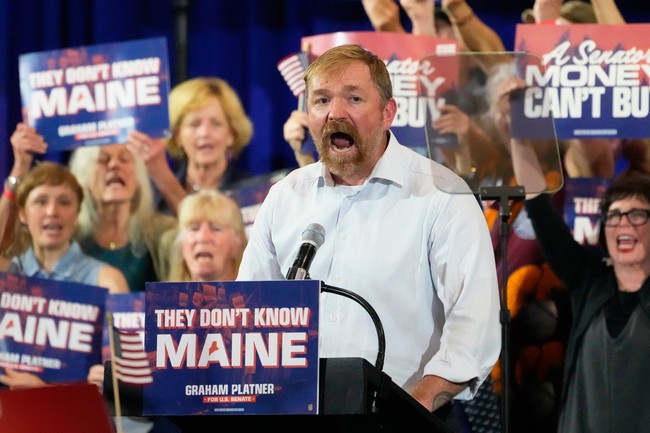
The latest polling in the Maine Senate race flips the script: Democrats threw their weight behind Graham Platner and now the numbers have tightened into a dead heat, raising real questions for their strategy and for voters who care about character and competence.
Democrats backed Platner hard despite a series of troubling revelations about him that many hoped voters would shrug off. For a time he enjoyed a comfortable advantage, with earlier polls showing him about nine points ahead of incumbent Sen. Susan Collins. That gap looked like validation for the Democrats’ gamble that Platner could flip the seat.
But the situation shifted quickly. Internal polling that once favored Platner showed the lead shrinking to roughly four points, a margin that often overstates the frontrunner’s position. Republicans and observers noted that the last three cycles have seen polls consistently undercount Collins’ support, which makes any slim lead for Platner fragile at best.
Then former President Donald Trump stepped in and endorsed Collins, criticizing Platner while acknowledging some policy differences with the senator. That endorsement was a clear signal to conservative voters in Maine, and it appears to have mattered where character questions did not. Endorsements still move voters, especially in close races where name recognition and trust matter.
New numbers from Quantus Insights now show the race essentially tied, with Platner at 46 percent, Collins at 45 percent, 7 percent undecided, and 2 percent other. Those figures put Platner below the generic Democratic advantage, while Collins outperforms the generic Republican, a pattern that favors the incumbent’s resilience and personal brand in Maine.
Jason Corley, a Quantus co-founder, explicitly described the contest as a “toss-up,” and that label fits the narrow margins and the volatility around Platner. A tie in the topline numbers hides underlying dynamics: undecideds tend to break toward proven local figures, and Collins has a history of pulling ahead late in close contests.
There’s another wrinkle: long-term polling trends suggest a bias that cuts in Collins’ favor. If past underestimates hold, she could actually be several points ahead when the dust settles. Polling is a snapshot, not a verdict, but for Republicans this trend is encouraging because it has repeated across multiple recent elections.
Democrats doubled down on Platner even as damaging details kept surfacing, and that choice now looks risky. Their generic advantage in the congressional ballot—where Democrats sit up about 10 points—has not translated to Platner’s campaign, which is underperforming the party baseline. That disconnect raises the question of whether Platner’s personal baggage is dragging down otherwise favorable partisan dynamics.
https://x.com/QuantusInsights/status/2065551896681877831
Beyond raw numbers, the electorate in Maine seems to care about character and judgment. Stories that some tried to dismiss as fringe or irrelevant have found traction with voters, proving that certain revelations do matter at the ballot box. For Republicans this is a reminder that emphasizing competence and steadiness can blunt high-profile attacks and keep a seat within reach.
Expect the Democrats to keep testing attack lines now that the primary is over, but they’ll have less room to shape a narrative if the race remains razor tight. Negative campaigns can cut both ways, and an aggressive approach risks energizing Collins’ supporters and mobilizing undecided voters who prioritize stability over drama.
On the ground, Collins’ brand of pragmatic conservatism and her record of weathering tough races are assets in a state that often rewards independence. Voters who know her work in Washington may be more inclined to stick with a familiar senator than to gamble on a nominee with fresh controversies attached to his name.
For Republicans watching national implications, holding this seat matters beyond Maine. A Collins victory would keep a reliable, if sometimes independent, vote in the Senate and blunt Democratic hopes of flipping control. Strategically, managing a tight race in a purple state is exactly the kind of fight that can decide majorities.
Democrats invested heavily in Platner and now face a campaign that is far closer than they expected. The numbers, local dynamics, and the historical tendency of polls to undercount Collins all suggest this contest could tilt back to the incumbent. If that happens, it will be a clear lesson in the limits of party line enthusiasm when candidate quality becomes a real voter concern.



This was written using Ai. Pretty sad for a current news website. Notice it say’s “former President Trump”, which is a dead give away for Ai.
Otherwise, it amazes me that a conservative state like Maine would ever consider a candidate like Platner. Maine used to be all about farmers and fishermen that were very proper and well mannered. Now they vote for a communist, woman hating pedophile that should be in jail. Makes no sense. I don’t agree with Collins most of the time, but she’s honest and votes for whatever she thinks is right, not by party lines. You have to respect that.
Howard; to the point and well said, and I agree with all you said here! Very disappointing to me but we are in radically changing times that are getting worse not better because so much confusion and even evil has permeated or infiltrated America and the World!
I say we all need to try a lot harder to get back to our faith in God and mean it; if not to only repair it but moreover ultimately to especially save our immortal souls from damnation!
God bless!