
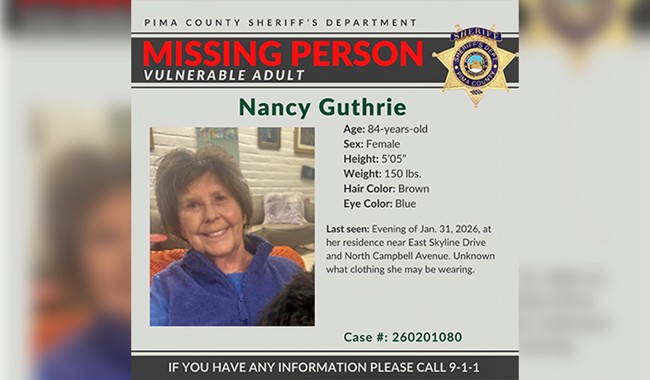
The disappearance of 84-year-old Nancy Guthrie has drawn intense local and federal attention, with new details about online searches and forensic leads shifting the investigation into fresh territory; investigators are probing Google activity tied to her address and to the public salary of her daughter Savannah Guthrie, while the FBI and local authorities continue to follow physical evidence and digital traces in hopes of locating her.
Nancy Guthrie was last seen on the evening of January 31, when family members say she was dropped off at her Catalina Foothills home and reported missing the next day. The case immediately drew a large response from the Pima County Sheriff’s Office and the FBI, who are treating the disappearance as a high priority and coordinating investigative steps across agencies.
Early in the inquiry, various ransom notes surfaced and investigators examined each one seriously, later concluding that several were hoaxes and making at least one arrest connected to those false leads. That distraction did not stop the continued search for reliable leads, and law enforcement has focused resources on physical evidence, witness statements, and digital records to piece together a timeline.
A recent development centers on internet searches that could provide context to the ransom note angle: records show that Nancy’s address appeared in Google Trends activity in Arizona in late June 2025 and again on January 11, 2026. Separate Google activity reportedly shows searches related to Savannah Guthrie’s salary occurring between December 13 and 20, 2025, which investigators see as potentially relevant to motive or targeting.
As the Pima County Sheriff’s Department and FBI continue work on the case, Fox News Digital has learned that mysterious Google searches for Nancy’s address and Savannah’s salary occurred before her disappearance.
Google Trends records show there was activity for Guthrie’s address in the Catalina Foothills between June 21 and 28, 2025, originating in Arizona. The address saw activity again once on Jan. 11, 2026.
The Jan. 11 date also surfaced in a message on the Ring camera app posted on Feb. 12, asking neighbors to share video from between 9 p.m. and midnight that day, as well as on the evening of Jan. 31, when Guthrie was last accounted for.
A PCSD captain replied to the post asking users to look for verified posts from the department when submitting tips. Officially, investigators are seeking home security video recorded within two miles of Guthrie’s home between Jan. 1 and Feb. 2.
Investigators are treating these search hits as pieces of a larger puzzle rather than proof of involvement, and digital forensics teams will need to dig into logs, IP metadata, and device activity to establish any useful leads. Searches in Google Trends are broad and can reflect casual curiosity, but timing and geographic origin matter, so detectives are evaluating whether patterns match potential suspect behavior.
Meanwhile, physical evidence has generated its own complications. A glove recovered roughly two miles from the home produced DNA that did not match entries in the FBI database, prompting investigators to widen their testing and pursue alternative identification techniques. That DNA is also said to align with material found inside the residence, a detail that investigators have described as significant in narrowing investigative leads.
Authorities have also been trying to gather private video footage from the neighborhood, including footage housed on Google Nest systems, but recovery has been slowed by the lack of an active subscription on the victim’s account. “We don’t think we can get anything, but we’ll try,” he told reporters, reflecting the frustration that often accompanies digital evidence collection when account access is limited.
The FBI’s involvement has included coordination with international partners, and officials say they communicated with Mexican authorities as part of routine cooperation given geographic considerations and potential cross-border vectors. That contact is described as standard, but it reflects the broad net investigators are casting to ensure no avenue goes unexplored.
Forensics teams continue to process items from the scene and surrounding areas, and officials have noted the importance of timely tips and footage from neighbors within a two-mile radius captured between January 1 and February 2. Officers and agents are piecing together doorbell camera clips, traffic cams, and any ancillary video that could place individuals near the property on crucial dates.
Reward efforts in the case have grown as public interest increased, and authorities confirmed a reward totaling $202,500 in hopes of spurring additional information from the community. That financial incentive aims to encourage anyone with even the smallest lead to come forward and help investigators close gaps in the timeline.
Investigators are balancing digital analysis with on-the-ground work such as canvassing, re-interviewing witnesses, and tracking transactional records that could show contact points or travel. Every strand of evidence is being weighed for its probative value, from a single search query to the minutiae of DNA and video timestamps.
The family’s public presence and media attention add both pressure and complexity to the investigation, as officers try to protect investigative integrity while keeping the public informed enough to generate helpful tips. Law enforcement continues to urge anyone with relevant information to make contact through official channels while they follow up on leads generated by recent digital and physical discoveries.


Add comment