
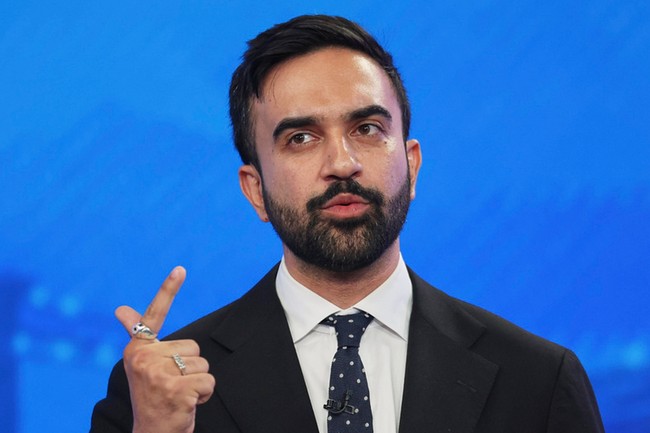
The piece looks at rising progressive influence in the Democratic Party through the lens of Zohran Mamdani’s New York City campaign and responses from figures like Sen. John Fetterman and Bill Maher, arguing that socialist policies are dangerous, highlighting political consequences for Democrats and potential harm to city residents.
Zohran Mamdani is leading in the race for New York City against former New York Gov. Andrew Cuomo and Republican candidate Curtis Sliwa. That surge has put a spotlight on how far left the Democratic Party has shifted and raised alarms among many voters. Andrew Cuomo has been closing the gap, and the race has become a critical test of whether voters reject or accept radical promises.
Many Democrats have not pushed back on Mamdani’s more extreme proposals, and in several cases they have embraced him with endorsements. That shift signals a broader realignment inside the party where moderates are increasingly sidelined. Elon Musk even called him out as the “future of the Democratic Party.”
Sen. John Fetterman stood apart over the weekend on CNN’s State of the Union with Jake Tapper, offering a blunt warning about where the party could be headed. He said plainly that while New York City will decide its next mayor, “Socialism was not the future of my party.” That short line cuts through the euphemisms and gets to the real debate.
“We all know how socialism works out,” he warned. That’s a sentence that needs no expansion for those who remember the historical record. Fetterman also criticized the party for failing to govern, saying, “This is wrong. We are hurting the very people we fight for. We’re getting nothing for them if we continue to keep our government shut down.”
Fetterman’s stance shows the strain inside the party between pragmatic governance and ideological experiments. As moderates get quieter or are pushed aside, voters who prioritize results notice the difference. That creates an opening for Republicans who stress accountability and the consequences of reckless reforms.
Bill Maher, a longtime liberal voice who does not hesitate to criticize his own side, has been making similar points about Mamdani and the national implications of local elections. On his Club Random podcast with Brian Tyler Cohen, Maher said Mamdani’s ascent would serve as a powerful ad for Republicans. He argued that when a major American city embraces radical solutions, it becomes a national cautionary tale.
“He [Mamdani] definitely has the power and influence to elect JD Vance, or whoever is the Republican candidate next time. It is a walking commercial for the Republican Party nationally.
When you let the Democrat Socialists – and now they’re actually calling themselves Democrat Socialists – take over a major American city, this is what you get: state-run grocery stores, which worked so well in Cuba, the Soviet Union, and Venezuela. Bad ideas. And an ugly streak of antisemitism.”
Brian Tyler Cohen pushed back that Republicans will try to use anything as a boogeyman, but Maher’s point was that real examples carry more weight than hypothetical fears. When policy experiments fail in plain view, voters learn from the results and adjust their choices. That’s basic political reality: people vote based on outcomes, not slogans.
The concern is not just about winning elections; it’s about the practical effects of implementing untested socialist programs in a large city. Critics warn that promises like state-run grocery stores, free services that are not funded sustainably, and expanded entitlements will strain municipal budgets. If infrastructure and safety don’t hold up, ordinary residents pay the price in higher crime, failing services, and reduced economic opportunity.
There is also a cultural and political cost to normalizing radical rhetoric within the party. What used to be labeled fringe is now moving toward the center of Democratic politics, and that changes how voters see the party’s priorities. Working-class voters in particular have been shifting toward Republicans because they want steady jobs, safe streets, and competent governance.
Even if Mamdani’s promises collapse under practical pressures, some on the left will blame external forces rather than policy choices. Expect arguments that failures stem from capitalism or partisan obstruction instead of flawed planning. That narrative may soothe activists, but it won’t fix a busted grocery program or rising crime in neighborhoods that need real solutions.
Republicans see a chance to press the case for limited government, fiscal responsibility, and public safety while demonstrating how radical policies have immediate consequences for families and small businesses. The political argument is straightforward: if people suffer under socialist experiments, they will turn to alternatives that promise real results. That is the long game many strategists are betting on.
Editor’s Note: The Schumer Shutdown is here. Rather than put the American people first, Chuck Schumer and the radical Democrats forced a government shutdown for healthcare for illegals. They own this.


Add comment