
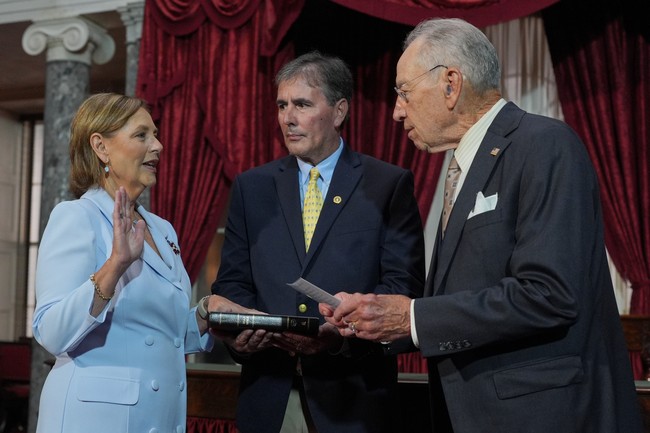
I’ll explain what happened with Darline Graham’s appointment, show how the leftist reaction misfires, place that reaction beside historical practice, preserve the key quotes and embeds, and highlight examples that undercut the DEI narrative.
South Carolina Gov. Henry McMaster appointed Darline Graham Nordone to fill the final months of her brother Sen. Lindsey Graham’s term after his death, and she was sworn in amid bipartisan condolences. The moment was emotional for colleagues who remembered Lindsey Graham, and the Hill offered warm greetings to Darline as she assumed the seat. Even so, a section of the media and commentators turned predictable and cruel, focusing less on the family’s loss and more on partisan talking points.
One thread from the leftist commentariat framed the appointment as proof of diversity theater and nepotism, insisting a minority could only reach statewide office by appointment. That line of attack ignored precedent and history and traded empathy for a cheap political angle. The rhetorical sleight-of-hand is thin: an appointment to finish a term is not a permanent elevation, yet it gets cast as systemic proof when it’s a routine step in filling vacancies.
SUNNY HOSTIN: I don’t love it. I don’t love it. You know, she’ll be the first woman to be a U.S. senator in South Carolina in the history of the state. And I think that that’s just — it’s just fundamentally wrong that South Carolina just couldn’t elect a woman and this is the only way that it was done.
I think the experience does matter. And while she is a certified optician and while she has done great work in that field, I don’t think that she should be representing the people of South Carolina in the U.S. Senate. I just don’t.
JOY BEHAR: Isn’t this the very definition of a DEI?
SUNNY HOSTIN: Correct! correct! It’s everything that the Republican Party stands against. Everything! Everything! It’s DEI. Nepotism. All these things thrown in together.
Watch:
Others piled on with the same lazy framing, including commentators who routinely attack Israel and American conservatives, treating the appointment like proof of a conspiracy instead of what it is: a short-term, lawful selection to keep a seat functioning. The outrage machine ignored that this kind of appointment has been a bipartisan tool for decades and often becomes a bridge to an actual election where the voters decide.
There is a long history of relatives filling seats after a lawmaker dies, a practice often called “widow’s succession.” The practice gave many women their first foothold in national politics when other routes were closed, and dozens of women entered Congress this way across the 20th century. That history matters because it shows this appointment is part of a pattern, not a new instance of woke manipulation.
The tradition of a “widow’s succession,” where a wife succeeds her late husband in Congress, has existed for a century. Although the practice has become less common, it played a historically significant role for women’s representation in the legislative body during the 20th century.
https://x.com/NickFondacaro/status/2077416151789838356
Forty-eight women have filled vacancies in Congress left by their late husbands through appointment or election. The first to do so was California Representative Mae Ella Nolan, who served from 1923 to 1925. Margaret Chase Smith—a Maine legislator who began her political career by filling her late husband’s seat in 1940—went on to serve 24 years in the U.S. Senate and was the first woman to serve in both houses of Congress. In 1964, she also became the first woman to seek the presidential nomination of a major political party.
Sunny Hostin’s suggestion that appointment was the only route for a minority to hold statewide office in South Carolina falls apart under simple facts. Black Republican Sen. Tim Scott won statewide races repeatedly, and he had been appointed once only to fill a vacancy before winning elections on his own terms. Nikki Haley, an Indian-American woman, won two terms as governor of South Carolina. Those are direct electoral wins, not appointments disguised as progress.
Many on the left reduced a solemn family loss to an opportunity for snark, and that choice reveals more about their taste than about the facts of the appointment. Public service often runs in families, and temporary appointments to preserve representation are a pragmatic part of governing. Attacking Darline Graham for stepping into a difficult moment does nothing for public discourse and smacks of performative outrage.
If you want to look at precedent and outcomes instead of sound bites, the record shows that appointments like this are a bland administrative step more than a political coup. They keep representation intact until voters or officials can pick a longer-term successor, and they have historically increased opportunities for women and minorities to enter public life. Treating every such appointment as proof of a woke conspiracy is both dishonest and tired.
The grief in the Graham family deserves respect, and the Senate’s tributes to Lindsey Graham showed that colleagues remember his work and character. Turning that moment into a narrative about DEI and nepotism was unnecessary and mean-spirited, and it distracted from the real issue: honoring a life of service while keeping democracy functioning in a respectful way.
“But I am comforted by the knowledge that in the end, he has just changed his address. And that one day…. We will laugh together again,” an emotional Sen. Majority Leader John Thune (R-SD) said in his speech.
Watch:



Add comment