
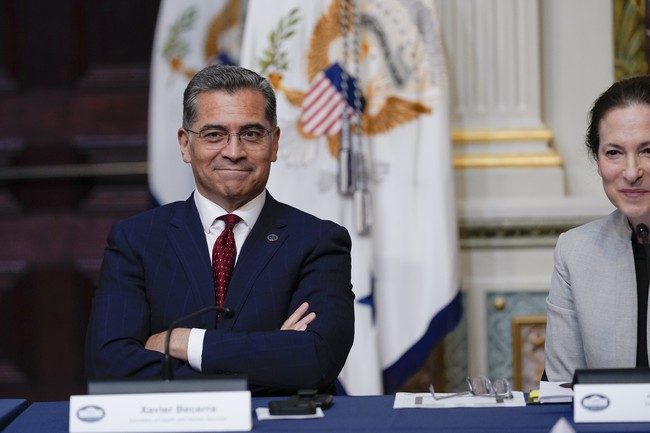
Former HHS Secretary and current California gubernatorial candidate Xavier Becerra faced a blistering interview that exposed a defensive, dismissive tone on serious issues, especially around missing children and the department’s oversight failures during his tenure. His interview with KTLA showed him preemptively accusing the reporter of playing gotcha while downplaying a New York Times investigation about thousands of unaccounted-for children, and that exchange has fanned doubts about his leadership and empathy. The clip has circulated widely and given Republicans fresh ammunition to portray him as out of touch and unwilling to accept responsibility. This article lays out the key moments from the interview and what they mean for his campaign.
Becerra’s campaign momentum among Democrats looks fragile even as polling nudges him up; the crowded field demands a compelling, confident candidate and this performance did the opposite. Right from the start he snapped, “By the way, this is a profile piece, this is not a gotcha piece, right?” which set a combative tone before a question was asked. That sort of preemptive defensiveness reads as avoidance, not strength, and it paints a portrait of a politician more interested in controlling optics than answering tough questions.
Observers quickly noticed microexpressions and a shift from forced geniality to barely hidden anger, suggesting a man trying to manage temperament rather than lead. One commentator wrote, “Trying to come across as jovial, kind Becerra… but that ain’t who he is.” That reaction captures the essence of the problem: gestures and smiles can be practiced, but credibility is not so easily faked. For a campaign competing to be the Democratic standard-bearer, appearing impatient and lecturing toward a reporter doesn’t help broaden appeal.
The interview turned particularly ugly when the reporter asked about a 2024 New York Times investigation that reported more than 85,000 migrant children went unaccounted for after release from federal care. Instead of acknowledging legitimate concerns and outlining corrective steps, Becerra pushed back hard: “That’s not accurate. What you just read is not accurate. First, that’s what I’ll say, because it was never the case that we could not find kids.” That defensive posture sidesteps the central issue: children were released without sufficient follow-up, and many wound up exploited.
When the reporter referenced the Times’ findings about children forced into hazardous work and exploitation, Becerra insisted the abuse happened after they left federal care. He added, “Some of these kids, probably because they needed to earn some money, started working in places that were very exploitive.” Framing exploitation as a voluntary choice by vulnerable children minimizes the duty of a federal agency charged with protecting them. Voters who expect accountability see this as a head-in-the-sand response.
Here’s the back and forth:
Ramos: During your time as HHS Secretary, a New York Times investigation found the health department couldn’t find some 85,000 children it had released.
Becerra: That’s not accurate. What you just read is not accurate. First, that’s what I’ll say, because it was never the case that we could not find kids. You’re essentially, I don’t know if you got those talking points, from Donald Trump.
Ramos: It’s from a New York Times article.
Becerra: That’s not what the New York Times article said, The New York Times said that individuals, the children and their sponsors, did not respond to calls. They didn’t say we couldn’t find kids
Ramos: Working overnight in slaughterhouses, replacing roofs, operating machineries and factories children as young as 14 years old.
Becerra: That part occurred after these children had left the care of Department of Health and Human Services.
Ramos: Do you let these children go into those individual sponsors in their responsibilities?
Becerra: Some of these kids, probably because they needed to earn some money, started working in places that were very exploitive.
That exchange doesn’t sit well with voters who expect empathy from someone seeking the governor’s office, especially on matters involving children. The inspector general’s review warned of lapses: shelters handing children to sponsors without thorough vetting and delayed safety checks. Those are operational failures, not rhetorical quibbles, and political leaders should be ready to own and fix them instead of parsing semantics.
Becerra also tried to claim local roots by returning to Highland Park for the interview, but the lived reality is a long career in Sacramento and Washington that distances him from everyday Californians. Attempts to sound authentic on the debate stage have read as pandering rather than connection, and that’s a problem in a state where voters want tangible results. When a candidate appears more interested in performance than policy, voters notice.
Polling shows Becerra trailing key rivals and still scrambling to consolidate support among Democrats, while Republicans present a clear alternative that voters find appealing. The viral nature of this interview compounds his trouble: it crystallizes a narrative of defensiveness and lack of ownership. For a party that needs unity and clarity heading into the primary, this episode is damaging and keeps the spotlight on competence and character rather than platitudes.
At a minimum, a strong response would have acknowledged the pain in the report, accepted responsibility where systems failed, and outlined concrete reforms. Instead, the tone conveyed in the clip makes it easy to question whether he understands the gravity of the failures that occurred under his watch. That perception matters, and for voters deciding who should lead California, perception and accountability count for a lot.

Add comment