
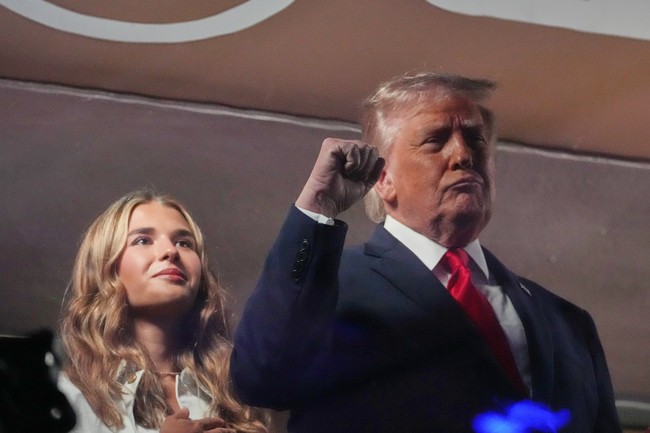
I’ll break down what happened at Madison Square Garden: the NBA commissioner defended President Trump’s presence at a Knicks playoff game, called for sports to unite people, and dismissed partisan criticisms from House Minority Leader Hakeem Jeffries as out of touch. The exchange highlighted how politics keeps seeping into simple public events, and how league leadership pushed back against that trend at the Garden. That moment matters because it shows an institution choosing community over political theater. Below I walk through the comments, the theater around them, and why the commissioner’s words landed for many.
Adam Silver spoke directly to fans and the broadcast audience before Game 3, and his message was clear and practical. He reminded folks that President Trump had a longstanding presence at Madison Square Garden and described that history in plain terms. His point was never about a political endorsement; it was about acknowledging a real, decades-long connection to the city and the arena.
“He was a fixture at Madison Square Garden,” he told the ESPN broadcast crew from the floor of the Garden; that crew included retired NBA greats Shaquille O’Neal and Charles Barkley. “You guys remember – all of you – when you played here back in the old days, he had courtside seats. He was here all the time. He was at drafts, so he’s a genuine Knicks fan.”
That factual rebuttal undercut the narrative pushed by some on the left that the president’s attendance was inappropriate or a stunt. Saying someone is a fan because they have attended games and draft events is simple commonsense, not a political argument. The commissioner emphasized that sports venues have long been pluralistic spaces where people with different views come together to cheer.
On Capitol Hill earlier the same day, Hakeem Jeffries took a different tack and tried to make the president’s fandom a political matter. His press conference included jab after jab questioning the president’s qualifications to be a fan, turning a sporting outing into a political production. That shift from enjoying a game to scoring political points is precisely what Silver warned against when he spoke about community.
During a congressional presser earlier in the day, Jeffries, decked out in a pale pink Knicks hat and seersucker suit, vented his frustrations, questioning whether Trump, a longtime Knicks fan, even knew enough about the team to qualify to be a fan.
https://x.com/EricLDaugh/status/2064139003322826794
Jeffries’ theatrical outfit and choice of words made the whole episode look like a fashion and optics exercise rather than serious civic discourse. The spectacle played into the idea that some politicians are more focused on scoring headline bites than preserving normal civic life. For many watching, that felt petty and small compared with the larger idea that sports should bring people together.
The commissioner reinforced that belief when he said, “I think we should be using sports to create more of a sense of community with people, not less.” Those are straightforward words from the head of a major league about what sports should do: build community, not divide it. In practice that means letting fans of all stripes enjoy events without every attendance becoming fodder for a cable-news narrative.
Critics on the left tried to turn the moment into a culture-war confrontation, framing a New Yorker attending his hometown arena as somehow a provocation. That framing ignores common experience and the basic reality of sports fandom. People who grew up around an arena, who bought courtside seats, who showed up at drafts and games, are by definition fans, and public life should allow for that normalcy.
When league leadership calls out attempts to politicize routine public acts, it matters beyond any single game. Silver’s remarks were a reminder that institutions can push back against constant politicization and reclaim neutral spaces for their primary purpose. Fans, players, and teams all benefit when sports remain an arena for community rather than a stage for partisan theater.
The day’s exchanges illuminated a broader truth about public life: not every appearance by a political figure is a campaign move, and not every critic speaking from a podium represents the broader public mood. The Garden’s packed stands and the extra security measures on display were reality checks on the notion that the president’s presence was some bizarre intrusion. For many attendees, it was just a night at the game and nothing more.
That contrast between the commissioner’s calming, community-focused remarks and the political grandstanding from the Hill was the main takeaway. It showed how leaders in different arenas decide whether to fan the flames or put them out, and in this case the NBA’s leadership chose to cool things down. The choice to emphasize community over conflict is worth noting, especially in a season where nearly every public event risks being turned into a partisan spectacle.


Add comment