
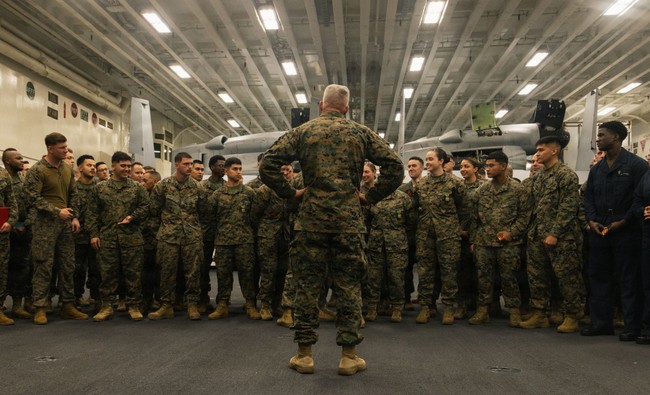
The Department of War has ordered the amphibious warship USS Tripoli and its embarked Marines into the Middle East amid an escalating conflict with Iran, and this move centers on stopping Iran’s blockade of the Strait of Hormuz and protecting freedom of navigation in the Persian Gulf.
The USS Tripoli is part of an Amphibious Ready Group that includes the USS San Diego and USS New Orleans, and it sails with the 31st Marine Expeditionary Unit based at Camp Hansen, Okinawa. That MEU numbers roughly 2,500 Marines, organized into a Battalion Landing Team of about 1,100 Marines plus an aviation element of V-22 Ospreys and helicopters, along with logistics and command-and-control assets.
Official reporting indicates that the Tripoli and its Marines have been ordered into the U.S. Central Command area of operations, although some press reports have relied on anonymous sources to suggest the entire ARG and MEU will deploy. What is confirmed is movement of the Tripoli with embarked Marines into the theater, and that implies at minimum roughly 1,700 Marines are available for employment once they arrive.
If only a portion of the MEU is sent, the likely missions would be signaling to Tehran that U.S. forces can threaten Iranian coastal assets such as Kharg Island, or providing reinforced security for embassies and critical onshore installations. Both options are constrained by time and distance; it will take weeks for ships and troops to transit from East Asia to the Persian Gulf, so immediate effects would be limited and primarily deterrent in nature.
Should the entire MEU deploy, the operational picture changes significantly. A full MEU brings ground combat power able to clear Iranian forces from coastlines and chokepoints that have been used to attack commercial shipping, with organic fire support, reconnaissance, and amphibious lift to seize and hold terrain if necessary.
Kharg Island is a logical focal point because it controls a disproportionate share of Iran’s oil export infrastructure while hosting a minimal civilian population. Taking or neutralizing Kharg would shape Iran’s ability to choke off maritime traffic and would strike at the mechanisms supporting the blockade of the Strait of Hormuz.
U.S. military leaders have framed the objective clearly. Joint Chiefs of Staff Chair Gen. Dan Caine said that U.S. Central Command will continue to “destroy the Iranian Navy to ensure freedom of navigation, and this means going after Iran’s mine-laying capability and destroying their ability to attack commercial vessels.” That language reflects a recognition that sinking Iranian naval units alone did not end the threat to shipping, and additional steps are now on the table.
Some online commentary has downplayed the ability to operate against Iranian coastal defenses, but that view misunderstands the tools a MEU brings. Counterbattery radar, precision fires such as HIMARS, and aviation support change the calculus; well-equipped Marine units are capable of suppressing and countering coastal batteries that might otherwise harass an island like Kharg.
The administration’s decision to include an MEU in the regional posture signals a judgment that air power alone will not resolve the problem. There are times in warfare when boots on the ground and infantry with decisive resolve are the right answer to secure chokepoints and protect civilian maritime traffic.
Politically, this step also answers a strategic necessity: allowing a selective Iranian blockade to persist sends a dangerous message that long-range reprisals and asymmetric attacks can succeed without cost. Strong, credible military measures to reopen Hormuz to normal navigation are essential to restoring deterrence and upholding the principle that international waterways remain open.
Operational details and the exact size of the deployed force will likely remain classified or unconfirmed in public reporting, but the presence of the Tripoli and embarked Marines changes both the tactical and strategic picture in the region. The mission now is straightforward: deny Iran the ability to interdict commercial shipping and reestablish freedom of navigation through decisive, calibrated action.


To update a mite. Those Iranian coastal defenses, at least on that island, have been obliterated. “….the amphibious warship USS Tripoli….” Ahh, I remember her well! I spent 30 days onboard that LPH-10 during the ‘original’ Iran hostage crisis. We were ready to go in, but never did. It took the elimination of Carter with the Reagan replacement to FINALLY get those hostages FREED! I was also involved in that FAILED hostage rescue mission, in the desert, that ended in disaster! Unlike this current Iran “incursion,” which has been all but flawless, the hostage rescue planning, in ’81, lacked completeness, considering the terrain those helicopters were to operate in.