
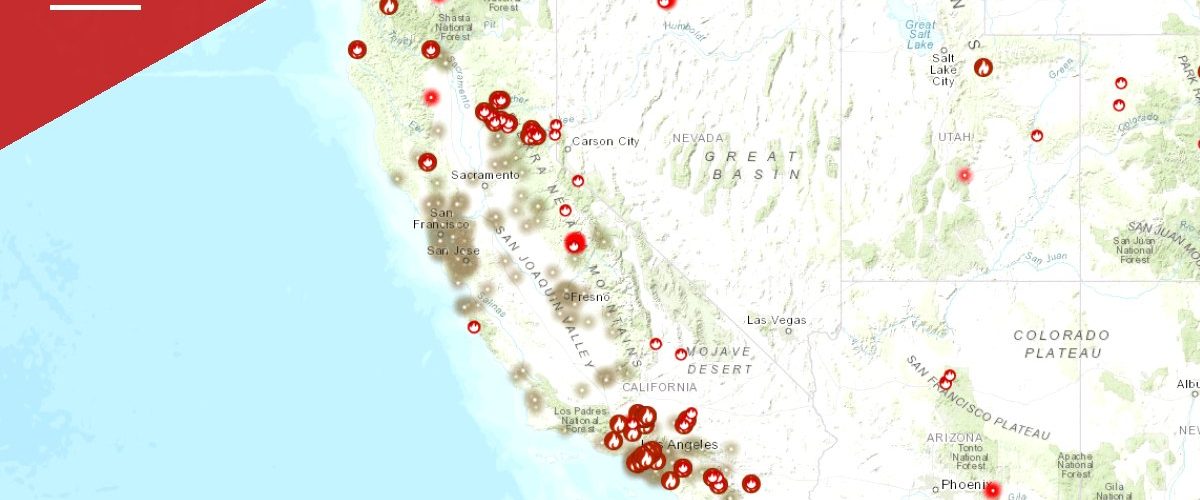
Wildfires are burning across large stretches of California this week as a record-breaking heat wave bakes the state, according to an interactive tracking map released by Frontline Wildfire Defense, a wildfire sprinkler company.
As of Monday, the blazes were concentrated mainly in Southern California near Los Angeles and around national parks north of Sacramento. The map displays active fire incidents with a fire icon, fire perimeters marked with a light red overlay and bold red outline, and thermal hotspots shown as red dots.
Frontline Wildfire Defense cautions that those hotspots are not always fires in progress. The company notes the dots “could be the beginnings of wildfires, or they may be false positives that the satellite picked up … like volcanic activity, oil and natural gas wells.”
The fires are igniting during an unusually intense heat wave. Southern California has recorded a streak of 100-degree days over the past week, and Los Angeles alone has already logged three days of triple-digit heat in October. Heat advisories have been issued from Southern California to the Bay Area, with some areas forecast to hit near 105 degrees Fahrenheit.
“We’re going on Day 4 of this really significant heat wave and we still have several more days of heat,” Rose Schoenfeld, a meteorologist with the National Weather Service in Oxnard, told the Los Angeles Times.
Frontline Wildfire Defense’s data shows the scale of the state’s wildfire problem over the past two years: 8,024 total wildfire incidents were recorded in 2024, and another 578 fires ignited in March 2025 alone.
California’s dry climate and strong Santa Ana winds are frequently cited as key drivers behind the state’s fire activity, as high wind speeds can turn small fires into major blazes rapidly.
Add comment