
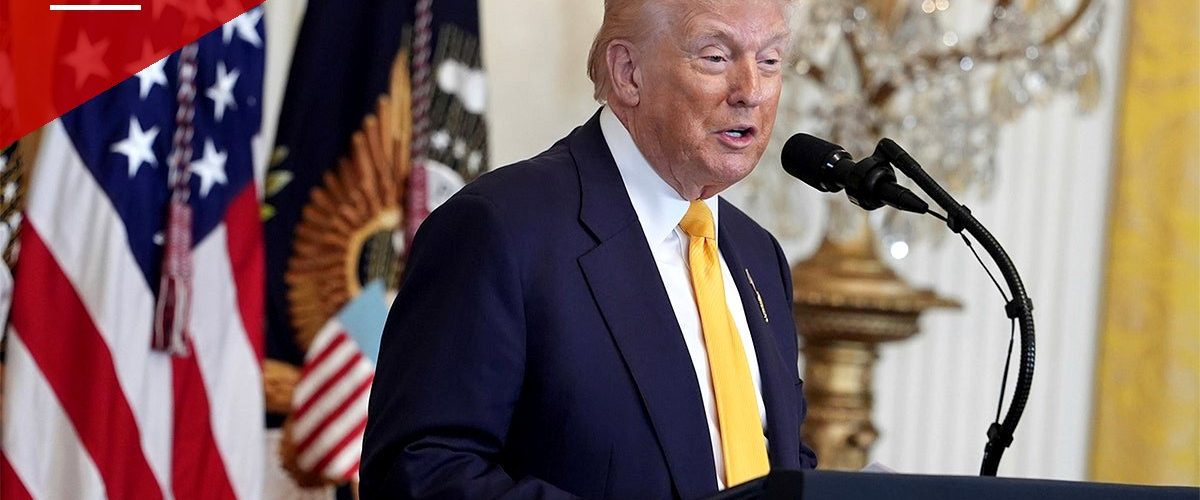
President Donald J. Trump has raised the possibility of trilateral nuclear arms control talks with China and Russia, reviving a subject that has been largely dormant since the last U.S.-Russia arms control treaty, New START, expired on Feb. 5. Trump first brought up the idea during his May trip to Beijing and again when Chinese President Xi Jinping visited Washington.
“The President advocated for trilateral arms control negotiations” among the United States, China and Russia, according to a White House statement issued Sept. 24. White House spokesperson Olivia Wales said Trump wants to “discuss the reduction of nuclear weapons in the world,” which he considers very dangerous.
The push comes as China’s nuclear arsenal has grown rapidly. The Pentagon says China has doubled its stockpile from roughly 300 warheads in 2020 to more than 600 today, and estimates the arsenal will reach 1,000 warheads by 2030 and 1,500 eventually. China has also fielded new delivery systems, including the JL-3 submarine-launched ballistic missile, with a range of 5,400 miles, and the H-6N bomber, which carries air-launched nuclear cruise missiles. China has additionally developed a fractional orbital bombardment system capable, in theory, of placing a nuclear hypersonic warhead into low Earth orbit. North Korea has developed its own nuclear arsenal with assistance from both Russia and China.
No previous U.S. president has attempted to bring China into nuclear arms control talks, which would mark a departure from past bilateral U.S.-Russia agreements such as the 1987 Intermediate-Range Nuclear Forces Treaty signed under President Ronald Reagan.
Triad Modernization Underway in Four States
Regardless of the outcome of any talks, the United States is in the midst of modernizing all three legs of its nuclear triad, with major work centered in California, Montana, North Dakota and Wyoming.
The land-based leg is being rebuilt around the new LGM-35 Sentinel intercontinental ballistic missile, which will replace the 1970s-era Minuteman III. The first test flight of Sentinel is expected in 2027. In September, the missile completed a stacking test at Vandenberg Space Force Base on the California coast, with all components loaded into a launch silo. Roughly 400 Sentinel missiles are planned for deployment in new silos across missile fields in Montana, North Dakota and Wyoming.
The air-delivered leg currently relies on 76 B-52 bombers and 20 B-2 Spirit stealth bombers. The newer B-21 Raider stealth bomber completed its first weapons release on a test range on Nov. 13, and the Air Force plans to accelerate production.
The sea-based leg is being rebuilt around the Columbia-class submarine. The lead vessel, the USS District of Columbia, has a 520-foot hull. Rear Adm. Rob Gaucher, the Navy’s program manager for undersea warfare, said shipyards doubled their work output over the summer, putting the submarine’s delivery back on track for 2028. The Navy ultimately plans to build 12 Columbia-class submarines, each capable of carrying 16 Trident II missiles armed with up to 12 nuclear warheads, to provide the sea-based leg of the deterrent.
Add comment