
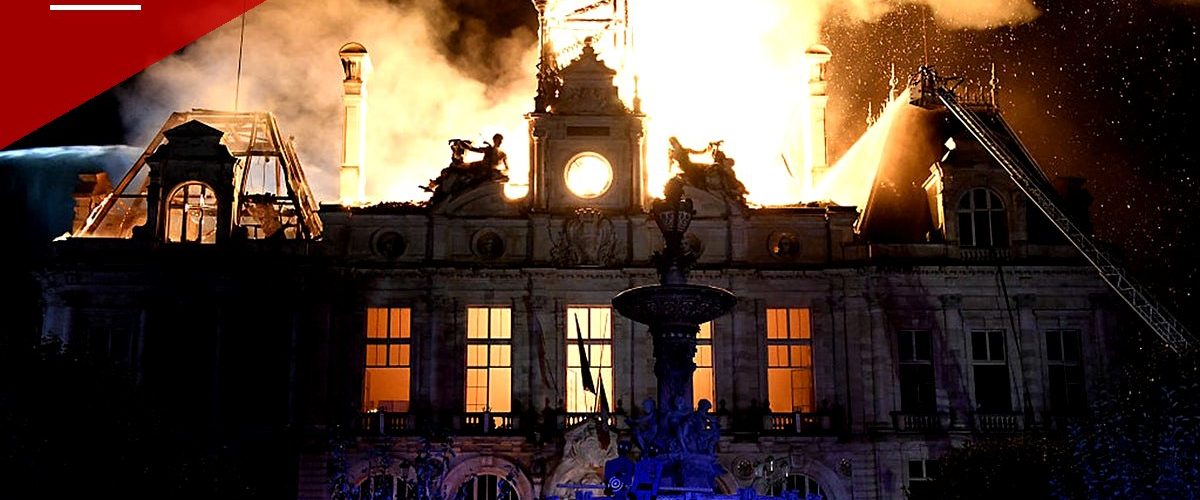
France is facing a wave of violent unrest that has shut down one of its most famous cultural institutions and left government buildings damaged in multiple cities. The Louvre museum in Paris, home to the Mona Lisa, closed Monday “due to a student social movement,” as protests originally sparked by high-school students have widened into broader, often destructive demonstrations.
In Limoges, rioters set fire to the town hall, destroying its historic tower. In Marseille, demonstrators broke into city hall and vandalized the interior. In Paris, video circulated online appearing to show a group chasing and throwing down a policewoman while shouting insults, amid broader property destruction and street assaults.
The unrest began with high school students protesting overcrowded classrooms, deteriorating school buildings, and limited access to college. They have since been joined by retirees who say state pensions do not cover the cost of living, along with others angry over the broader cost of living in France.
Looting and Vandalism
Video from French media showed looted storefronts on Rue Paradis in Marseille, a street known for both high-end jewelry and fashion shops and small family-run businesses. Many of these stores were left as empty, ransacked shells, their protective metal shutters torn off or broken.
Marseille Mayor Benoit Payan, whose own office was damaged in the break-in at city hall, has blamed the national government for failing to protect the building and local shops. He is calling on the national government to cover the cost of the damage.
A Government Under Pressure
President Emmanuel Macron, who is in the final year of his second term and cannot run again, condemned the violence in a speech on Sunday. On Tuesday, he kept to his prior schedule and traveled to the Gulf region as the unrest continued at home.
France holds presidential elections next April. Among the leading contenders are Marine Le Pen of the right-wing National Rally, who has called for lower migration and limits on welfare payments to migrants, and Jean-Luc Melenchon of the left-wing France Unbowed, who supports continued mass migration and opposes cuts to benefits.
The Numbers Behind the Unrest
France has not balanced its national budget in 50 years. This year’s deficit exceeds 5% of GDP, economic growth is under 1%, and national debt stands at 120% of GDP. Diesel fuel costs roughly $10 a gallon. Like other developed nations, France’s fertility rate has fallen below the replacement level even as the country has absorbed millions of immigrants from its former colonies.
Law enforcement capacity is also strained. France’s national police cover cities, while gendarmes handle rural areas, both funded by the central government. Municipal police forces in individual towns are not equipped or trained for riot control, and the country’s specialized riot units are limited in number. The French military, while regarded as among Europe’s strongest, is not deployed for domestic unrest.



Add comment