
The race for air dominance over the Pacific has become a modern pivot point in great power competition, with lessons from World War II echoing today as America rebuilds its edge in stealth, long-range fighters, bombers, drones, and the logistics that will decide the fight.
History offers a clear parallel: in World War II American bombers needed an escorting fighter with range to survive deep in enemy airspace, and the P-51 Mustang provided that edge. That shift turned fragile daylight raids into sustainable pressure on Germany, because a single platform that combined range and performance changed operational reality.
Fast forward to the present and our air fleet faces a similar challenge in the Pacific. The F-35 and F-22 are phenomenal fighters, but their time-on-station is limited without forward bases or persistent refueling. In any clash with China those limits turn into liabilities, because basing and tankers become targets inside a dense missile threat environment.
From new stealth bombers to AI-enabled drones, the U.S. and China are reshaping airpower for a Pacific showdown – each betting its technology can keep the other out of the skies.
The U.S. is charging ahead with its next-generation F-47 fighter, while China scrambles to catch up with jets designed to match the F-35 and F-22.
After a brief program pause in 2024, the Air Force awarded Boeing the contract in March for the F-47, a manned sixth-generation fighter meant to anchor America’s next air superiority fleet. The first flight is expected in 2028.
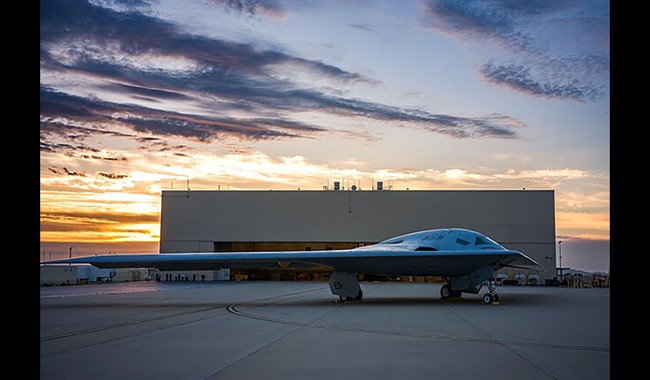
At the same time, the B-21 Raider, the stealth successor to the B-2, is deep into testing at Edwards Air Force Base. The Air Force plans to buy at least 100 Raiders – each built to survive inside heavily defended Chinese airspace.
Stealth bombers change the matchup because an interceptor pilot can’t engage what he can’t find visually or on radar. That advantage only lasts so long if the logistics tail and tanker fleet are exposed. American reach is built on tankers and forward bases, and those points are precisely where an adversary will try to cut our lines of action.
Forward bases are the modern equivalent of 1940s staging fields: indispensable but vulnerable. If missile salvos or drone swarms can keep runways cratered and fuel trucks burning, aircraft that rely on nearby basing lose their punch. Long-range platforms reduce that exposure and let commanders press the fight from safer depths.
Chinese military writings identify airfields as critical vulnerabilities. PLA campaign manuals call for striking runways early in a conflict to paralyze enemy air operations before they can begin. Analysts believe a few days of concentrated missile fire could cripple U.S. bases across Japan, Okinawa and Guam.
“The U.S. bases that are forward deployed – particularly on Okinawa, but also on the Japanese mainland and on Guam – are exposed to Chinese missile attack,” said Mark Cancian, a retired Marine colonel and senior advisor at the Center for Strategic and International Studies. “In our war games, the Chinese would periodically sweep these air bases with missiles and destroy dozens, in some cases even hundreds, of U.S. aircraft.”
Technology is shifting the balance again. The new F-47 is designed around the idea of manned leadership controlling semi-autonomous drone wingmen, a force-multiplier that can extend situational awareness and firepower without putting pilots directly in harm’s way. China is pushing its own programs, which means this will be a tech race where the cost of falling behind is strategic exposure.
High-end systems demand high-end sustainment. The F-22 is notorious for maintenance hours that dwarf its flight hours, and next-generation platforms will require even more specialized support, parts, and highly trained maintenance crews. That is not a sexy topic, but logistics and sustainment are the backbone of operational success.
Wars are decided by the ability to keep the fight supplied and repaired, not just by flashy first-strike headlines. Fuel, munitions, spare parts, and repair expertise have always decided campaigns; in a Pacific fight they matter more because distances are vast and redundancy is limited. If we want to project power and hold it, we must secure the logistics chain as aggressively as we pursue stealth and speed.
On the strategic level, the right mix is clear: longer-legged fighters and survivable stealth bombers combined with robust, resilient logistics and dispersed basing will blunt an opponent’s ability to paralyze our airpower. That combination reduces single points of failure and forces an adversary to expend scarce precision munitions and planning on many targets instead of a few.
From a Republican defense perspective, rebuilding American strength means investing in the platforms that restore deterrence and buying into the hard work of sustainment and readiness. The goal is simple: make any potential aggressor think twice by ensuring we can keep planes flying, weapons flowing, and command intact under fire.
Editor’s Note: Thanks to President Trump and Defense Secretary Pete Hegseth’s leadership, the warrior ethos is coming back to America’s military.

Add comment