
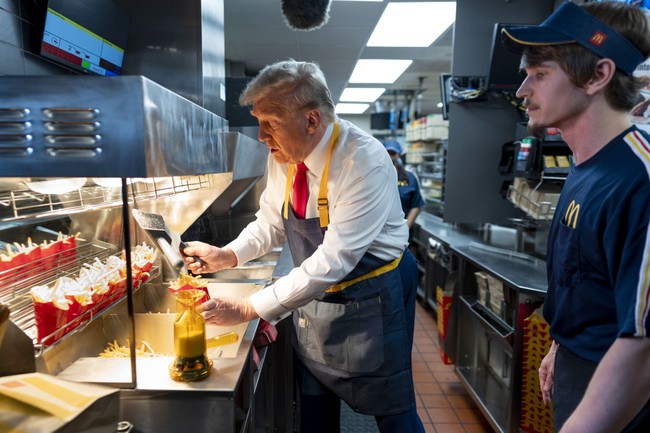
I’ll cover how Trump blended humor and policy at the McDonald’s Impact Summit, his personal McDonald’s anecdotes, the jobs and wage claims he cited, moments of levity involving guests, and his pledge to keep driving down costs for Americans.
President Donald Trump leaned into both jokes and policy during his remarks at the McDonald’s Impact Summit, using his familiar swagger to make an economic point. He opened with a self-deprecating line about his fast-food past, framing it as a badge of working-class credibility. The tone moved quickly from playful to pointed as he pivoted to national economic figures and his administration’s priorities.
“I’m honored to stand before you as the very first former McDonald’s fry cook ever to become President of the United States,” he said, and then added some barbed humor comparing his short shift at a McDonald’s counter to Kamala Harris’s experience. The quip landed with a crowd that expected a little theater alongside policy talk, and it set the stage for a speech aimed squarely at everyday voters. Trump used that familiarity to puncture the usual political distance between a president and regular Americans.
He reminded the audience of the time he worked behind a fryer and in a drive-through during the 2024 campaign, a stunt meant to humanize him and showcase his connection with blue collar life. That clip and those anecdotes served as more than nostalgia; they were a platform to argue that his administration understands what families face at the grocery store and gas pump. He returned several times to the theme that knowing the grind gives him a different perspective on policy choices.
On substance, Trump emphasized job gains and wage improvements as signs the nation is moving in the right direction under his leadership. “There’s still a lot of work to do….and we’re making tremendous progress. 1.9 million more American-born workers are employed today than when I took office… Wages for hourly workers are rising at the fastest pace in 60 years,” he declared. Those numbers were presented as proof that his policies favor native-born workers and lift paychecks for folks who clock in daily.
His remarks cited a nearly two million increase in native-born employment year over year and highlighted an uptick in hourly wage growth. He linked that progress to policies on immigration enforcement and economic management that, from his perspective, restore opportunities for American workers. For his audience, the argument was straightforward: stronger borders, better enforcement, and pro-growth economic choices translate into more jobs and higher pay.
Blue-collar workers have seen real wage growth of almost two percent in the first five months of President Donald Trump’s second term, the largest increase for any administration in nearly 60 years.
The 1.7% pay bump is in stark contrast to negative growth under Joe Biden, according to new data from the US Department of the Treasury.
Since Richard Nixon in 1969, Trump has been the only president to record positive growth for blue-collar workers in his first five months. He also achieved 1.3% in his first term.
He moved from numbers to everyday examples, pointing out that energy prices and grocery costs like eggs have eased for many families, while stressing there is still more work ahead. The message was familiar: recent improvements matter, but the administration plans to keep pushing until ordinary costs are consistently lower. That promise is aimed at voters who feel the pinch of inflation and want concrete relief.
The event also offered lighter moments that underscored the summit’s theater. Trump managed to coax Robert F. Kennedy, Jr., into trying a Big Mac, a moment the crowd enjoyed as both comic relief and a symbolic cross-party wink. He even broke into a little dance on stage, the kind of spontaneous move that gets captured and replayed and keeps the summit in the public eye. Those flashes of levity were threaded through the economic pitch to keep attention on the policy points.
Throughout, Trump blended populist rhetoric with practical claims about employment and wages, framing his record as pro-worker and pro-affordability. He positioned himself as someone who both talks like the people he represents and tries to deliver measurable results. That combination of humor, anecdote, and policy appeal was the essence of the presentation at a venue symbolically tied to working Americans.
The McDonald’s Impact Summit provided a stage where cultural moments and economic messaging mixed in equal measure, and Trump used both to reinforce a simple argument: when policies favor American workers and focus on affordability, families see the difference in their paychecks and their weekly budgets. He wrapped his case in the kind of plainspoken language that plays well with voters who want leaders to cut through the noise and deliver real improvement.


Mʏ ʟᴀsᴛ ᴘᴀʏ ᴄʜᴇᴄᴋ ᴡᴀs 8500 ʙᴜᴄᴋs ᴡᴏʀᴋɪɴɢ 10 ʜᴏᴜʀs ᴀ ᴡᴇᴇᴋ ᴏɴʟɪɴᴇ. My younger brother friend has been averaging 11k ʙᴜᴄᴋs for months now and he works about 22 hours a week. I cant believe how easy it was once I tried it out…….
Tʜɪs ɪs ᴡʜᴀt I ᴅᴏ__________ EarnApp1.Com