
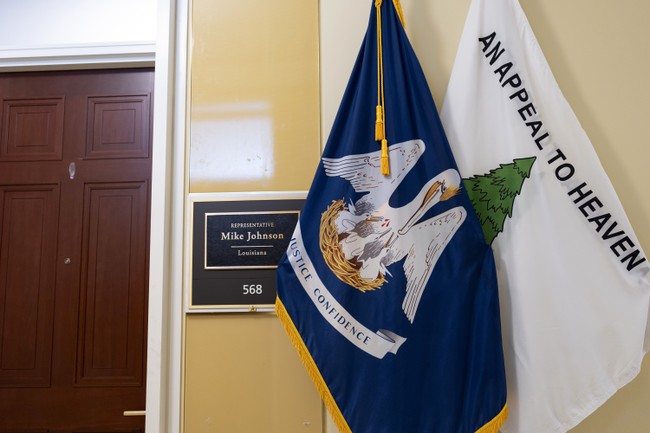
The piece examines how mainstream outlets repeatedly attack the “Appeal to Heaven” flag, tracing recent coverage that labeled it as tied to Christian nationalism and January 6, and argues that those portrayals distort history and political context while spotlighting a new USA Today story about a Department of Education official’s flag display.
The media has a habit of turning benign symbols into controversies, especially when conservatives are involved. Recent coverage treating the “Appeal to Heaven” flag as a fresh sign of extremism is just the latest example. Reporters often frame these stories to suggest a direct line from old Revolutionary War imagery to modern political violence. That framing ignores nuance and history in favor of sensationalism.
One persistent claim in coverage is that the flag “largely fell into obscurity” until recent years, a line used to suggest it has been revived only by fringe movements. That assertion is shaky because the flag’s history and its periodic appearances in American civic life are more complicated. Calling something obscure doesn’t make it newly sinister. It just makes a tidy narrative for a journalist who wants a hook.
The latest flap centers on a USA Today reporter who described the flag as a “Christian nationalist” flag before adjusting the wording to say it is “a ‘symbol associated with Christian nationalism.'” That correction matters, because labels shape public perception in powerful ways. A rushed headline or an imprecise phrase can turn an historical banner into an indictment of anyone who displays it.
USA Today noted the banner was “long tied to the American Revolution” but also linked it to groups like the Proud Boys and certain neo-Nazi outfits, mixing legitimate historical context with tenuous contemporary associations. Lumping a Revolutionary-era emblem together with extremist groups is a stretch unless you can prove direct organizational adoption and intent. Context and intent are the two things most headlines never bother to test.
Conservative voices pushed back strongly on social platforms when the story ran, criticizing the reporter and the outlet for what they saw as biased framing. Sen. Mike Lee was among those who publicly condemned the coverage, arguing that it reflected a broader pattern of media hostility toward conservative symbols. That backlash prompted some public corrections and clarifications from reporters, which says something about how quickly narratives can be revised when people push back.
There is a pattern to these flag controversies: the Gadsden, the inverted American flag, and now the “Appeal to Heaven” standard have all been treated like smoking guns by certain newsrooms. Each time, the reporting leans hard on association and implication rather than clear evidence of violent intent or organized extremism. The result is a culture war where symbols become proxies for entire political movements instead of points for honest historical discussion.
Historical symbols get messy when they reappear in modern politics, and that messiness should invite careful reporting rather than reflexive condemnation. Many symbols from the Revolutionary era have been repurposed by people across the ideological spectrum for different reasons. That reality complicates any attempt to make a single, definitive claim about what the flag now means.
Calling out perceived bias isn’t the same as defending bad faith actors, and critics say that distinction is too often lost. When outlets leap from past usage to present-day guilt by association, they abandon fair reporting and move into advocacy. That pattern erodes trust and confirms to many conservatives that the press is stacked against them.
The relentless coverage of conservative iconography reads less like investigative journalism and more like a political campaign staffed by reporters chasing easy narratives. Labels like “Christian nationalist” get tossed around with minimal qualification, which inflames audiences and simplifies complex cultural phenomena. Responsible coverage would interrogate motives, document clear ties to violent behavior if there are any, and avoid broad-brush accusations.
Readers who follow these stories closely see recurring tactics: emphasize a shocking connection, downplay historical context, then amplify outrage on social platforms. Those tactics create news cycles that feed political division and obscure the real issues. Meanwhile, people who display historical flags for reasons unrelated to extremism get smeared in the process.
Accurate history deserves better than selective quotation and rushed verdicts. When a flag has documented Revolutionary origins, that fact should be presented plainly alongside any evidence of contemporary misuse. Mixing the two without clear proof is a rhetorical trick that benefits outrage machines more than it serves truth.
“It’s not clear how long the banner has been hung outside the D.C. office of Murray Bessette, the principal deputy assistant secretary in the Office of Planning, Evaluation and Policy Development,” the report noted after also linking the flag, which it briefly pointed out “was ‘long tied to the American Revolution,'” to “the Proud Boys and certain neo-Nazi groups.”
As coverage continues, expect the same pattern: dramatic claims, heated pushback, minor corrections, and then the cycle repeats with a new symbol. That loop is predictable because it suits outlets that prioritize viral moments over careful reporting. For observers on the right, it confirms a long-standing skepticism about mainstream media fairness and motives.



Add comment