
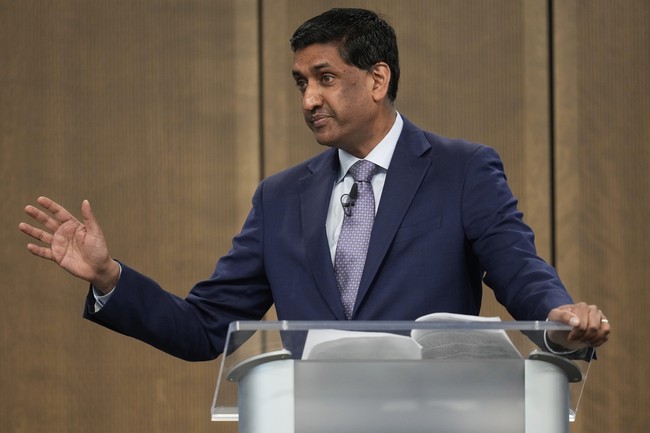
New: Watch Ro Khanna Twists Himself Into a Pretzel on Platner, With Surprising Take on Allegations
The piece examines Rep. Ro Khanna’s public defense of Democrat Graham Platner amid serious allegations, arguing Khanna’s reasoning strains credibility and highlights a broader Democratic problem. It recounts Khanna’s rally appearance, his verbal gymnastics around what counts as disqualifying behavior, and how his stance conflicts with the party’s past rhetoric. The article reproduces key quoted passages exactly as said, and places embedded media where they originally appeared. The tone is critical of Khanna’s defense and frames the situation as politically damaging for Democrats heading into the Senate race in Maine.
Democrats in Maine have handed Republicans a rare opening by nominating Graham Platner for the Senate, a choice that looks increasingly like a misstep. From a Republican viewpoint, Platner’s candidacy is self-inflicted trouble for the left, and fellow Democrats rushing to defend him only dig the hole deeper. Rep. Ro Khanna’s recent appearances in support of Platner make that damage more obvious because his explanations strain basic logic.
Khanna traveled to Maine and joined Platner at a rally, lending a high-profile imprimatur to a man facing credible accusations from an ex-girlfriend. That kind of public backing matters — it signals to voters where the party is headed and what standards it will apply. Instead of making a clear judgment based on allegations, Khanna offered a narrow definition of disqualifying conduct that reads more like legal parsing than moral clarity.
The controversy got louder after Khanna doubled down on his position during a Sunday interview where he tried to set a “red line” for supporting Platner. His answer avoided the core of the allegations and left significant wiggle room, which only raises questions for voters who expect elected officials to take reports of abusive conduct seriously. This is especially striking given Democrats’ past insistence on believing accusers when the target is a Republican.
“My view is that even according to the NY Times piece, they said there was no harm, no injury. There was toxicity, and there was verbal intimidation, which I condemn. But Graham has made it clear that there was no evidence of violence. That to me is a red line.
Khanna’s line that only certain kinds of physical harm constitute a disqualification ignores the practical reality that abusive behavior can be violent even when it doesn’t leave broken bones. Voters know the difference between a clean legal conviction and patterns of coercive behavior that make someone unfit for public office. Defending Platner on the grounds of “no evidence of violence” instead of addressing the reported conduct looks like a partisan shield rather than a moral judgment.
https://x.com/RNCResearch/status/2063646194144837886
If there was evidence of violence, I would not support. If there was evidence of sexual assault, I would have zero support for him.”
Meanwhile, the ex-girlfriend’s account describes repeated episodes that, to any reasonable observer, amount to abusive behavior even if they didn’t leave a fracture. Her narrative includes being grabbed hard enough to leave marks, being yanked out of a cab, having an arm twisted behind her back, and being held in a room against her will. Those details matter because they show a pattern, not a single isolated incident, and patterns reflect on character and judgment.
But she said he regularly grabbed her by the shoulders — sometimes hard enough to leave marks — and, on one occasion, yanked her out of a cab by her wrist after an argument when she wanted to stay in the car.
During one argument, she recalled, he twisted her arm behind her back, shoved her into a bedroom and held the door closed from the other side so she couldn’t getout, telling her to remain there until she was “calm.” Eventually, Ms. Fifield said,she fell asleep and left the next morning.
“It hurt,” she said. But she added: “It didn’t cause an injury, it didn’t break my arm.”
Khanna has previously supported the “believe all women” line when accusations targeted Republicans, which makes his current posture look inconsistent and politically motivated. From a Republican perspective, that inconsistency undermines the Democrat message and suggests double standards in how allegations are handled. It also hands Republicans a simple argument: standards that shift depending on partisan advantage are not principles at all.
Rather than offering a firm rebuke or calling for an independent inquiry, Khanna appears to want both outcomes: to maintain support for Platner while nominally acknowledging the account. That posture will not satisfy voters who want accountability or those who expect elected leaders to act decisively when confronted with credible allegations. Politically, it’s a risky maneuver that amplifies the optics of party defensiveness.
At the end of the day, the story is less about one man’s denial and more about a party choosing to protect its nominee at the cost of consistency and credibility. Republicans will point to Khanna’s equivocation as proof Democrats prioritize power over principles, and that argument will resonate with swing voters concerned about character and accountability. The episode will linger as a lesson in how not to handle serious personal allegations in public life.


Add comment