
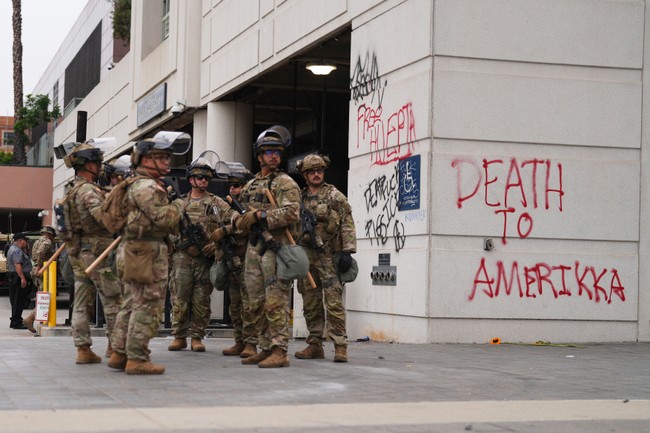
This piece explains a recent court order from a Northern District of California judge that blocks parts of the federal government’s use of California National Guard troops, why the judge found the administration’s approach legally troubling, and what this means for control of the Guard and future appeals. It lays out the timeline of federalization orders, the judge’s legal reasoning against indefinite re-federalization, and the immediate practical effect of returning control to the state while acknowledging an expected appeal. The article preserves the judge’s central statements and quotes verbatim for clarity.
Judge Charles Breyer made no mystery of his view in a recent ruling, and he wrote plainly about his concerns over the federal government’s use of state National Guard forces. From the bench and on paper he treated the federalization of California Guard members as something that raises constitutional and historical alarms, and he used strong language to describe the risks of a permanent federalized force made of state troops. That perspective is important because it sets up a direct clash between executive authority and state sovereignty at the heart of this dispute.
The case traces back to a June federalization that converted many California Guard members into federal status for a federal mission. The administration later scaled that number down, then issued additional federalization orders in August and October that kept roughly 300 Guardsmen under federal control. Those subsequent orders became the focus of the lawsuit brought by California, which challenged the idea that once troops are federalized they can be re-federalized or extended forever without judicial review. The judge found that claim legally suspect and constitutionally dangerous.
Breyer opened his ruling with a pointed reminder about the Framers’ design for checks and balances and then criticized the defendants’ stance as seeking a “blank” check. He emphasized that the courts retain a role in reviewing government action and rejected arguments that would make re-federalization immune to judicial scrutiny. From a conservative viewpoint, the concern is not merely academic; it is about preserving the constitutional allocation of power and protecting state authority from permanent federal encroachment.
Six months after they first federalized the California National Guard, Defendants still retain control of approximately 300 Guardsmen, despite no evidence that execution of federal law is impeded in any way—let alone significantly. What’s more, Defendants have sent California Guardsmen into other states, effectively creating a national police force made up of state troops. In response to Plaintiffs’ motion to enjoin this conduct, Defendants take the position that, after a valid initial federalization, all subsequent re-federalizations are completely, and forever, unreviewable by the courts. Defendants’ position is contrary to the law. Accordingly, the Court ENJOINS Defendants’ federalization of California National Guard troops.
Breyer then walked through the series of orders and appeals that produced this litigation, noting the procedural posture created by the initial June federalization and the later August and October extensions. The judge clarified that the August order was not before the Ninth Circuit on appeal and that he retained jurisdiction to rule on the challenges to these subsequent actions. That procedural nuance matters because it allowed a district court judge to address whether repeated federalization can be treated as a one-way street beyond judicial review.
The administration has argued that once troops are validly federalized, future re-federalizations are not subject to court oversight. Breyer rejected that reading because it would allow a president to convert state forces into a perpetual federal instrument. He tied the concern to the Founders’ deep wariness about standing national armies and the need to protect individual liberty and state sovereignty against permanent federal control. The judge warned of the constitutional consequences of accepting an interpretation that would permit indefinite national control of state troops.
That is shocking. Adopting Defendants’ interpretation of Section 12406 would permit a president to create a perpetual police force comprised of state troops, so long as they were first federalized lawfully. Such a scenario would validate the Founders’ “widespread fear [of] a national standing Army,” which they believed “posed an intolerable threat to individual liberty and to the sovereignty of the separate States.”
The practical effect of Breyer’s order is straightforward: it enjoins the administration from deploying California National Guard members in Los Angeles and directs the federal government to return control of the Guard to the governor. The judge stayed his own order briefly to allow the government time to pursue appeal, which is expected. That stay shows the court anticipated additional review at the appellate level and acknowledged the likelihood of continued litigation over executive power.
From a conservative standpoint, the ruling underscores two persistent principles: respect for constitutional limits on federal authority and the need to guard state control of their own militia forces. The case is now headed into the appeals process, where judges will have to confront whether re-federalization can be insulated from judicial review and whether the executive branch can treat state troops as a national, permanent force. How the appellate courts resolve that question will matter for future uses of the National Guard and for the balance between federal necessity and state prerogative.
The dispute combines constitutional history, emergency powers, and practical military deployment decisions, and it will likely shape how future presidents and governors navigate the line between federal missions and state control. Expect further filings and appeals, because the stakes involve not just the California Guard but the broader principle of who controls the instruments of force in our federal system. The legal path forward will determine whether the executive branch can claim an open-ended right to federalize state forces or whether courts will remain a check on such assertions.


Add comment