
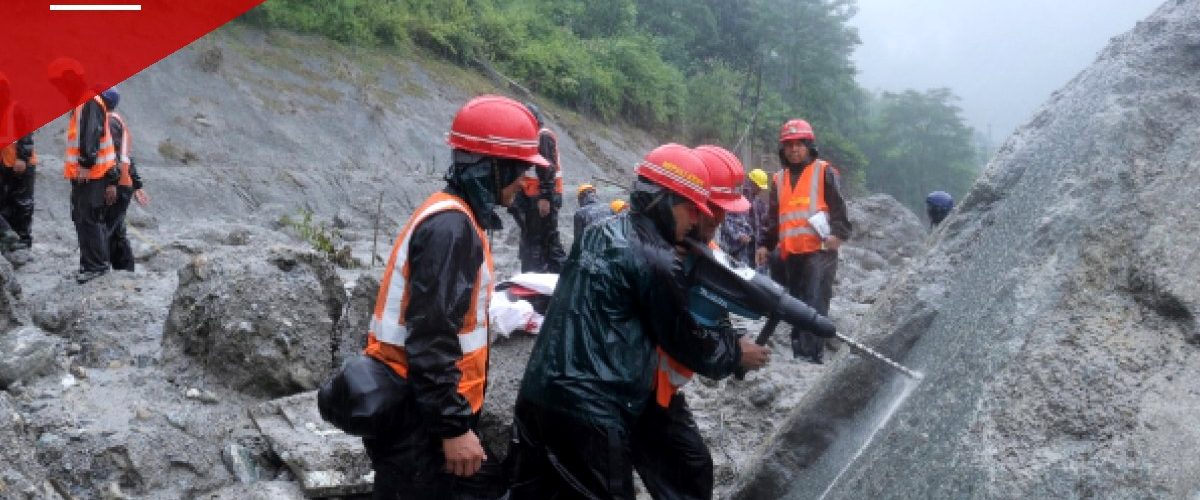
Rescue crews in Nepal are racing to reach more than 900 hydropower workers still unaccounted for after a catastrophic flash flood tore through the country’s border region with Tibet last Wednesday. As of Monday’s updated toll, the flood has killed over 900 people, with more than 4,200 still missing.
Many of the missing are believed trapped underground in tunnels beneath a dozen hydropower installations. Mohan Kumar Dangi, president of the Nepal Independent Power Producers’ Association, said Monday that distress calls were broadcast from several flood-hit sites. Some workers sheltered in the tunnels and later escaped, but reported that many colleagues remained trapped, with oxygen possibly running low.
One of the earliest emergency calls came from a hydropower plant under construction in the Rasuwa district, where South Korean firm Doosan Enerbility said roughly 20 of its employees were trapped by the fast-moving floodwater. South Korea moved quickly to dispatch a rescue team, but Nepal initially declined foreign assistance, touching off a diplomatic standoff over the weekend.
Doosan Enerbility said Monday that nine employees had since been rescued from Rasuwa and returned home, while a tenth — the site manager — stayed an extra day to help with search efforts. Six more Doosan workers and three employees of the state-run Korea South-East Power Company remain unaccounted for.
“It Looks Like a Lunar Landscape”
Arnold Dix, an Australian engineering professor advising on the rescue effort, told the U.K.’s Radio 4 on Monday that the flood’s destructive force has made it difficult just to locate where tunnel entrances used to be.
“The actual signature of them has gone — everything is just missing. It looks like a lunar landscape,” Dix said.
Dix said there is “some hope” for workers trapped underground, since the tunnels themselves may have shielded them from the worst of the flood. The challenge now is clearing debris — including “boulders bigger than houses” — from the tunnel entrances safely.
“We know that virtually anyone near the surface or near the entrances to those tunnels have lost their lives,” Dix told the Associated Press on Monday, adding that some of Nepal’s leading hydropower experts were onsite when the flood hit and are now among the missing and dead.
Nepalese Prime Minister Balendra Shah said Monday that the Nepali Army has rescued 279 people from hydropower sites, including 254 workers pulled from a single large facility, the Upper Trishuli-1 Hydropower Project. The army also reported finding at least one body in tunnels beneath the Langtang Hydro project.
Rescue crews are draining partly flooded tunnels and pumping in air with compressors, but bad weather, rough terrain and swollen rivers are slowing the work. The Trishuli River, which feeds Trishuli-1 and other plants, has reportedly changed course several times in recent days.
A Government Admits It Was Overwhelmed
Bhim Gautam, CEO of the Independent Power Producers Association of Nepal, told NPR that the government’s delay in accepting outside help was a serious mistake, because Nepal lacks the equipment and expertise to run a rescue operation of this scale on its own.
“Our expertise is only in dealing with small flooding. We have never faced a situation like this before,” Gautam said. “Late last week, the government approved rescue teams from China, India, and Australia to come, but it is so late now.”
China’s Ministry of Natural Resources issued a hazard assessment Sunday identifying eight “high-risk geological hazard sites” in the flood region, along with 52 additional areas of lesser concern.
A Booming Industry Caught in the Middle
Nepal’s rivers give it the theoretical capacity to generate more than 42,000 megawatts of hydropower, and the country currently operates 120 hydropower plants with another 235 under construction — though even that build-out taps less than 10 percent of Nepal’s potential. Indian and Chinese firms have competed aggressively for construction contracts there, with India gaining ground by barring Indian consumers from buying power generated by China-linked projects. That policy has helped India take over four Nepali hydropower projects from Chinese firms, including one originally promoted as part of China’s Belt and Road Initiative when Chinese leader Xi Jinping visited Nepal in 2019. Some Nepali officials worry the arrangement could eventually leave the country short of its own power even as foreign firms compete to build out its rivers.


Add comment