
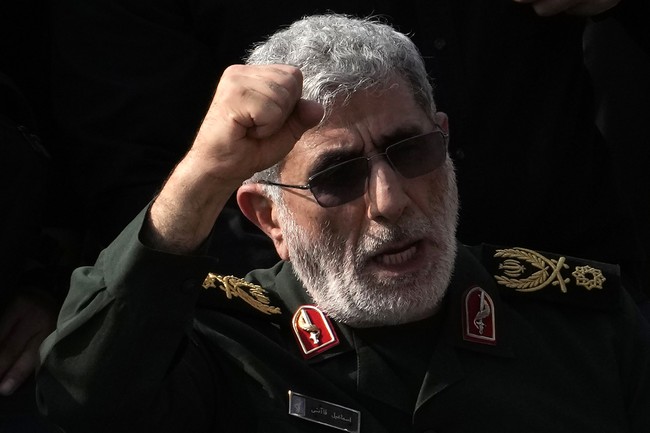
Iran’s leadership has been openly threatening American forces while facing widespread domestic protests, and U.S. officials have signaled readiness to respond if Tehran violently suppresses demonstrators. This piece examines the rhetoric out of Tehran, the limits of Iran’s conventional military power, the regional exposure of U.S. bases, and the strategic choices Washington faces as protests spread inside Iran.
There’s an old saying about someone’s “mouth writing checks his butt can’t cash.” It’s meant to describe threats that far outstrip capability. Iran’s leaders are making bold statements now, even as large sections of the population push back against theocratic rule.
As nationwide protests continued to spread across Iran on Friday, the regime’s hardline Parliament speaker warned the U.S. that American forces and bases in the region would be considered “legitimate targets” if Washington intervenes in the country’s ongoing political unrest.
Parliament Speaker Mohammad Bagher Qalibaf made the comments after President Donald Trump said earlier Friday that the U.S. would take action if Iran uses force against demonstrators. It comes as protests entered a sixth day and appear to be spreading, with Iranian opposition groups claiming at least eight deaths.
“The disrespectful President of America should also know that with this official admission, all American centers and forces across the entire region will be legitimate targets for us in response to any potential adventurism,” Qalibaf wrote in Persian on X.
So let’s be blunt: what exactly would Tehran use to hit U.S. forces? Iran’s air fleet is mostly Cold War vintage aircraft with limited sortie rates and aging maintenance backlogs. Even if some fighters remain technically airworthy, modern U.S. air assets — including stealth and advanced avionics — would dominate the skies quickly in a conventional clash.
Iran does possess a robust missile and air-defense network that complicates strikes on its own soil, and its missile arsenal gives it regional strike options. Those systems matter if the United States tries to hit deep inland targets, but they do not erase the disparity in surveillance, precision strike, and electronic warfare that the U.S. can bring to bear.
Roughly 40,000 active-duty U.S. troops and War Department civilians are deployed across the Middle East, according to Military Times, citing Pentagon officials. Forces are stationed in countries including Qatar, Bahrain, Kuwait, Iraq and Syria, according to Reuters.
Trump said earlier Friday that the United States is “locked and loaded and ready to go” if Iranian authorities violently suppress demonstrators.
“If Iran shoots and ‘violently kills peaceful protesters, which is their custom, the United States of America will come to their rescue,’” Trump wrote on Truth Social.
That regional footprint means many U.S. personnel and bases would be at risk in any serious escalation, especially from proxy attacks or long-range rocket and missile strikes. The danger there is asymmetric: Tehran can use proxies and indirect means to raise costs without exposing its own metropolitan centers to immediate retaliation.
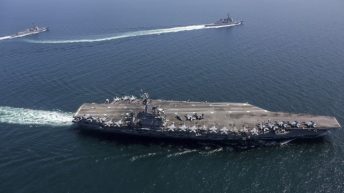
Aerial dominance would be the logical U.S. response if direct intervention were ever chosen, because ground operations inside Iran would be politically and logistically nightmarish. Establishing air superiority quickly would let American forces shape the battlefield with drones and precision munitions while minimizing U.S. ground exposure.
Still, the preferable route for many observers is to avoid direct military intervention and to let Iranians determine their own future without obvious outside coercion. Heavy-handed external involvement risks energizing nationalist narratives that the regime would exploit to discredit domestic opposition.
Washington can also back popular movements with nonmilitary tools: intelligence sharing, secure communications support, sanctions relief promises, and conditional diplomatic recognition are leverage points short of bombs and boots. Those measures carry risks and limits, but they avoid the direct costs of kinetic engagement while helping protesters undermine regime control.
Iran’s rhetoric about making U.S. bases “legitimate targets” is a political message aimed at deterrence and domestic audiences as much as it is a threat of action. Bold words do not always translate into effective capability, but they are a warning flag nonetheless, especially given Tehran’s history of using proxies across the region.
Whatever happens next, the dynamic on the ground in Iran is unpredictable. The protesters have shown resilience, the regime has shown ruthlessness, and the international response will shape outcomes. The United States is signaling it will not sit idle if peaceful demonstrators are massacred, and Tehran appears to be testing whether bluster will change that calculation.


The only answer to this evil and madness is to take out all Iranian leadership from the fraud political ideology Muslim/Islam ayatollah along with mullahs and military.