
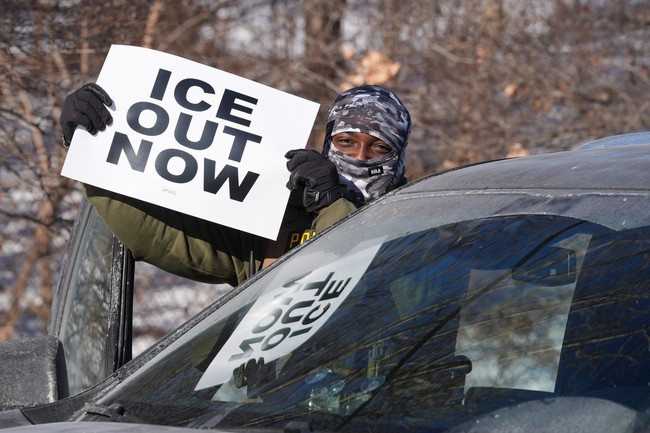
The Minneapolis teachers union president admitted that elected officials and union bosses are participating in encrypted Signal chats used by anti-ICE activists, raising questions about coordination between public servants and organized efforts to obstruct federal immigration enforcement.
Minneapolis has been a flashpoint for clashes between activists and federal agents, and the revelation that public figures are in the same Signal groups as protesters changes the discussion from rumor to reality. This is not about abstract protest; it is about elected officials and union leaders trading messages in private channels tied to disruptive street operations. That level of involvement demands straightforward answers from those officials and a clear look at how public resources and influence may be used to hinder law enforcement.
Marcia Howard, who leads the Teacher Chapter of the Minneapolis Federation of Educators, spoke plainly in an interview when she said, “The notion that people that are actively engaged in ICE watch, in being vigilant in protecting our neighbors, in Signal chat groups, running plates, in their cars doing patrols — that somehow we’re ashamed of that activity, that somehow you can call our bosses and show our faces and then we would be shunned by our community…” The quote places teachers and organizers in direct operational roles rather than mere observers at protests. That matters because teachers work in schools and are trusted by families; their participation in direct action blurs the line between civic engagement and institutional influence.
Howard’s other blunt line must also be noted exactly: “Our bosses are in the Signal chats with us,” she said. “Our elected officials are in the chats with us.” If elected officials are in the same encrypted groups as activists who are monitoring federal agents and sharing vehicle plates, voters deserve to know whether those officials used their office to support, shield, or facilitate those activities. Transparency is the minimum standard for public servants, and being part of clandestine chats tied to interference with federal operations falls far short of that.
The admitted overlap of activists and officials on Signal suggests coordination that goes beyond public protest. When educators and city leaders are involved in organizing patrols or monitoring agents, the activity shifts from peaceful assembly to a form of tactical opposition against federally authorized law enforcement. That raises legal and ethical questions, especially when children and schools are part of the environment surrounding these actions.
Howard also described teachers as being “armed with whistles and our phones making sure that students are safe going to class,” and she framed confrontations with federal agents as escalating matters that targeted a sympathetic immigrant workforce. The rest of her comments recounting taunts and descriptions of federal agents in hotels sketch a narrative that portrays federal intervention as heavy-handed. Even so, the central issue remains the same: union leaders are not merely commenting on events; they are active participants in networks that monitor federal activity.
Activism has a place in a free society, and people are free to protest federal policies they oppose. But when public employees and elected officials participate in coordinated efforts that effectively hinder federal law enforcement, the balance tilts toward obstruction. People who hold authority within schools or city government have responsibilities to the public they serve, and those responsibilities should preclude covert involvement in actions that put others at risk.
There are practical implications to consider as well. If teachers are using their positions or schedules to support street operations, parents and school boards have a right to raise concerns about priorities and judgment. Likewise, if elected officials are leveraging influence to shelter activists from federal enforcement, that conflicts with the oath many of those officials take to uphold the law. Citizens should demand clarity about where the line is drawn between lawful protest and enabling illegal interference.
The story also touches on a broader pattern some observers see in parts of the country: activists and sympathetic officials working in tandem through encrypted platforms to coordinate real-world actions. Whether those actions are framed as defense of vulnerable neighbors or as direct resistance to federal authority, the consequence can be the same—chaos on streets and questions about accountability. For voters who value law and order, this revelation is a prompt to hold leaders to account for where they stand in practice, not just in rhetoric.
At stake is public trust. When people chosen to lead communities operate inside secret channels with activists opposing federal law enforcement, it undermines the expectation of impartial governance. Elected leaders and union heads must be asked to explain the nature of their participation, to state whether public resources or authority were used, and to accept the scrutiny that comes with their roles in any organized effort that tangles with federal agents.


Add comment