
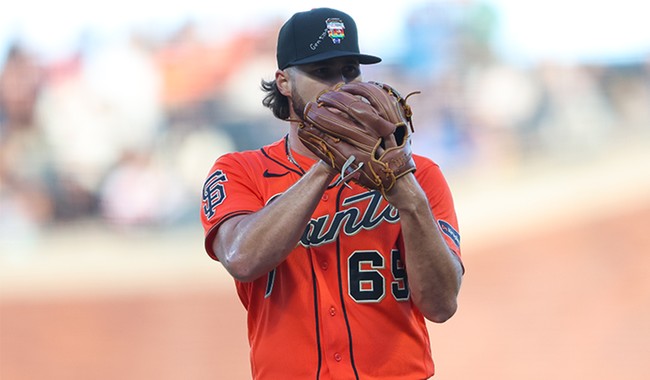
The MLB warning to three San Francisco Giants pitchers for writing Bible verses on Pride Night caps has reignited a debate about religious expression in sports and whether the league applies rules evenly when it comes to personal messages on uniforms.
Major League Baseball told three Giants pitchers that writing Bible verses on Pride Night caps violated uniform rules and warned them about future violations. The league’s statement said, “The writing on the cap violates our rules, and consistent with normal practice, we have warned the players about future violations.” That explicit warning sets a tone: the league will tolerate certain messages but not others.
This feels less like neutral rule enforcement and more like selective censorship. Players have a long history of personalizing equipment to honor people, causes, or beliefs, from patch tributes to initials and numbers worn after the deaths of beloved players. When those expressions align with league-approved events or popular culture, MLB looks the other way or even promotes the customizations.
For decades, players have altered caps and uniforms in ways that become accepted parts of the game’s culture. The Pittsburgh Pirates wore a “21” patch to honor Roberto Clemente, and after Kirby Puckett’s death players wrote KP or 34 on their caps. Players’ Weekend encourages nicknames and colorful details. Those examples show the league can be flexible when it wants to be.
Yet when players wrote Bible verses that link the rainbow to Genesis, MLB moved quickly to warn them. The verses referenced God’s covenant with Noah, his descendants, and every living creature, a clear statement of faith rooted in scripture. The swift reaction raises questions about why a message tied to religious belief would be singled out while other personalized or political messages are permitted.
Critics see a double standard. Clayton Kershaw reportedly added the same Bible verse, Genesis 9:12-16, to his hat last season without consequence, which fuels a narrative of unequal treatment based on profile. If enforcement comes down to who you are rather than what you write, that’s troubling for players who want to publicly practice their faith on the field.
The context matters: Pride Night hats are themselves an alteration of the standard uniform, promoted by teams and the league as part of a marketing and community engagement strategy. If MLB insists on strict uniformity, it would logically have to remove rainbow patches and similar event-driven changes. That outcome is unlikely because those events generate revenue and public relations benefits.
For many conservative observers, this episode is a cultural flashpoint. It’s not simply about caps. It’s about whether baseball, long an American institution, will treat religious expression the same as other forms of personal expression. When a league embraces some messages and discourages others, it sends a message about whose views are acceptable in public spaces tied to national pastimes.
There are practical questions too: what is the threshold for violating the rulebook? Rule 3.03 and similar provisions allow the league to remove non-conforming players from play, which is an extreme step. The prospect of fines or barring players for handwritten verses escalates the stakes and could chill open expression in the clubhouse and on the field.
https://x.com/TheAthletic/status/2066683262924476840
Players who hold traditional religious beliefs should not be forced into silence while other groups freely display messaging that the league endorses or promotes. The choice to warn players for Bible verses but readily permit Pride Night alterations looks less like neutral governance and more like ideological preference. That perception undermines trust between the league and its conservative players and fans.
The hard fact remains: baseball has always been more than a game; it’s a cultural arena where Americans express values. If MLB wants to be an honest arbiter of uniform policy, it needs to apply rules evenly and transparently, not selectively enforce them in ways that appear to punish religious speech. Until then, this incident will be another example cited by those who believe big institutions favor certain viewpoints over others.
There is precedent for players speaking out when league choices clash with personal convictions. Some veterans have criticized past league decisions that mocked religion, and those voices matter in a sport that relies on tradition and community. When enforcement feels politically motivated, players and fans will push back hard, and that pushback will shape the conversation around faith and free expression in sports.


Add comment