
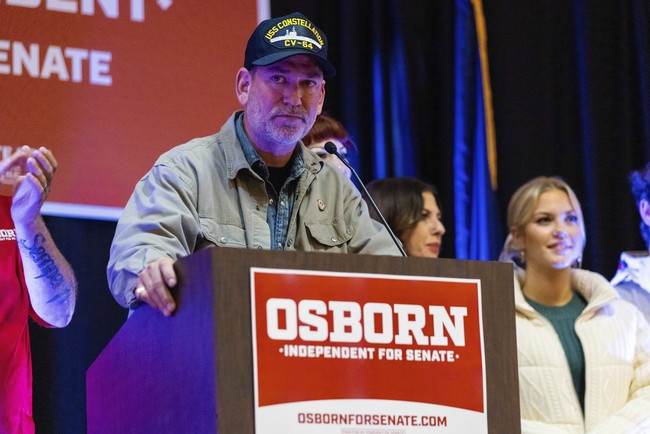
This article examines an undercover video that alleges Nebraska Democrats engineered support for “independent” candidate Dan Osborn to unseat Republican Sen. Pete Ricketts, showing party operatives describing a plan to present Osborn as nonpartisan while channeling Democratic resources his way.
The new footage, shared with conservative outlets, portrays a scheme where Democrats deliberately avoided running a standard party candidate so Osborn could face Ricketts without a clear Democratic label splitting the vote. Sources in the tape describe tactical moves intended to consolidate anti-Ricketts votes behind a candidate presented as independent. For Republican voters, the implications are straightforward: a manufactured independent candidacy can mask partisan goals and change the dynamics of the race.
In the video, a candidate identified as Caitlin Knutson lays out a plan that sounds like careful vote engineering rather than grassroots choice. She explains that Democrats initially did not intend to field their own candidate and instead aimed to let Osborn become the primary challenger. The rationale was that having Osborn alone in the general election would avoid siphoning votes with a third-party entry.
Republicans reading the tape will note how tactical maneuvers can be dressed up as independence while significant support flows from partisan channels. Knutson says, “Then the general election, it will be Osborn versus Ricketts so there won’t be votes pulled away by a third [candidate].” Taken at face value, that admission describes a deliberate plan to shape the ballot for partisan advantage.
Other clips captured Knutson telling an associate plainly that Dan Osborn “is a Democrat.” That exact phrasing cuts through any fog of plausible deniability and makes it clearer why conservative voters reacted strongly. When a candidate presented as independent is, according to footage, a Democratic operative in all but name, voters deserve to be told the truth before they make their choice in November.
The tape also revisits prior allegations that Osborn helped recruit an outside candidate in Maine, a claim raised by a member of his campaign staff caught on camera boasting, “This is not really out there publicly, but he recruited Graham Platner.” That earlier episode, combined with the new Nebraska footage, paints a pattern of cross-state tactical activity that benefits one party’s strategic goals.
Financial patterns back up the concern that Osborn’s campaign is being amplified by left-leaning networks. Multiple reports have pointed to contributions from progressive fundraising systems and PACs with known Democratic ties, creating a funding picture that aligns with the on-the-record admissions in the video. For voters skeptical of party gamesmanship, money following a candidate can be as revealing as what people say on tape.
Nebraska is not a toss-up every cycle, and national Democrats view any opportunity to flip a seat as vital to their Senate strategy. If what the video shows is accurate, it would be a textbook example of strategic seat targeting: present a candidate as independent, concentrate opposition to the incumbent, and deploy outside dollars to amplify reach. That combination is a threat to transparent elections and to voters who expect to know where candidates truly stand.
The broader lesson from the footage is about trust and transparency in campaigns. Voters have a right to know whether a candidate claiming independence will actually caucus and vote with one party. The tape’s blunt admissions make it harder to accept vague claims of nonpartisanship at face value, especially when political actors discuss stepping aside or manipulating primary fields to create a favorable general election matchup.
Republican voters concerned about preserving their Senate majority will see this episode as confirmation that Democrats are willing to use unconventional tactics to flip seats. When operatives describe the plan plainly on camera, that does not look like ordinary campaigning; it looks like running a shadow play with voters as the unwitting audience. The stakes in Nebraska are real for national control of the Senate, and this kind of activity raises legitimate questions about fairness and disclosure.
The taped statements demand scrutiny from journalists, election officials, and voters alike, because the integrity of a race depends on honest presentation of who candidates are and who supports them. If party operatives are engineering independent labels while moving money and influence behind the scenes, that undermines the voters’ ability to make an informed choice. The coming months should reveal whether the strategy succeeds and how voters respond once the full context is clear.


Add comment