
The piece examines a public clash between President Donald Trump and Pope Leo XIV over Iran and foreign policy, showing how a brief dispute escalated into a sustained, personal attack on the pope’s judgment, neutrality, and political role. It traces Trump’s Truth Social posts and remarks to reporters, the pope’s responses, reactions within the Vatican, and the wider implications for presidential conduct and religious leadership. The account preserves key quotes and includes original embeds for context. The conflict raises questions about presidential norms, the proper role of a pope in public debates, and how quickly foreign policy disputes can become personal fights.
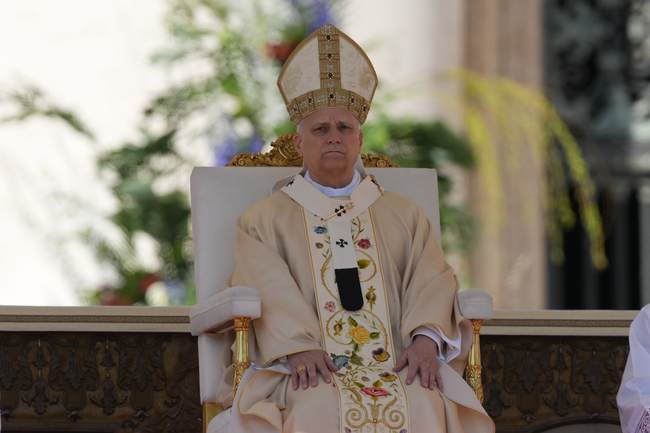
President Donald Trump used Truth Social to launch a broadside at Pope Leo XIV, turning a disagreement over Iran into a full-scale critique of the pope’s credentials and motives. Trump accused the pope of hypocrisy and partisan behavior, arguing that his background and alliances undermine any claim to moral neutrality. This was framed not as ordinary disagreement but as an assault on legitimacy, a step no modern president has taken with a pontiff.
Trump’s message was blunt and personal, dismissing the pope’s selection and questioning his impartiality. “He was a shocking surprise. He wasn’t on any list to be Pope, and was only put there by the Church because he was an American.” The tone moved quickly from policy to personality, signaling that Trump intended to make the pope a political target, not merely an interlocutor in a foreign policy debate.
The president also moved to define the pope on matters of law and order, using stark language that framed spiritual leadership as a failing on crime and foreign affairs. “Pope Leo is WEAK on Crime, and terrible for Foreign Policy,” Trump wrote. “He talks about ‘fear’ of the Trump Administration, but doesn’t mention the FEAR that the Catholic Church … had during COVID…”
Trump broadened his complaints to include pandemic-era church restrictions and historic U.S. stances toward countries like Venezuela, saying such episodes reveal a tilt in the pope’s views. He pointed to meetings and contacts that, in his view, cross into partisan territory and thus weaken the pope’s standing as a neutral spiritual authority. For Trump, those contacts matter because they show alignment with political actors he opposes.
The president did not shy away from red lines on strategic issues, making clear his view on deterrence and national security. “I don’t want a Pope who thinks it’s OK for Iran to have a Nuclear Weapon,” Trump wrote. That blunt assertion ties the domestic critique to a concrete foreign policy objection: a pope’s moral voice should not undercut strong defense postures or deterrence strategies.
The pope responded without retreat, reiterating his priorities and rejecting intimidation as a reason to be silent. Speaking to reporters en route to Africa, he said, “I have no fear of the Trump administration,” and added that he would “speak loudly of the message of the Gospel.” That answer framed his stance as a moral one, grounded in spiritual duty rather than political calculation.
The Vatican quickly pushed back on the notion that the pope had been improperly political, emphasizing respect and dialogue and asserting the pope’s role as a religious leader rather than a partisan actor. Church leaders defended the pope’s right to speak on war and human dignity, arguing those are inherently spiritual concerns. This response shows the Vatican intent on preserving its moral voice, even when it conflicts with an American president’s strategic aims.
Trump escalated the confrontation further, claiming credit and challenging the pope’s behavior in public. “If I wasn’t in the White House, Leo wouldn’t be in the Vatican,” he wrote, then urged the pope to “use Common Sense, stop catering to the Radical Left, and focus on being a Great Pope, not a Politician.” The rhetoric makes clear Trump’s aim: to force a binary choice between spiritual leadership and perceived political sympathies.
The episode is notable less for the policy differences and more for the breakdown of norms between the presidency and a major religious institution. Trump’s approach underscores a willingness to confront anyone he sees as opposing his foreign policy, while the pope’s stance underscores a determination to speak on faith-based principles even when they clash with national security arguments. The clash leaves unresolved questions about how political leaders and religious authorities should interact in moments of international crisis.


This is not a Good Pope and he is off the rails already! He knows full well what is going on and what Iran’s leadership is and represents!
Action should have been taken decades ago instead of emboldening the Fanatical Ayatollah Regime with promises of future nuclear warheads for their use any which way they decide! It was totally insane to ever trust that Islamist false religion nation in any way shape of form being that their theocracy is fully based on the False Prophet Warlord Muhammad which as a proven fact states the entire human race must convert to Islam or be killed! You never even attempt to bargain or play with a cobra snake and this is a million times worse to even allow such a madman nation to have nuclear weapons capability; they would assuredly use them on any country they had the chance to!
They have weapons grade hate and evil in their blood or DNA as they follow Satan!
Very bad and extremely dangerous what game this Pope is playing! I say at this rate the appearance of the Antichrist can’t be far off!