
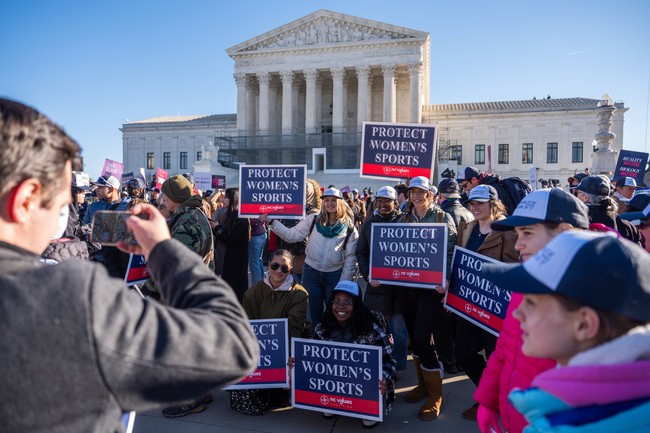
The Supreme Court delivered a day of decisions that conservatives are calling major wins: a ruling that limits on coordinated party spending violated the First Amendment, a Title IX decision protecting female sports, and a contentious birthright citizenship outcome that has many on the right upset. President Trump celebrated the two favorable rulings on social media, framing them as victories for fair play and free speech. These rulings will shape politics and athletics ahead of the midterms and spark fresh debates about constitutional limits and state authority.
Tuesday’s decisions landed like a political jolt, with the court’s conservative majority producing clear outcomes on two hot-button issues. The Title IX ruling affirmed that states can bar biological males from competing on girls’ and women’s teams, a move many conservatives view as a restoration of fairness in women’s sports. The coordinated-spending decision struck down federal caps that restricted party committees from spending with candidates, which Republicans say protects political speech.
President Trump emphasized the win on women’s sports in a forceful post, highlighting the court’s rejection of men playing in female competitions. The exact language he used was preserved and widely circulated:
BIG WIN: The United States Supreme Court just RULED AGAINST MEN PLAYING IN WOMEN’S SPORTS. Wow! That takes that ridiculous situation off the table!!! President DONALD J. TRUMP
https://x.com/RapidResponse47/status/2071969062150619282
The Title IX opinion makes clear the conservative majority sees state bans as constitutionally permissible and not in conflict with the federal nondiscrimination statute. The court’s six-justice majority concluded those state rules do not violate the Constitution and that the bans do not violate Title IX. Many on the right welcome this as a common-sense decision that protects opportunities for biological women who compete in school athletics.
Across the plaza of issues, the coordinated-party spending decision was likewise hailed by conservatives as a First Amendment victory. The court found that prior federal limits on coordinated spending between parties and candidates violated free speech protections. That ruling was written by a conservative justice and drew dissents from the court’s more liberal members, who warned about the risks of wealthy donors circumventing contribution limits.
Commentary from conservative analysts argues the spending decision could re-energize GOP campaign efforts ahead of the midterms by allowing parties greater flexibility. Critics fear this will further amplify money in politics, but supporters counter that political speech and association deserve strong constitutional protection. The outcome hands a tactical advantage to the party already positioned to benefit from increased independent and party-directed spending.
The day was not without controversy: the court’s handling of birthright citizenship left many conservatives frustrated and vocal. Some justices issued sharp dissents, and the disagreement underscores ongoing tension over the scope of constitutional interpretation and the proper role of the judiciary. Republicans who favor stricter immigration policy see this ruling as a setback but insist the other victories deserve full recognition.
Observers noted the political backdrop: these rulings come as the nation approaches competitive midterm elections and as state lawmakers continue to push policies aimed at protecting women’s sports. Conservatives argue that the court’s decisions reflect a return to constitutional text and to rules that respect biological distinctions. That message plays well with a base that has pressed these issues for years and wants results.
Public reaction split along predictable lines, with activists and liberal groups decrying the sports ruling as exclusionary and civil libertarians warning about the spending decision’s implications. Still, Republican leaders framed the day as corrective, portraying the rulings as common-sense outcomes that restore order to institutions and political norms. The tenor from the right was celebratory: wins should be acknowledged and used to build momentum.
The legal landscape after these opinions will be busy: lower courts, state officials, and party committees will now interpret and act on the guidance the Supreme Court provided. States that enacted bans on biological males competing in female sports will feel emboldened to enforce those policies, while political committees will reassess how they coordinate with candidates. Both areas promise follow-on litigation and policy battles as Americans gauge the practical effects.
For conservatives who have long argued for clear sex-based protections in athletics and robust First Amendment safeguards in political activity, the rulings are tangible proof that the judiciary can move policy in directions they favor. The victories do not erase frustration over other decisions from the same day, but they do deliver concrete changes that party leaders and state policymakers can now leverage. The coming months will show how those changes play out on the field and on the campaign trail.
“The Supreme Court on Tuesday issued a decision to uphold state laws barring transgender girls and women from playing on school athletic teams. The court’s six-justice conservative majority ruled that the state bans in Idaho and West Virginia do not violate the Constitution. The court also unanimously agreed that the bans do not violate Title IX, the federal law that prohibits sex discrimination in education.”


Add comment