
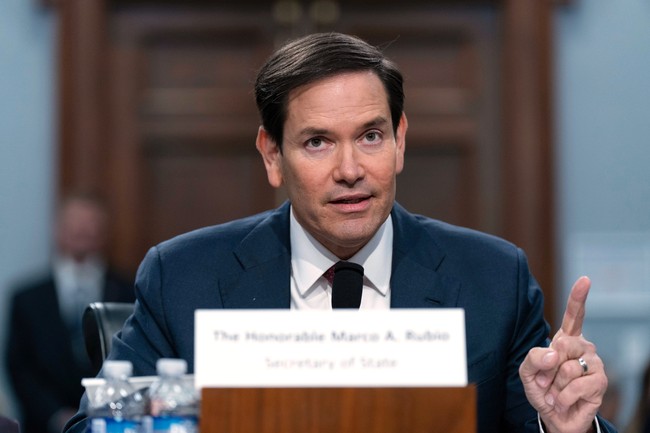
The Trump administration’s trip to China has sparked attention for its team composition, diplomatic maneuvers, and a viral Marco Rubio image that wrapped several threads together in a single moment.
The delegation traveling with President Donald Trump includes business and policy heavyweights assembled to advance U.S. interests on trade and global security. Names on the roster read like a who’s who of technology and finance, brought along to press trade advantages and discuss complex geopolitical issues. This is a purposeful mix of statesmanship and commercial muscle aimed at reshaping how America deals with rivals on the world stage.
Marco Rubio’s presence in Beijing drew particular notice because his history of confronting Chinese human rights abuses once led to sanctions that, by past accounts, included an entry ban. That background made his appearance with the president both surprising and symbolic, suggesting a pragmatic reset at the diplomatic level. Observers pointed out that Beijing chose not to enforce prior restrictions, which in itself sends a message about how negotiations and strategic interests can alter old stances.
Shortly before he took office in January 2025, the Chinese government and official media began using a different Chinese character for “lu” to represent the first syllable in his surname.
Two diplomats told the AFP news agency they believed that China made the change because Rubio was under sanctions, which included an entry ban, under the old spelling of his name.
China said Tuesday it would not block Rubio for his past actions.
“The sanctions target Mr Rubio’s words and deeds when he served as a US senator concerning China,” the Chinese embassy spokesperson, Liu Pengyu said.
Asked about the linguistic change last year, China’s foreign ministry spokesperson Mao Ning said that she “had not noticed it but would look into it”, according to Chinese state media. Mao said that Rubio’s English name was more important.
The optics matter. Letting a senior U.S. official who once criticized Beijing enter the country without public resistance looks like a concession to the administration’s diplomatic approach. It also shows how influence and engagement can open doors that rhetoric alone cannot. For conservatives watching this play out, it read as proof that strong, assertive diplomacy paired with American economic leverage can produce tangible results.
Social media seized on Rubio’s role too, turning a photograph of him on Air Force One into a viral moment that mixed policy symbolism with pop culture. The picture, shared by a White House communications official, harked back to other international incidents and uniforms, which gave the image layered meaning. People reacted with a mix of humor and approval, treating the shot as a political mic drop rather than a casual portrait.
Journalists and commentators then framed the scene as a full circle moment for Rubio, especially after Fox’s John Roberts called it, “What a turnaround!” The administration itself highlighted Rubio’s memorable line, referencing the senator’s blunt “find out” response in another context to underscore the narrative. That sequence—from past sanctions to viral image to official nod—made for sharp, repeatable messaging in the news cycle.
Beyond memes, the trip connects to broader strategic aims. Officials said the delegation would address issues including Iran, trade imbalances, and technology competition, and having corporate leaders on hand signals the administration’s intent to tie national security to industrial strength. This blend of policy and private sector clout is designed to protect American jobs while confronting unfair practices abroad.
The viral Rubio picture became shorthand for the trip’s tone: confident, coordinated, and unapologetic. It underscored how symbolism matters in diplomacy and how a single image can crystallize a message for both domestic and international audiences. For supporters, it reinforced the view that the administration is restoring American standing and getting results where softer strategies failed.
Political theater aside, the presence of a high-powered delegation in Beijing showed a willingness to engage directly on hard issues while also leveraging America’s economic and technological advantages. That combination aims to shift leverage back in Washington’s favor. As the visit continues to be parsed, the image of Rubio on Air Force One will likely stand as a memorable piece of the story.
Rubio’s role on this trip serves multiple purposes: he is a visible policy voice, a symbolic figure who has pushed back on abuses, and now part of a team using American strength to reset relationships. The interplay of message, image, and negotiation in Beijing will be dissected for days, but the administration has already scored a narrative point by turning past friction into present access. That pragmatic approach—mixing firmness with engagement—was on full display throughout the delegation’s arrival and early meetings.
Add comment