
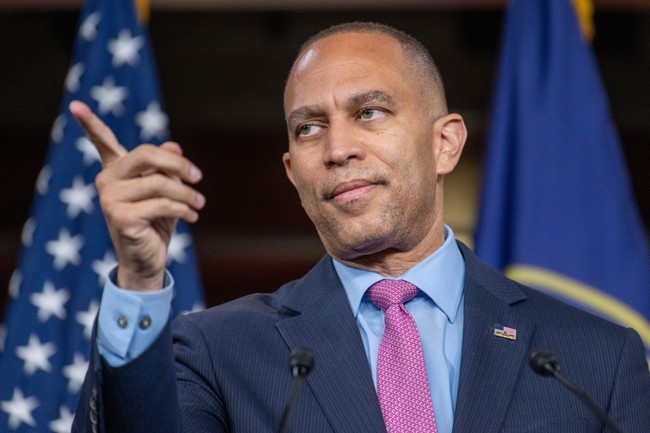
House Democratic Leader Hakeem Jeffries appears to be derailing a bipartisan effort to ban congressional stock trading by introducing a competing measure that adds the president and vice president, a move that effectively guarantees neither discharge petition will reach the majority needed for a floor vote and leaves the reform stalled.
Hakeem Jeffries is using a familiar political move to block progress on a popular ethics reform, and the result is gridlock dressed up as action. Instead of uniting behind the bipartisan discharge petition that would force a vote, Democrats filed an alternate petition that includes the president and vice president, a change that makes bipartisan support impossible.
Last week, I reported on concerns that House Democratic Leader Hakeem Jeffries (D-NY) was discouraging support for a bipartisan discharge petition to finally advance the exceedingly popular policy of ending congressional stock trading. Discharge petitions signed by a majority of House members get a guaranteed floor vote. The speculation was that Jeffries would rather keep the concept of a trading ban alive for campaigning (and maybe protect Democrats who want to keep trading) than take advantage of the ongoing rebellion against House Speaker Mike Johnson (R-LA) to make tangible progress.
I would say this is wholly confirmed now.
The tactic mirrors what Nancy Pelosi once did, and critics say it was intended to blow up a bipartisan negotiation rather than solve the problem. By broadening the ban to include the president and vice president, the Democratic petition becomes politically toxic to Republicans who might otherwise have supported ending members’ stock trading. That leaves both petitions short of the majority and the whole effort dead in the water.
The new proposal differs from the bipartisan bill in one key respect: It extends the stock trading ban to President Donald Trump and Vice President JD Vance. Regardless of the considerable merits of that idea, the reality is that no Republican will ever sign on to that, meaning that both competing discharge petitions will fail to obtain a majority.
“This is exactly what Pelosi did a few years ago,” said Dylan Hedtler-Gaudette of the Project on Government Oversight, referring to the former House Speaker’s endorsement of a trading ban in 2022 that extended to the Supreme Court, also blowing up a bipartisan negotiation. “This is not only an unserious effort, it’s an attempt to undermine and kill off the only bipartisan legislative vehicle that is gaining momentum. It’s really bad faith all around.”
Let’s be blunt: if the goal is to end self-dealing and special-access profiteering, then the House should pass a ban that members can actually support. Adding the White House to the list might sound principled, but it turns a winnable reform into a symbolic gesture. The politics are obvious: make the package unacceptable to the other side and claim you tried when the vote fails.
Members of Congress becoming wealthier through inside knowledge and privileged access is a real scandal, and voters are fed up. The principle of treating a public office as a path to private gain should offend everyone regardless of party. Ending those opportunities would be a clear, popular reform that confers political benefits to whoever delivers it.
Republicans say they will try again when the House is back in order next January, and they should. This is not a complicated policy question so much as a question of will. If leaders are serious about cleaning up corruption, they should back the bipartisan route that forces a vote and stops the charade.
Meanwhile, the procedural games expose the gap between rhetoric and action in Washington. Using procedural cover to avoid uncomfortable votes while keeping the issue alive for fundraising and campaign talking points is a cynical play. Voters deserve results, not maneuvering that looks like reform but amounts to stalling.
Jeffries’ move also undercuts momentum that could have used the current dynamics to secure meaningful change, and it hands Democrats an easy excuse when nothing happens. If the goal is to protect the integrity of the institution, leaders should prioritize legislation with real chances of passage over grandstanding that guarantees inaction.



How such a slimy snake devil can be in our US Government is a testament to how nefarious satanic minions like Soros have been corrupting for decades with one goal in mind which is to destroy our Constitutional Republic! This clown act is already assigned a permanent deep place in hell!