
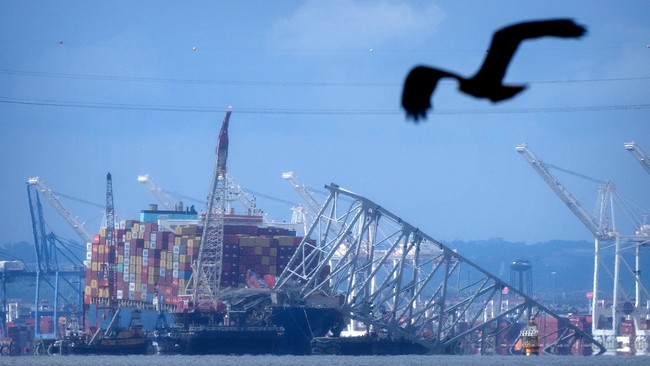
The Justice Department has charged two companies and a shoreside technical superintendent in connection with the March 26, 2024, Francis Scott Key Bridge collapse in Baltimore, accusing them of reckless decisions and concealment that led to power failures aboard the M/V Dali and the deaths of six construction workers.
The video of a powerless container ship striking the Key Bridge was seared into the public memory, and investigators treated the incident as preventable from the start. Federal prosecutors say the vessel suffered two power losses, with the second traced to a failure involving a flushing pump that should have restarted automatically. Authorities contend that the crew and associated firms concealed the true nature of those failures and ignored electrical problems that had been known. Now the Department of Justice has moved from investigation to indictment, putting corporate operators and an individual on the hook criminally.
At a press conference aboard a docked ship in Southeast Baltimore, US Attorney for the District of Maryland presented the charges and described the sequence that prosecutors say shows negligence and deliberate missteps. The first power loss was attributed to a loose wire in a high-voltage switchboard, but redundancies should have restored propulsion. The second power outage, prosecutors allege, occurred because a flushing pump used to deliver fuel to two generators did not restart automatically and required a manual intervention that never happened in time.
Foreign Operators and Technical Superintendent of M/V Dali Indicted for Roles in Key Bridge Crash
Indian and Singapore Corporations and Company Official Charged with Conspiring to Defraud the United States and Causing the Death of Six Construction Workers
“The collapse of the Francis Scott Key Bridge was a preventable tragedy of enormous consequence,” said Acting Attorney General @DAGToddBlanche. “This indictment is a critical step toward holding accountable those whose reckless disregard for maritime safety regulations caused this disaster. Six construction workers lost their lives, critical infrastructure was destroyed, pollutants were released into the Patapsco River and Chesapeake Bay, and the economic damage now exceeds five billion dollars. This Department is committed to securing justice for the victims and ensuring those responsible are held to account.”
Prosecutors have alleged that the ship’s operators not only failed to maintain systems properly but also misrepresented what happened after the blackout. Officials say crew members and company representatives lied about the flushing pump’s operation and willfully ignored electrical defects that should have been addressed. Those alleged falsehoods are central to the conspiracy and obstruction elements in the indictments, which aim to link reckless choices to catastrophic outcomes on the water and on the bridge.
Beyond the immediate human toll, the collapse wrecked a major artery spanning four lanes of Interstate 695, choked regional commerce, and set off a reconstruction effort of rare scale. The accident released pollutants into the Patapsco River and the Chesapeake Bay, and federal estimates put recovery and economic damage in the multi-billion dollar range. Officials say reconstruction is underway but will take years, with current projections extending into the end of the decade and costs rising with each delay and complication.
Criminal charges target two corporate entities and a shoreside technical superintendent, reflecting a prosecutorial view that accountability must reach beyond the watchstanders aboard the vessel. Federal authorities emphasized that maritime regulations exist to prevent exactly these kinds of disasters and that corporate and supervisory conduct that flouts them poses a systemic threat. The indictments are meant to send a message that ignoring safety practices and falsifying records can carry severe legal consequences when negligence produces loss of life and broad societal harm.
The justice effort also underscores the complex interplay between international shipping operations and domestic infrastructure resilience. A foreign-flagged cargo ship operating near a critical American bridge created a chain of failures that cascaded into a national crisis. Prosecutors have framed the case as one where technical failures and human decisions intersected, producing outcomes far beyond the ship and its crew, and now the legal system is stepping in to determine culpability and consequences.
Communities and families directly affected by the collapse continue to push for answers and accountability as reconstruction proceeds and investigations play out in court. Federal filings, witness accounts, and forensic engineering all form part of a larger record that will determine criminal liability and potential penalties. Meanwhile, the region copes with disrupted trade routes, altered traffic patterns, and the long, costly process of rebuilding a critical piece of infrastructure that once linked thousands of daily commuters and commerce flows.
In addition to criminal indictments, civil and regulatory reviews are likely to follow, seeking to recoup damages and tighten oversight where lapses occurred. The legal and policy fallout could prompt changes in maritime safety enforcement, shoreside oversight, and the procedures companies use to report and fix equipment failures. If convictions or settlements arise, they may also form the basis for broader reforms aimed at preventing another preventable disaster.
The events in Baltimore are a stark reminder that technical errors combined with poor decisions can lead to enormous human and economic costs. As this case moves through the courts, the focus will remain on whether those accused knowingly contributed to a preventable tragedy and how the justice system will allocate responsibility for the collapse and its aftermath.
The federal narrative stresses deterrence as much as punishment, arguing that strong enforcement will discourage willful ignorance of safety systems and false reporting. For victims’ families, public officials, and the community, the indictments offer a legal mechanism for accountability even as recovery and reconstruction continue. The coming months will reveal how prosecutors define criminal responsibility for complex industrial failures and what penalties follow when preventable mistakes become deadly.

Add comment