
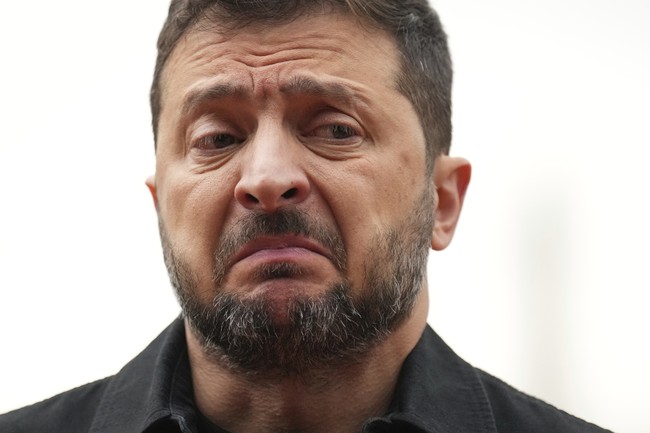
President Zelensky has floated a new peace plan that would create a demilitarized zone and a free economic zone in parts of the Donbas, asking both Ukraine and Russia to pull back forces; whether Vladimir Putin will accept any of it is an open question, and Republicans watching this want clarity on U.S. leadership and security guarantees as talks proceed.
Volodymyr Zelensky’s proposal lays a simple, politically risky offer on the table: remove troops from contested areas and convert parts of the Donbas into a demilitarized and economically distinct region. That sounds reasonable on paper, especially to civilians tired of fighting, but it raises immediate concerns about how to secure those zones and who enforces any withdrawal. Republicans insist that peace must not come at the cost of American strength or credibility in the region.
The Donbas remains a densely populated, strategically important area where loyalties and identities are mixed, including a substantial Russian-speaking population. Census data from 2001 showed heavy concentrations of ethnic Russians in Donetsk and Luhansk provinces, which complicates any territorial settlement. Republicans argue that demographic detail is not a carte blanche for territorial concessions; sovereignty and deterrence are still core national interests.
Ukrainian President Volodymyr Zelensky said he would be willing to pull troops out of the eastern region of Donetsk and create a demilitarized free economic zone as part of a potential peace deal, provided Russia took similar steps to withdraw from areas it controls.
Zelensky said the proposal and other aspects of a 20-point plan would be put to a referendum.
The territorial dispute across the Donbas, the eastern flank of Ukraine where some of the heaviest fighting is raging, is one of the chief sticking points in the latest version of a plan to end the conflict drafted with the U.S. Kyiv worries that surrendering fortified positions in the area could make it easier for Russia to stage further attacks. Several attempts have already been made to break the impasse, but to no avail.
Any deal that asks Ukraine to cede positions would need ironclad verification and credible guarantees against renewed aggression. Republicans take a skeptical view of Russian pledges given the Kremlin’s record of violating ceasefires and using tactical pauses to regroup and strike anew. A durability test for any proposal is whether it actually prevents future strikes, not just pauses them for a season.
Zelensky reportedly wants a referendum on the plan and expects alignment with the United States on certain elements, but his call for a leaders-level meeting reflects the sensitive nature of territorial questions. Republicans believe high-level diplomacy must be backed with strategic clarity: if the United States supports a plan, it should state upfront what security commitments will accompany that support. Vague promises leave allies exposed and embolden adversaries.
Zelensky said Kyiv is now mostly aligned with Washington on the plan, but that Ukraine says a meeting with President Trump is needed to iron out some of the elements. He said he was also ready to explain Ukraine’s position to the Russian side as well.
“We are ready for a meeting with the United States at the leaders’ level to address sensitive issues. Matters such as territorial questions must be discussed at the leaders’ level,” Zelensky said.
Russia wants Ukraine to withdraw from territories in the Donetsk region as part of a deal to end the war, but Kyiv previously said it has no moral right or constitutional leeway to give up Ukrainian territory. The U.S. is looking for a compromise in creating a “free economic zone” in the area.
The “free economic zone” idea is intended to reduce tensions by separating civilian commerce and reconstruction from military operations, but without clear enforcement mechanisms it could become a gray area that invites exploitation. Republicans warn that a zone with ambiguous sovereignty could be manipulated to provide a pretext for further Russian influence. Any economic incentives must come with monitoring, sanctions enforcement triggers, and a credible multinational presence to guard against coercion.
History suggests that concessions obtained under duress are often temporary. When a hostile actor gains territory without real accountability, the next step is rarely acceptance; it is consolidation and further pressure. Republicans stress that peace through strength is the only reliable path to durable settlements: deterrence backed by capability and resolve prevents aggression more effectively than optimistic pauses in fighting.
It’s reasonable to explore diplomatic pathways, especially when millions of civilians suffer, but Americans who support Ukraine also expect the United States to demand enforceable terms. Republicans view negotiation as a tool to secure a stable outcome, not as a first resort that accepts strategic losses. Any plan must preserve Ukraine’s sovereignty and ensure Russia cannot turn a demilitarized area into a staging ground for fresh offensives.
Observers should watch whether proposals include independent verification, timelines for withdrawals, and contingency measures if violations occur. Republicans will scrutinize U.S. alignment, wanting clarity on whether American backing means security guarantees, rapid sanctions, or military support if Moscow steps outside agreed parameters. Without those elements, a plan could simply paper over the problem.
Editor’s Note: Thanks to President Trump and his administration’s bold leadership, we are respected on the world stage, and our enemies are being put on notice.


Add comment