
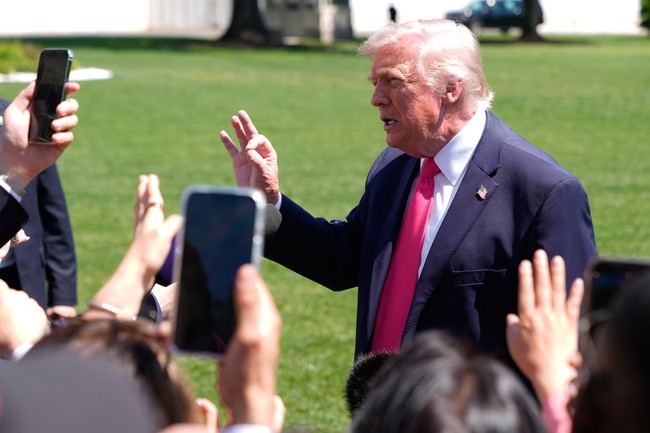
President Donald Trump, speaking briefly before boarding Air Force One en route to Nevada and Arizona, said Iran has agreed to give up enriched uranium and to forswear nuclear weapons, calling the commitment “very powerful.” The announcement followed last week’s peace talks in Islamabad where U.S. negotiators had walked away after Iran resisted some U.S. demands, and it came amid conflicting reports that Tehran would not abandon enrichment. Several verbatim quotes from Trump and from Vice President JD Vance were given during the exchanges, and two embeds accompany the report for direct reference to the remarks.
On the tarmac the president framed the development as the biggest breakthrough of the day, noting the strategic context and recent military actions that, he said, shaped the leverage behind any agreement. He emphasized that Iran “does not have a nuclear weapon and they’ve agreed to that,” and described the return of material he called “nuclear dust” removed after strikes involving B-2 bombers. The tone of the announcement was confident and succinct, aimed at signaling a concrete shift after difficult diplomacy.
Trump said:
Very important is that Iran does not have a nuclear weapon and they’ve agreed to that. Iran’s agreed to that, and they’ve agreed to it very powerfully. They’ve agreed to give us back the nuclear dust, which is way underground because of the attack we made with the B-2 bombers. So, we have a lot of agreement with Iran, and I think something’s going to happen very positively.
WATCH:
Last week’s talks in Islamabad had been tense, and Vice President JD Vance later described what had stalled the negotiations: Tehran would not commit to halting uranium enrichment or abandoning nuclear ambitions. U.S. team members, including Jared Kushner and Special Envoy Steve Witkoff, ultimately walked away after being unable to get Iran to accept U.S. terms. That public disappointment made Thursday’s tarmac claim feel abrupt and raised questions about what, precisely, had changed.
Vance said:
But again, we just could not get to a situation where the Iranians were willing to accept our terms. I think that we were quite flexible. We were quite accommodating. The President told us, “You need to come here in good faith and make your best effort to get a deal.” We did that, and unfortunately, we weren’t able to make any headway.
Only days earlier, reporting from other outlets relayed a senior Iranian official’s remark that Tehran would not agree to completely forgo enriching uranium under any theoretical deal. That account described the official speaking on background as mediators worked to revive talks, and it underscored how far apart the sides appeared to be when negotiators left Islamabad. The juxtaposition of that reporting and Thursday’s statement from the president created immediate demand for clarity from both governments.
A reporter pressed the president on an apparent timeline question from the failed negotiations, asking whether there was a 20-year minimum for stopping enrichment. Trump pushed back on the premise of a fixed limit, telling reporters that there was no such 20-year cutoff in the understanding he described. He reiterated that what mattered, in his view, was Iran’s agreement not to possess nuclear weapons beyond any set term.
Trump responded, “We haven’t agreed to any, we haven’t agreed to any…. What we have is, we have a statement, a very powerful statement, that they will not have — beyond 20 years — that they will not have nuclear weapons. That’s beyond, there’s no 20-year limit.”
WATCH:
Beyond the president’s on-the-spot remarks, official details remain scarce and the claim has not been supported by independent confirmations from other governments or international inspectors. Diplomacy with Tehran has a long history of last-minute shifts, competing narratives, and strategic ambiguity, which makes outside verification a crucial next step. Observers will be watching for formal documentation, follow-up statements from negotiating partners, and any inspections or inspections arrangements tied to a genuine removal of enriched material.
The announcement also interacts with an ongoing military and intelligence posture termed Operation Epic Fury, which has been mentioned in broader discussions about pressure on Iran. Analysts will want to know how any diplomatic understanding aligns with military activity and whether such actions are intended to compel compliance or simply to shape bargaining power. For now, the story is in flux and will likely produce additional statements from Washington and regional capitals as it develops.
Readers should note that the president’s remarks were delivered off the cuff during an impromptu press scrum, and that formal confirmations normally follow in diplomatic channels. As the situation evolves, officials will need to lay out the terms, timelines, verification measures, and the role of international monitors if Iran’s commitment is to be credible and lasting. The details will determine whether Thursday’s claim represents a durable shift or another chapter in a long, fraught negotiation process.


Add comment