
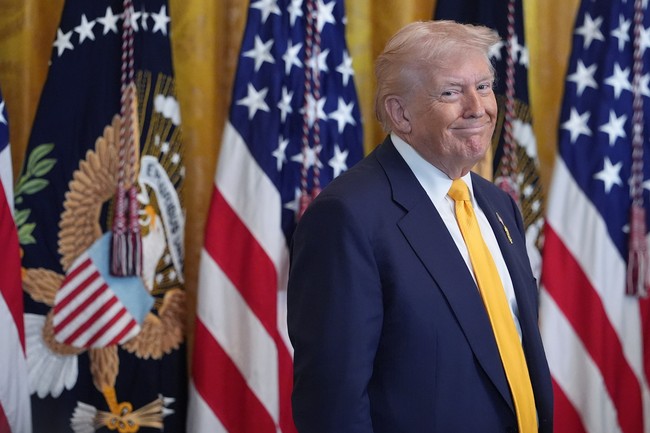
President Donald Trump and Japanese Prime Minister Sanae Takaichi shared a high-energy White House visit that mixed warm personal moments, symbolic gifts, and big economic and security commitments — from 250 cherry trees to multibillion-dollar investments in U.S. energy projects — all framed as wins for American workers and national strength.
The tone of the meetings felt upbeat and personal, with Takaichi openly embracing the president and leaning into camaraderie rather than stiff formality. That warmth translated into concrete cooperation on regional security, including the allies’ statement addressing tensions in the Strait of Hormuz. Those diplomatic touches matter because they build trust when it comes time to deliver deals.
She handed over 250 cherry trees to mark the U.S. 250th birthday, a gesture that ties modern diplomacy to long-standing cultural exchange. The cherry trees that Japan has gifted to Washington are famous for a reason, and this renewal of that tradition sends a friendly message. Small symbolic moves like this smooth the way for tougher, larger negotiations.
Takaichi even called the relationship “best buddies,” a line that captured the mood and made for an easy headline. That phrase says more than a handshake; it signals a partnership focused on making both countries strong and prosperous. It also meant an enthusiastic hug at the start of the day, the sort of moment that underlines both camaraderie and mutual respect.
On the security front, the two leaders discussed the Strait of Hormuz and joined a broader allied statement aimed at reducing risks to global trade and energy flows. American leadership matters here, and allies responding to U.S. pressure shows influence turning into results. The effort to coordinate allies on a confined strategic point is exactly the sort of targeted diplomacy that protects American interests.
There was a lighter moment that quickly became fodder for social media: Takaichi’s reaction to a photo of Joe Biden on a White House wall. The response drew laughs and instant memes, the kind of spontaneous human reaction that plays well in the public square. You could tell President Trump appreciated the moment and the optics it delivered.
Beyond the smiles, the visit produced major economic announcements that favor American industry and jobs. Japan pledged to invest $73 billion in U.S. next-generation nuclear reactor and gas-fired power plant projects, a headline number that moves the needle. Those investments target energy infrastructure across multiple states and will lead to plenty of work for American companies and workers.
Japan pledged to invest $73 billion in American next-generation nuclear reactor and gas-fired power plant projects Thursday after Prime Minister Sanae Takaichi’s White House meeting with President Trump.
The investment marks the start of the second phase of Japan’s $550 billion spending commitment on American projects, which Trump secured through a massive trade agreement last summer after threatening the US ally with 25% tariffs.
The latest batch of investment will see Japan spend $40 billion on the construction of small modular reactors (SMRs) by GE Vernova Hitachi in Tennessee and Alabama; $17 billion on natural gas generation facilities in Pennsylvania; and $16 billion on natural gas generation facilities in Texas.
That breakdown matters: $40 billion aimed at small modular reactors in Tennessee and Alabama, $17 billion for gas generation in Pennsylvania, and $16 billion for gas projects in Texas. These are specific, shovel-ready commitments that boost energy independence while creating middle-class jobs. The investments also follow earlier promises tied to a sweeping trade framework.
Japan had previously announced $36 billion in commitments that included a natural gas plant in Ohio, a crude oil export facility along the U.S. Gulf Coast, and a synthetic diamond manufacturing site in Georgia. Layering new commitments on top of that old batch shows momentum and follow-through, not just talk. For working Americans, that means more projects, more payrolls, and more tax revenue flowing back home.
President Trump highlighted the terms of the larger package, saying the U.S. would receive 90 percent of the profits from the $550 billion agreement. Framing the deal as heavily tilted toward American benefit is a central Republican argument for tough, results-oriented trade deals. The important thing is that these arrangements lead to jobs and strengthen U.S. industry.
Energy independence and security are tightly linked, and these investments serve both goals. Building SMRs and modern gas facilities at home reduces reliance on foreign energy sources and hardens supply chains. At the same time, the projects animate domestic manufacturing and construction sectors, sectors where American workers see real, immediate impact.
Critics in the liberal media may downplay or ignore these concrete results, preferring to dwell on style or sound bites instead of outcomes. But the record will show projects launched, contracts signed, and factories upgraded. That is how you measure success in a practical, worker-focused way.
The visit also showcased how a strong U.S. posture can persuade allies to invest at scale, and how personal rapport between leaders can unlock those opportunities. When trust is present, deals close faster and oversight is simpler. The outcome here looks like more secure supply chains and more American jobs, which is what voters expect.
Moments of levity and symbolic gestures helped grease the wheels, but the substance is what counts: billions in planned investment, strategic cooperation on security, and a renewed cultural touchstone in the cherry trees. This combination of optics and outcomes is the playbook for winning both hearts and livelihoods. For conservatives focused on national strength and prosperity, that reads as a clear success.


Add comment