
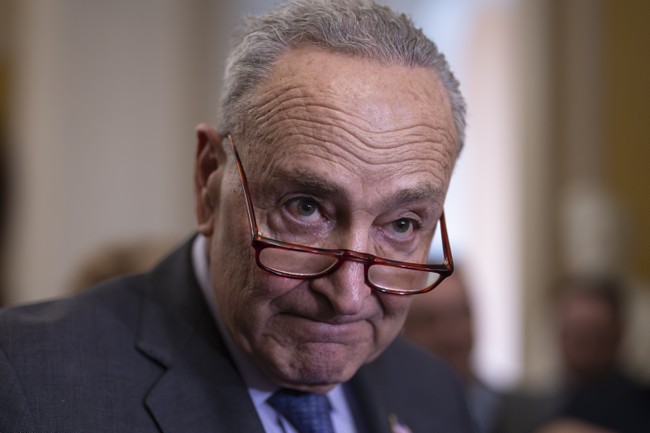
Chuck Schumer is taking a political pounding across the country, sinking to historically low approval numbers and even losing favor with his own Democratic base after the drawn-out government shutdown and its fallout. New national and New York state surveys show his job performance rating near the bottom of modern measures for top leaders, and activist Democrats are already talking about a primary challenge. This piece walks through the polls, the internal party fallout, the specific criticism around the shutdown, and the likely political consequences for the Senate minority leader.
Recent Gallup data put Schumer at a stunningly low 28% job approval, the worst among 13 national figures measured. That number is striking not only because it trails President Donald Trump, whom Schumer routinely targets, but because it signals deep unease among voters who should be his natural allies. The optics of a party leader losing ground in his own ranks are politically dangerous and rare.
The Senate minority leader got the worst approval rating out of all top US political leaders in a new survey.
The New York Democrat notched just a 28% job approval rating, the lowest of 13 politicians named in the Gallup Poll released Tuesday.
Worse for Schumer is the collapse of support among Democrats themselves. Gallup’s analysis highlights a dramatic shift: two years ago most Democrats backed his leadership, but now a majority disapproves. That kind of internal erosion can quickly translate into public weakness and encourage primary challengers who see an opening.
“Schumer’s rating among his own party has worsened markedly. Two years ago, 76% of Democrats approved of his job and 20% disapproved, but now 39% approve and 56% disapprove,” Gallup said in its analysis.
The shutdown made the problem worse. Voters remember that the recent budget impasse stretched on and ended without clear gains for the Democrats’ stated priorities, and many blamed Schumer’s handling of negotiations. That political damage cut across usual partisan loyalties and fed narratives of ineffective leadership at a moment when voters want results, not drama.
State-level numbers echo the national picture. A Siena College survey found Schumer with his lowest approval in two decades of tracking among New York voters, with a majority viewing him unfavorably even in a reliably blue state. That local unpopularity undercuts the ironclad safety often enjoyed by long-serving senators and exposes him to intra-party dissent.
A Siena College poll of New York state voters taken last month also showed Schumer with his lowest approval rating in 21 years of surveys. A majority of voters in deep blue New York had an unfavorable view of the longtime senator.
Outside analysts have pointed out how rare this is; one commentator noted Schumer is the least popular Senate leader since the 1980s by certain measures. Those rankings matter because party reputations are interconnected: a struggling minority leader drags overall approval for congressional Democrats down, and voters often make sweeping judgments about competence and priorities based on a few headline fights.
Schumer’s team issued a defensive statement claiming Democrats had ended the year on the offense, stressing healthcare and cost issues as wins. Angelo Roefaro, a campaign spokesman, framed the party’s record as protective of health coverage and focused on affordability. That public posture is standard, but it’s running up against raw voter dissatisfaction on tangible issues like healthcare costs and the perception of stalled reforms.
“Democrats finished the year strong and on their front foot as the only party focused on fighting to protect healthcare and lowering costs for people, which Schumer has championed,” said Schumer campaign spokesman Angelo Roefaro.
Critics argue that Democrats created the healthcare affordability squeeze with policies that left subsidies set to lapse and prices still out of reach for many families. That critique is resonating even among Democrats who expected the party to shield them from pain, and the result is anger directed at national leaders who promised relief but failed to deliver clear improvements.
Democratic activist organizations have announced plans to consider primary challenges after the shutdown missteps, and figures like Rep. Alexandria Ocasio-Cortez have been floated as potential challengers to the Senate leader’s position. When a party’s activists turn toward internal accountability, incumbents face pressure from the left and the right, shrinking political space for recovery.
Looking ahead to the next budget fights, Schumer will enter critical funding debates with weakened leverage and a public image of ineffective negotiation. That increases the chances of further political turbulence when Congress returns, and it raises questions about whether Schumer can rebuild trust in time to avoid serious primary or electoral repercussions.
It’s long past Schumer retired from and left politics behind!
Schumer and Jeffries should get a Taco truck together and try selling their bullsh-t in the ghetto and even the hood people can’t stand their bullsh-t anymore their careers are over forever. All their lies and corruption are gone to bury them permanently. How do these two corrupt politicians become multimillionaires on government salaries especially Jeffries who was almost bankrupt before getting his government job. Lots of democrats need to be finically investigated immediately how they become so rich on government salaries. Corruption at it’s finest