
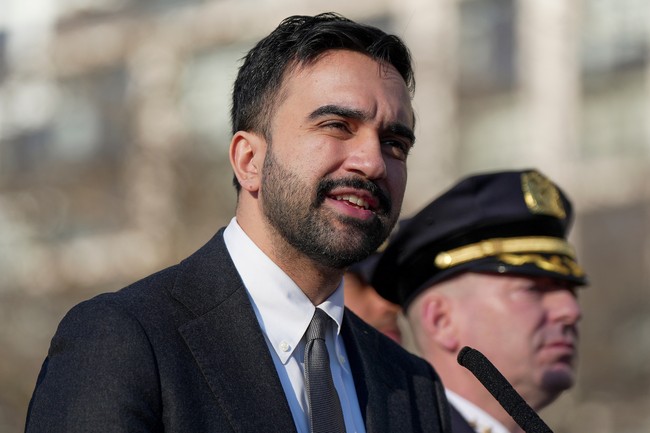
The arrest of two men for attempting to detonate improvised explosive devices near Mayor Zohran Mamdani’s residence and his public response reveal a city leadership problem more than a one-off security incident; this piece examines the facts of the arrests, Mamdani’s handling of the incident, the political and ideological implications, and how voters should view a mayor who sidesteps the motive behind an attempted act of terrorism.
Two suspects were taken into custody after an attempt to detonate explosives at a protest close to the mayor’s home, and authorities have tied the incident to Islamist inspiration. The suspects, identified as Emir Balat and Ibrahim Kayumi, were alleged to have lit one device and dropped another, with testing showing explosive residue on both. Police leadership has treated the event as a serious act of terrorism that could have killed or injured civilians and officers alike.
What matters now is not just the attack but how the city’s leader frames it. Instead of naming the ideology implicated by investigators, Mayor Mamdani chose to denounce “white supremacy” in his initial public remarks. That choice raises real questions about political calculation and whether ideology or identity shapes the mayor’s public statements more than facts on the ground do.
The mayor’s presser is instructive for its omissions as much as its words. He accused a protest organizer of bigotry and called for unity, which is standard language for public officials addressing unrest. Yet when credible evidence points toward an extremist Islamist motive, the failure to acknowledge that plainly looks like a political dodge or a blind spot driven by sectarian sympathies.
Below are the mayor’s exact words from his earlier statement, preserved in full and unedited to show what he said and did not say.
MAMDANI: Yesterday, white supremacist Jake Lang organized a protest outside Gracie Mansion rooted in bigotry and racism. Such hate has no place in New York City. It is an affront to our city’s values and the unity that defines who we are.
What followed was even more disturbing. Violence at a protest is never acceptable. The attempt to use an explosive device and hurt others is not only criminal, it is reprehensible and the antithesis of who we are.
I want to thank the brave men and women of the NYPD who acted quickly to keep New Yorkers safe. Our officers ran toward danger without hesitation, demonstrating once again the courage and dedication it takes to protect this city every single day.
My administration is closely monitoring the situation and I remain in close contact with our Police Commissioner.
The mayor later held a press conference where he reiterated condemnation of “white supremacy” and framed the protest as motivated by anti-Muslim sentiment. He emphasized his own experience as the first Muslim mayor and the broader problem of Islamophobia in public life. That context is valid, but it does not excuse ignoring credible leads pointing to Islamist extremism in an attempted bombing.
When the mayor took questions and offered prepared remarks at the Monday presser, his opening lines set the tone in a way that many found jarring. He described the protest as “Stop the Islamic takeover of New York City,” labeled the event vile, and underscored his personal connection as a Muslim living in Gracie Mansion. Those comments underscore his focus but not the central investigative findings.
MAMDANI: Good morning. On Saturday, a protest was held outside Gracie Mansion, where I live with my wife Rama. Neither of us was home at the time. This was a vile protest rooted in white supremacy entitled “Stop the Islamic takeover of New York City.” I’m the first Mulsim mayor of our city. Anti-Muslim bigotry is nothing new to me, nor is it anything new to the roughly one million New Yorkers who know this city as our home.
Despite those remarks, investigators publicly described the suspects as acting with Islamist inspiration, even calling the case “ISIS-inspired terrorism.” The contrast between the mayor’s narrative and the law enforcement assessment is striking and politically consequential. Leaders who avoid naming the specific ideological threat risk obscuring the motive and confusing the public about who actually perpetrated the crime.
This isn’t just about rhetoric; it’s about public safety and credibility. New Yorkers deserve a mayor who draws on facts provided by investigators, acknowledges the reality of violent Islamist extremism when supported by evidence, and shows consistent clarity about threats to the city. Political considerations and personal identity shouldn’t trump a straightforward naming of motive when the stakes include lives and urban security.
Beyond this incident, critics point to administrative problems that have plagued the mayor’s early tenure, such as budget gaps and operational issues like snow removal. Those practical failures compound the concerns raised by how the mayor handled this event. Voters are right to ask whether a leader who dodges clear investigative findings can be trusted to manage crises or prioritize the safety of all residents.
In the end, this episode highlights the need for clear-eyed leadership that puts public safety first. Officials should acknowledge the evidence, support investigators, and avoid letting identity politics shape the framing of violent acts. Only honest clarity will preserve public confidence and keep the city safer.
Add comment