
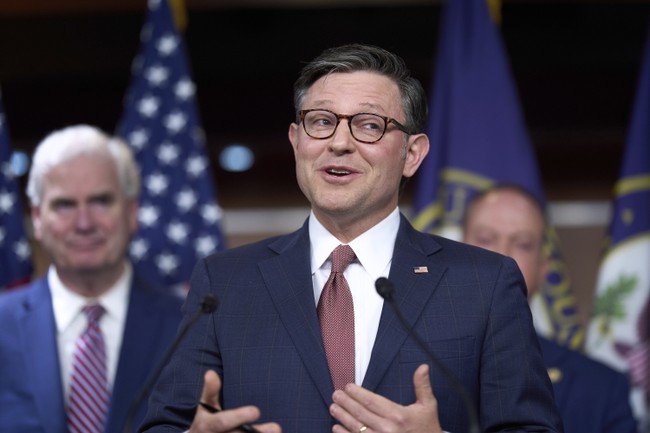
New: Speaker Johnson Faces Lawsuit Over Swearing-In Delay
The government shutdown driven by Senate Democrats has dragged on into its fourth week, and the dispute over a clean continuing resolution is still front and center. Republicans argue that adding trillions to bailouts is exactly what the American people rejected.
A fresh legal fight has emerged from Arizona after a special election filled the seat of the late Representative Raul Grijalva. His daughter, Adelita Grijalva, won that contest, but swearing her in has become tangled in shutdown rules and House procedure.
The State of Arizona sued Speaker Mike Johnson to force a swearing-in despite the shutdown, framing the matter as voter disenfranchisement. The filing comes from Arizona Attorney General Kris Mayes and raises constitutional and political questions about representation during a funding lapse.
“Speaker Mike Johnson is actively stripping the people of Arizona of one of their seats in Congress and disenfranchising the voters of Arizona’s seventh Congressional district in the process,” Arizona Attorney General Kris Mayes, a Democrat, said in a statement.
“By blocking Adelita Grijalva from taking her rightful oath of office, he is subjecting Arizona’s seventh Congressional district to taxation without representation. I will not allow Arizonans to be silenced or treated as second-class citizens in their own democracy.”
Johnson dismissed the lawsuit as a bid to get “national publicity” in comments to reporters earlier this week and on Tuesday evening.
From a Republican perspective, the dispute is less about silencing voters and more about following rules that govern a federal body during a lapse in appropriations. When Congress is not operating normally because of a shutdown, procedural limits kick in and the House cannot simply ignore them.
Speaker Johnson’s response has been blunt and procedural: the House is following precedent and asserting its jurisdiction over who gets sworn in and when. That stance reflects a conservative view that institutional rules matter and must be upheld even under political pressure.
“I think it’s patently absurd. We run the House. She has no jurisdiction. We’re following the precedent,” in response to the state attorney general. “She’s looking for national publicity, apparently she’s gotten some of it, but good luck with that.”
The precedent Johnson cites is concrete and bipartisan: prior Speakers have delayed swearing members when the House was not in session or when the chamber’s ability to conduct business was compromised. That includes a well-known case where a previous Speaker waited to swear in a member after a special election during a period of disruption.
https://x.com/SyedahAsghar/status/1980759209848295751
Republicans point to the real culprit in the shutdown: Senate Democrats who have insisted on major new spending, including provisions that many voters oppose. The House passed a clean continuing resolution, but it stalled in the Senate where leadership has pushed for large spending additions.
Arizona’s lawsuit layers politics on top of procedure, and critics say it risks turning every administrative decision about oath timing into instant litigation. From this view, the lawsuit is a political maneuver to spotlight the shutdown and shift blame to House leadership rather than to the Senate where negotiations are stalled.
Those defending Johnson stress that swearing in a member does not magically restore federal operations when appropriations are frozen. Even a sworn Representative cannot compel agencies to act if funding and authorization are paused by the shutdown.
Arizona’s attorney general frames the issue as immediate injustice, while House leadership frames it as follow-through on rules and precedent. The tug-of-war highlights how shutdowns can weaponize even routine moments of representation into partisan fights.
As the courts consider the challenge from Arizona, the larger political battle over spending and priorities will continue to determine when normal House business can resume. For Republicans, preserving institutional norms and resisting unfunded expansions remains the guiding principle in this dispute.



Add comment