
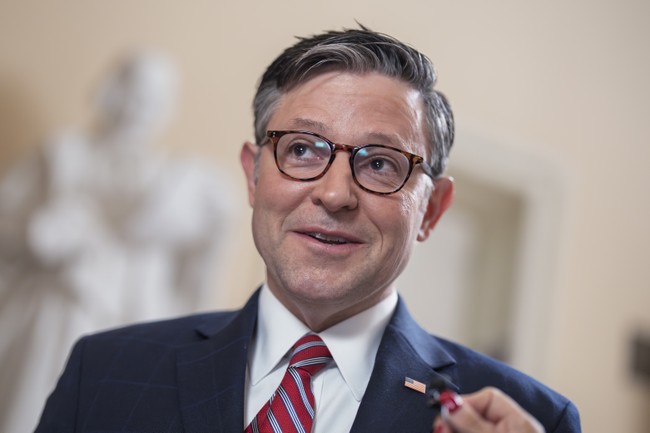
This article covers Speaker Mike Johnson’s blunt response to questions about the United States allegedly planning to buy or use force to acquire Greenland, his framing of the issue as an America First strategic matter, and his pushback against how the press handled remarks by Secretary of State Marco Rubio and the White House press secretary.
‘Everybody Relax’: Speaker Johnson Schools Press on the Possibility of U.S. Going to ‘War’ on Greenland
Republican Speaker of the House Mike Johnson (LA-4) pushed back hard against speculation that the U.S. is poised to buy Greenland or invade it by force, reminding reporters that diplomacy and national interest come first. He tied the discussion to the America First priorities that defined the Trump administration and its campaign pledges. Johnson made clear the idea of military action was neither a policy nor something Congress was entertaining. The tone from the podium was calm but firm: this is not an imminent plan to seize territory.
Johnson faced a string of questions about talk that the Trump administration might purchase Greenland or even use military means to acquire it, and he shut down the most sensational interpretations. He told reporters, “We’re not at war with Greenland,” and spelled out that there was no reason to be. That line cut through the fevered coverage and refocused the conversation on strategy rather than headlines. He kept returning to the idea that any curiosity about Greenland would be pursued through ordinary channels.
In addressing the militarized framing of the story, Johnson was unmistakable: “So, all this stuff about military action and all that. don’t even think that’s a possibility. I don’t think anybody’s seriously considering that. And in the Congress, we’re certainly not.” His remark was designed to tamp down panic and ridicule what he saw as an overblown narrative. He emphasized Congress’s role and the low likelihood of any forced acquisition. That clarity was intended to put the media on notice not to treat rumor as policy.
Johnson said the U.S. has legitimate reasons to examine Greenland’s role in American strategic planning, and he framed that inquiry as part of defending the nation’s interests. “It is an America First priority to look to our strategic and national defense initiatives and what would be advantages to us,” he said, and pointed to Greenland’s geography and its rare earth minerals. He stressed that evaluating strategic assets is routine and sensible for a nation that wants to protect its future. The focus, he insisted, should be on diplomacy and policy analysis, not chest-thumping speculation.
When pressed about comments reportedly made by Secretary of State Marco Rubio in a classified briefing, Johnson treated the remarks as offhand and not policy. He acknowledged, “Did Marco say something like that? I think he did,” but added that Rubio smiled and was being humorous. Johnson warned against reporting jokes from sensitive briefings as if they were official moves, and he rejected the idea that Rubio had informed the Gang of Eight of any concrete plan to buy Greenland. He urged journalists to consider context before running with wild headlines.
Johnson also pointed out the demographic reality: Greenland’s population is small, and that fact undercuts the notion of some grand military grab. “Now that said, does that mean we’re going to go send troops into Greenland and take it over? No. I mean, they only have, what, 40, 50 thousand people there. This is not a thing.” He used plain numbers to make the scenario seem both improbable and unnecessary, aiming to return the story to rational national-security debate. His framing moved the discussion away from melodrama toward policy priorities.
The speaker reiterated that briefings and deliberations would continue, advising patience while officials sort through options. “You know where I stand….We’re going to get a briefing today, and then see how it develops. So, everybody relax,” he told the press, again demanding that speculation be chilled. He positioned Congress as a body that will be briefed and informed before any decisions are made. The message was steady: scrutiny, not sensationalism, will guide any next steps.
At the White House, press secretary Karoline Leavitt acknowledged multiple options were being discussed and that diplomacy was part of the approach, which Johnson and others echoed. Reports that focused only on a military option missed the broader context she described. The conversation, from the Republican perspective, centers on protecting American interests while using the proper channels of statecraft. That balance is what Johnson sought to reaffirm in front of a skeptical press corps.
The debate over Greenland mixes real strategic questions with media-driven drama, and Johnson tried to separate the two by insisting on facts, briefings, and measured discussion. He emphasized that America First means looking at strategic advantages and resources without leaping to extremes or allowing offhand comments to become policy. His directive to the press was simple: stop treating speculation like a plan and let elected leaders and agencies do their jobs in public and in classified settings as needed.

Add comment