
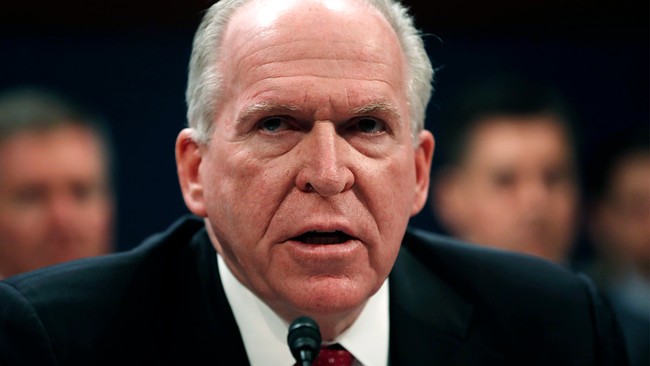
The Justice Department is reportedly moving toward grand jury subpoenas in an investigation tied to former CIA director John Brennan, and this article examines the allegations, the newly declassified material, and the legal path that could lead to criminal charges for lying to Congress.
If John Brennan thought he would escape scrutiny for his role in the Russia collusion narrative, he was mistaken. After the indictment of former FBI director James Comey for making false statements and obstruction, federal prosecutors are now focusing on Brennan’s actions during the same era. U.S. attorneys in the Southern District of Florida are preparing grand jury subpoenas related to Brennan, and an indictment now appears likely as investigators zero in on testimony discrepancies.
Brennan was a central figure in shaping the intelligence community’s Russia collusion assessment during the 2016 election cycle. He pushed for inclusion of the Steele Dossier material in the 2017 intelligence assessment despite that document being widely criticized and known to be opposition research. Critics argue that the dossier was unreliable and that its use helped distort the narrative about the Trump campaign at a critical moment in American politics.
Justice Department officials in Miami and Washington, D.C., are actively preparing to issue several grand jury subpoenas relating to an investigation into former CIA Director John Brennan, Fox News has learned. U.S. Attorney for the Southern District of Florida Jason Reding Quiñones is supervising the probe, Fox News is told.
What investigators are looking for is criminal exposure where it clearly exists: false statements to Congress. Allegations center on Brennan’s 2023 congressional testimony where he denied that the Steele Dossier was used as part of the 2017 intelligence assessment and said the CIA opposed its inclusion. Prosecutors will assess whether those statements were accurate and whether any contradictions in declassified documents rise to the level of perjury or obstruction.
Recently declassified materials have added teeth to the line of inquiry. Those records show a more active role for the CIA in drafting an annex that summarized dossier material, and they suggest Brennan overruled officials who objected to including that material. Lawmakers leading the referral maintain that the documents contradict Brennan’s public testimony and point to a deliberate decision to insert questionable intelligence into the assessment for political effect.
Brennan’s assertion that the CIA was not ‘involved at all’ with the Steele dossier cannot be reconciled with the facts. As the newly declassified documents show, a CIA officer drafted the annex containing a summary of the dossier; Brennan made the ultimate decision, along with then-FBI Director James Comey, to include information from the dossier in the ICA; and, as discussed further below, Brennan overruled senior CIA officers who objected to the inclusion of the dossier material.
There is a clear difference between political misuse of office and criminal conduct, but lying under oath is plainly unlawful. The Justice Department appears to be concentrating on those lines—statements Brennan made in a congressional setting that might be demonstrably false given the newly released paperwork. If prosecutors can show intentional falsehoods rather than mere memory lapses or misstatements, the path to indictment is straightforward in principle.
That said, high-profile politically charged prosecutions are never simple. Past efforts have shown the legal system can be unforgiving in practice, and successful prosecution depends on meticulous evidence, timing, and jury perception. Still, if the Brennan matter mirrors the Comey case in evidentiary strength, it would be hard to justify leaving it uncharged without creating the appearance of selective inquiry.
Beyond the legal questions, the Brennan episode raises a broader institutional concern: senior intelligence officials framing or shaping narratives that affect elections and public trust. Many conservatives view this as part of a larger pattern of politicized intelligence and bureaucratic overreach. Holding officials accountable for false testimony is one way to deter future politicization and reinforce that public office carries a duty to truth.
Accountability also matters as a practical political point. If the Justice Department proceeds with subpoenas and charges, the process will expose internal debates and decision-making at the heart of the intelligence community during a fraught political season. For Republicans and others who have long questioned how intelligence was used in 2016 and thereafter, a rigorous investigation and, where warranted, prosecution would be vindication that the rule of law applies equally to powerful officials.


No indictments for Holder, Lynch, Hillary Clinton, Nasty Nancy Pee lousy, or the crime boss, Obama.