
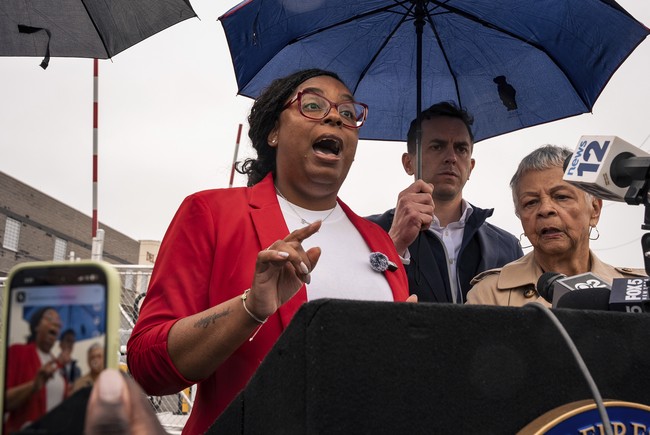
The House hearing erupted when Democrat Rep. LaMonica McIver confronted Acting ICE Director Todd Lyons with a personal, moral accusation amid criminal charges that stem from an alleged assault on ICE agents — behavior captured on video and now the center of a debate about decorum and accountability in Congress.
Republicans have a straightforward standard: elected officials must face consequences for unlawful conduct, and representation means acting responsibly, not staging confrontations. LaMonica McIver arrived at a federal facility allegedly assaulting agents and later used her committee time to press a dramatic moral condemnation. That sequence — a criminal charge followed by a public spectacle — raises a clear question about fitness for office and the duty of colleagues to enforce standards.
The hearing with Acting ICE Director Todd Lyons provided the flashpoint many had feared. McIver pressed a religiously framed accusation at Lyons, insisting he answer whether he was “going to hell” and suggesting he bears “so much blood” on his hands. Those words were aimed at a law enforcement witness, not a political opponent in debate, and they crossed the line from oversight into personal attack.
MCIVER: Mr. Lyons, do you consider yourself a religious man
LYONS: Yes mam.
MCIVER: Oh, yes. Okay. Well, how do you think judgment day will work for you with so much blood on your hands?
LYONS: I’m not going to entertain that question.
MCIVER: Oh, okay. Of course, not. Do you think you’re going to hell, Mr. Lyons?
LYONS: I’m not going to entertain that.
MCIVER: Of course, not. How many government…
GARBARINO: The gentle lady will suspend, the gentle lady will suspend
MCIVER: Chairman
GARBARINO: The gentle lady, as I said, the issues we are debating here are important to ones that members feel deeply about. While vigorous disagreement is part of the legislative process, members are reminded that we must adhere to established standards of decorum and debate. The witnesses are here voluntarily, and I will continue to remind members that while oversight is important, aggressively attacking those witnesses personally is inappropriate and not in keeping with the traditions of our committee.
MCIVER: Mr. Chairman, I’m just asking a question. You guys are always talking about religion here and the Bible. I mean, it’s okay for me to ask a question, right?
Video evidence complicates McIver’s defense and makes inaction by the House appear worse. When an alleged assault is caught on camera, the public expects swift, consistent action that upholds the rule of law and preserves institutional integrity. Allowing a member under criminal indictment to keep using their seat as a podium undermines public trust and gives the impression of selective accountability for powerful people.
Republicans in the House have a responsibility to protect committee decorum and the safety of witnesses who answer questions under oath. Chairman Garbarino did attempt to moderate the exchange, but his warning was not enforced in a way that stopped the personal attacks. That failure matters because committee hearings are meant to gather facts and provide oversight, not to become stages for political grandstanding with criminal clouds overhead.
McIver’s rhetoric accused ICE of murder in connection with enforcement actions, a claim that outweighs ordinary criticism and ventures into libelous territory when unsupported by the public record. There is no evidence that ICE has carried out a targeted campaign of murder; the public incidents that are cited involve complex, often violent confrontations where multiple actors bear responsibility. Accusing federal agents of murder on live record while under indictment looks reckless and dangerous.
Congress is supposed to be a place where facts matter and process protects everyone, including witnesses and members alike. When members weaponize religion and morality as tools to shame witnesses, they shift hearings from fact-finding to spectacle. That harms legitimate oversight and sets a precedent where personal attacks are tolerated as long as the speaker wears a congressional badge.
Political deals that spare members from stronger discipline also send the wrong message to voters. When leaders negotiate to save a colleague from censure or expulsion despite credible allegations and video evidence, it reads as privilege over principle. That dynamic fuels cynicism and erodes the idea that the law applies equally to all, regardless of party or position.
The House must balance due process with institutional credibility. If the evidence supports criminal charges, the courts should handle those claims, and the House should act to preserve decorum and protect witnesses from personal attacks. Allowing members to continue to use a committee seat to conduct what amounts to a public crusade while under indictment weakens the institution and gives opponents every reason to call for stronger ethical enforcement.
In the end, voters expect their representatives to behave better than the worst people they criticize. McIver’s conduct during the hearing — coupled with the allegations captured on video — demands clarity from House leaders and a consistent application of rules. If Congress wants to claim moral authority, it must show it can hold its own members to account without bias or special deals.


Add comment