
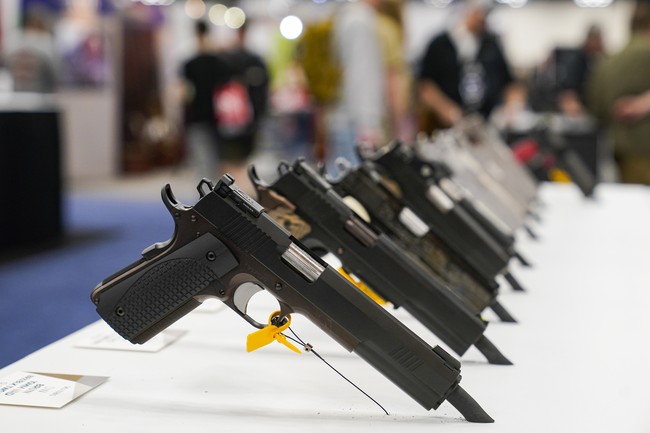
The D.C. Court of Appeals has overturned Tyree Benson’s conviction over possession of a high-capacity magazine, finding the District’s ban unconstitutional, and the ruling exposes the messy legal fights over magazine limits, conflicting lower court decisions, and political shifts in enforcement and appeal strategy.
The case began when Tyree Benson was arrested in 2022 for possessing an unregistered 9-millimeter handgun equipped with a magazine capable of holding 30 rounds. The District of Columbia had a local law outlawing magazines that contain more than 10 rounds, and Benson’s conviction under that ban was the subject of appeal. A three-judge panel on the District of Columbia Court of Appeals reversed the conviction by a 2-1 vote. The panel’s key finding included the statement: “Because these magazines are arms in common and ubiquitous use by law-abiding citizens across this country, we agree with Benson and the United States that the District’s outright ban on them violates the Second Amendment.” The opinion and dissent were described in one place as an 84-page decision and in another as a 54-page ruling.
This ruling matters because it flips a local criminal conviction and puts D.C. law at odds with earlier federal court outcomes. A federal district court had previously upheld the magazine ban, and the D.C. Circuit had affirmed that federal ruling, while the Supreme Court declined to take that appeal. Now, the highest local appeals court in the capital has reached a contrary conclusion for a local prosecution, creating a jurisdictional split that could draw further litigation.
There are over a dozen ongoing challenges nationwide to bans on large-capacity magazines, and those challenges have had mixed results in recent years. Several state-level bans have been defended successfully by prosecutors and courts, while other appellate rulings have struck down similar measures. This uneven legal landscape has left both gun owners and law enforcement officials uncertain about what rules will apply in a given place and moment.
The composition of the D.C. panel drew attention because the majority included appointees from different presidential administrations, a reality that shows judicial philosophy does not always map neatly onto party labels. Reporters noted that a Trump appointee and an Obama appointee formed the majority, while a George W. Bush appointee dissented. The split underscores how Second Amendment issues now cut across conventional expectations and how judges from different backgrounds can reach similar conclusions about constitutional protections.
Benson faced additional charges beyond the magazine count, including possession of an unregistered firearm, carrying a pistol without a license, and unlawful possession of ammunition, but the appeal focused narrowly on the magazine prohibition. Those other counts remain legally distinct and were not resolved by this decision, leaving open separate questions about registration and licensing regimes that many conservatives view as inconsistent with recent Supreme Court precedent. There remains debate about what “unlawful possession of ammunition” means under modern Second Amendment interpretations.
The Justice Department’s posture in the appeal shifted when the federal government intervened on Benson’s side, a move that attracted political commentary. Conservatives saw the Trump Justice Department’s involvement as a correction to policies pushed under the prior administration. Critics on the other side had relied on prior federal rulings upholding magazine limits, and the change in representation highlights how federal priorities influence which legal arguments are advanced and defended.
This opinion applies to the District of Columbia alone, but its reasoning and the quote about ubiquity could carry persuasive force elsewhere. When a local high court emphasizes that an arm is common and widely owned by law-abiding citizens, it signals a posture favoring individual rights under the Second Amendment. That line of reasoning could be invoked in other appeals challenging magazine bans, even as federal and state courts continue to split on the issue.
Practically speaking, the ruling creates immediate uncertainty for prosecutors and residents in the District: laws that have been enforced for years are suddenly vulnerable to reversal in individual cases. Lawmakers and police will need to sort through what convictions and pending charges are affected, and conservative observers expect further litigation and potential legislative responses. The decision also sharpens the political argument: for Republicans, it reinforces the view that broad prohibitions on commonly owned firearm accessories conflict with constitutional protections.
The case will likely continue to ripple through legal circles, sparking additional appeals and possibly new challenges aimed at resolving the split between federal and local rulings. In the meantime, citizens and legal practitioners in D.C. must contend with a changed legal landscape where a long-standing magazine limit has been called unconstitutional by the District’s highest appeals court. Expect more courtroom skirmishes and pointed political debate as parties seek a final answer.

Add comment