
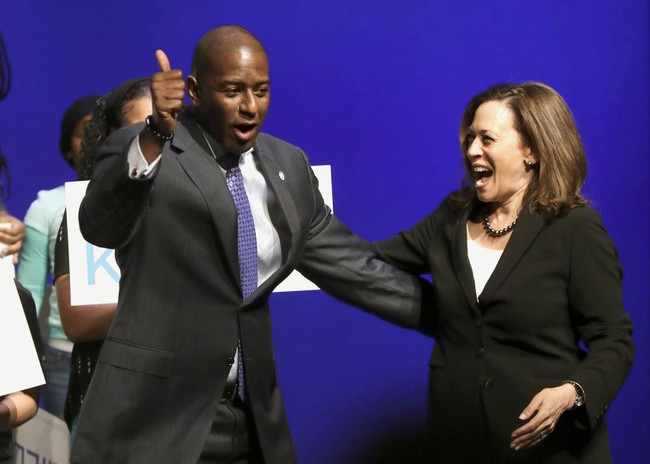
Andrew Gillum, the Democrat who nearly defeated Ron DeSantis in Florida’s 2018 governor race, was arrested in Alabama after a traffic stop allegedly turned up marijuana and methamphetamine; this article recounts the stop, the charges, Gillum’s past struggles, and how the 2018 race looks in hindsight.
Andrew Gillum, once the rising star of the Democratic Party and the 2018 nominee for Florida governor, was stopped by Alabama authorities late on July 2 after officers reported erratic driving on U.S. Highway 98 near Daphne. Police say the officer noticed a glass pipe on the center console, which led to a probable cause search of the vehicle. The stop produced evidence officers claim included rolled marijuana cigarettes and packages testing positive for methamphetamine, and Gillum was taken into custody and booked.
“Several rolled marijuana cigarettes and three packages of a substance that tested positive for methamphetamine were recovered,” police said.
The charges listed in the booking mirror what Alabama law describes as serious offenses: unlawful possession of a controlled substance, a Class D felony, and second-degree marijuana possession, a Class A misdemeanor. Gillum was initially held in the Daphne City Jail and then moved to the Baldwin County Correctional Facility before records show he was released. Court records remain limited as the case is in its early phase and details about legal representation were not immediately public.
Gillum’s fall from national prominence makes the arrest feel like another chapter in a troubled pattern that has followed him since the 2018 campaign. He lost to Ron DeSantis by a razor-thin margin, fewer than 34,000 votes, in a race that drew national attention and big-name endorsements. Democrats once treated Gillum as a future star; now the episode is being framed by critics as confirmation that Florida voters narrowly avoided a different kind of leadership.
Even before the Alabama arrest, Gillum had publicly confronted personal crises. In 2020 he was found intoxicated in a Miami Beach hotel room where another man had apparently overdosed, an incident that prompted concern and headlines but produced no criminal charges. Following that episode, Gillum stepped back from public life and announced he would enter treatment for alcohol abuse and depression, acknowledging his struggles in candid remarks to the press.
“This has been a wake-up call for me,” Gillum said at the time. “Since my race for governor ended, I fell into a depression that has led to alcohol abuse.”
Two years after that, Gillum faced federal charges tied to allegations about misuse of campaign-related funds; the case produced an acquittal on lying to the FBI and a mistrial that resulted in other charges being dropped. Those legal entanglements further dimmed the promise that once surrounded his name and made his comeback to public life a cautious, politicized discussion. He has since reappeared as a commentator and co-host of the “Native Land Pod,” but the Alabama arrest raises fresh questions about both his personal stability and public judgment.
The political context matters because the 2018 contest remains one of the closest gubernatorial fights in recent Florida history, a moment when a different result would have reshaped state and national politics. DeSantis secured the governorship by a narrow margin and later won reelection by a substantially larger margin in 2022, cementing his profile as a prominent Republican governor. Conservative commentators and many voters now point to the near-loss in 2018 as one of those consequential, narrowly avoided outcomes.
From a Republican perspective, the Alabama arrest feeds a narrative about candidate vetting and the stakes of close elections. When a statewide contest is decided by less than one percentage point, the personal conduct of candidates becomes more than gossip; it has implications for governance, policy direction, and public trust. That Gillum was once supported by national liberals and even received campaign help from prominent figures only increases the sense of missed signals for some observers.
Legally, the Alabama matter will proceed through the system, and the evidence and charges will face scrutiny in court. At this stage, law enforcement’s account drives the story: the stop, the discovered items, and the booking records. For citizens and voters watching, the episode will be parsed in political terms as well as legal ones, and it will likely shape how some remember the high-profile 2018 contest for years to come.
Whatever the ultimate legal outcome, the arrest underscores how personal difficulties and past controversies can follow a public figure and alter the way their earlier achievements are recalled. Gillum’s near-victory in Florida is still in the record books, but his subsequent troubles have complicated his legacy and given opponents fresh material to use when discussing the choices Florida made in that tight race.

Add comment