
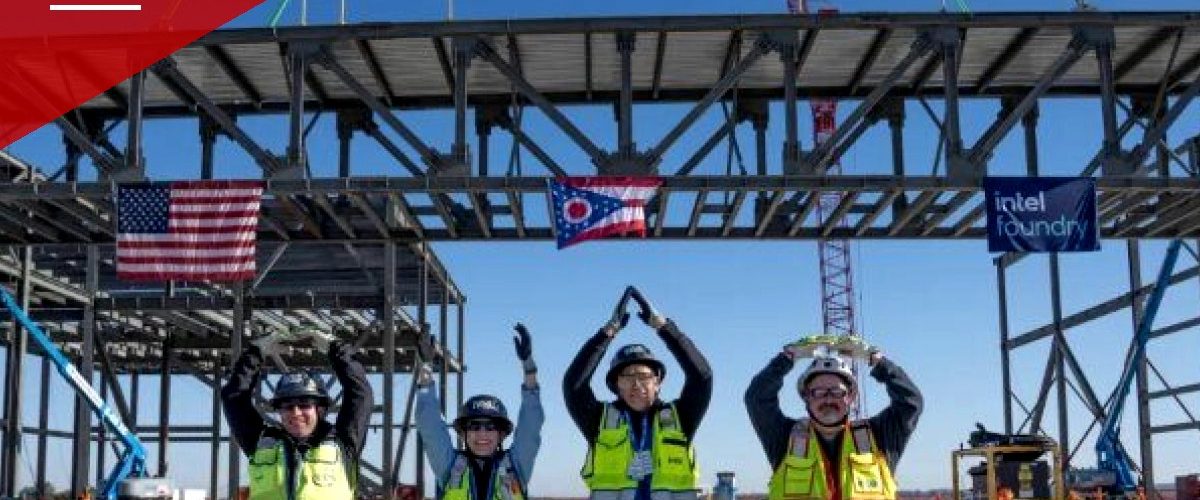
Intel has installed the first major structural truss at its chip manufacturing site in New Albany, Ohio, marking a visible construction milestone for a project that has slipped years behind its original schedule.
The New Albany site, just northeast of Columbus in Franklin County, was announced in 2022 with production originally expected to begin in 2025. That timeline came and went without a working fab. Intel now says construction on the first fabrication plant at the site will be completed in 2030, with a second fab targeted for 2031.
Naga Chandrasekaran, who leads Intel Foundry, said in a company statement that the truss installation “represents another significant step toward expanded U.S. leading-edge semiconductor capacity.”
The project, which Intel has branded as part of a “Silicon Heartland” push, began under former CEO Pat Gelsinger. Current CEO Lip-Bu Tan, who took over in 2025, has moved more cautiously, favoring confirmed customer commitments over speculative capacity expansion before greenlighting new fab construction.
That caution extends to Intel’s Arizona operations as well. The company said on October 21 that its next Arizona fab is expected to begin operations by the end of 2028. Intel reached high-volume production on its existing Arizona fab, which makes 18A chips, by late 2025 — but it has not yet landed a major outside customer for those chips and is currently using the output for its own processors.
There are signs of outside interest in the Ohio facility specifically. Reports surfaced in September that SK Hynix could lease foundry space at the New Albany site to produce memory chips, though neither company has confirmed an agreement.
Why Chipmakers Are Looking Past Taiwan
Dan Hutcheson, an analyst at TechInsights, said major chipmakers have incentive to diversify away from Taiwan Semiconductor Manufacturing Co., which dominates the industry and has struggled to keep up with AI-driven demand.
“People want a second source to be able to twist TSMC’s arm and keep them honest on pricing,” Hutcheson said.
Hutcheson added that “all the big ones have been testing there,” referring to interest from major chipmakers in Intel’s facilities.
The federal government has a direct stake in Intel’s fortunes: President Trump negotiated a 10 percent stake in the company for the United States in 2025.



Add comment