

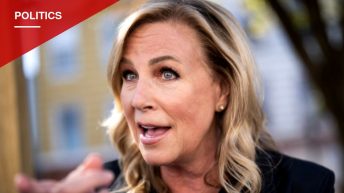
Minnesota Lt. Gov. Peggy Flanagan, the Democratic nominee for U.S. Senate, has acknowledged she was never a member of Phi Beta Kappa, the nation’s oldest academic honor society, despite telling state lawmakers in 2016 that she had graduated as one, according to an October 21 report from the Wall Street Journal.
Flanagan made the claim during a March 2016 Minnesota House hearing while pushing legislation to diversify the teaching workforce in public schools. She was describing how her grades improved dramatically after high school, where she had graduated with a 1.75 GPA.
“Everything changed, there was a switch, something clicked,” Flanagan said at the hearing. “I graduated Phi Beta Kappa because I saw myself reflected in my teacher and I saw myself reflected in my curriculum.”
The Journal found that the commencement program from Flanagan’s 2002 graduating class at the University of Minnesota did not list her among honors students, even though the program recognized graduates with GPAs of 3.5 or higher. The university’s current threshold for senior Phi Beta Kappa membership is 3.65.
The newspaper contacted Flanagan’s campaign on October 12 asking for proof of membership, and noted that Phi Beta Kappa’s national headquarters could release records with her consent. Eight days later, the campaign conceded she had never joined.
“The lieutenant governor was nominated for Phi Beta Kappa, but like too many other students, she couldn’t afford the application fees to become a part of the honor society,” campaign spokeswoman Alexandra Fetissoff told the Journal.
A lifetime membership at the University of Minnesota chapter currently costs $99, though the fee was likely lower when Flanagan was in school more than two decades ago. The Journal noted many chapters waive fees for students facing financial hardship. The campaign’s explanation confirms Flanagan was nominated but did not complete membership — a different outcome than the one she described to lawmakers in 2016.
Degree Also Misstated
The Journal identified a second discrepancy in Flanagan’s official state biography, which states she “earned her bachelor’s degree in American Indian studies and child psychology” — phrasing that implies a double major. Her College of Liberal Arts commencement program, however, lists child psychology as her sole major. Her campaign confirmed she earned a minor, not a second major, in American Indian studies.
Part of a Broader Pattern of Scrutiny
The credential questions follow other recent reporting on Flanagan’s record in state government. A 2019 state audit found more than $29 million in Medicaid overpayments to the White Earth Nation and Leech Lake Band of Ojibwe for opioid treatment programs over a decade, including $3.8 million paid in 2019 under the Walz-Flanagan administration after the state had already determined the payments violated legal requirements. Flanagan called demands that the money be repaid “unacceptable”; the reporting did not establish fraud by either tribe or detail her personal role in resolving the repayment issue. The matter has drawn fresh attention amid broader investigations into potential fraud exceeding $9 billion across Minnesota’s taxpayer-funded programs, with Flanagan pointing to Gov. Tim Walz when asked about accountability.
A separate 2025 audit of Flanagan’s own office turned up 12 findings on financial management, including unrecovered employee overpayments, $7,893 in flower purchases and $7,343 in furniture purchases broken into transactions under a $5,000 approval threshold, errors in 14 of 40 employee reimbursements, incomplete documentation for 40 of 41 vendor payments, and incorrect state-airplane payments. Flanagan’s office said recovering the employee overpayments was “not in the public interest.” Minnesota Senate Republican Leader Mark Johnson said, “Overpaying employees, losing state property, and stiffing vendors for months — it’s no wonder massive fraud is exploding across state government.”
Separately, Flanagan and Walz appointed Trahern Pollard, founder of We Push for Peace, to the state’s Juvenile Justice Advisory Committee in 2021 and again in 2025. Minneapolis paid his nonprofit nearly $2 million for violence-prevention work between 2021 and March 2025. In May 2026, the Minnesota Attorney General’s Office sued Pollard and another individual, alleging they diverted more than $6.5 million in nonprofit assets, with over $6 million benefiting Pollard personally. The lawsuit does not allege wrongdoing by Flanagan.
Flanagan has also faced renewed attention for 2023 remarks to the Somali American Coalition, where she pledged additional funding for “culturally relevant” treatment and care, touted a proposed $1.5 billion housing package, and highlighted a $200 million initiative for organizations serving minority and immigrant communities. “We have set aside $200 million to go directly to organizations that serve communities of color, immigrant communities, Native communities, because we know how to spend that money best and invest in the things that our communities need,” she said at the time. She did not specify recipients or funding amounts for the culturally relevant treatment services she described.

Add comment