
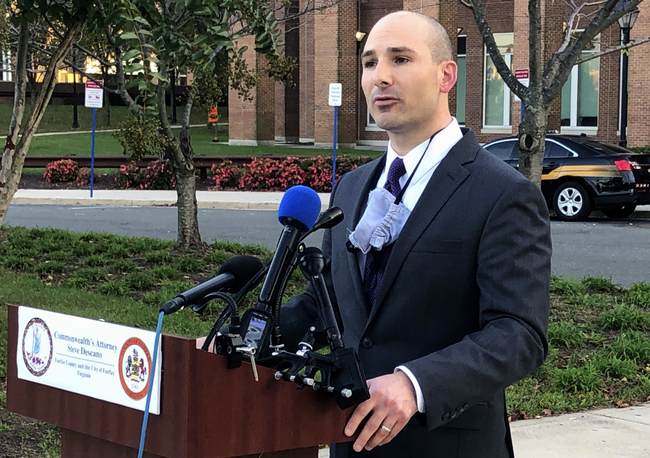
The story examines a deadly sequence in Fairfax County where a 23-year-old Salvadoran national with a criminal history was released after charges were dropped by Commonwealth’s Attorney Steve Descano, and was later connected to a murder investigation, raising questions about prosecutorial choices, local law enforcement policies, and accountability for public safety.
Stop me if you’ve heard this one before: an individual crosses the border, lands in an American community, and instead of rebuilding a life, commits violent crimes. Authorities arrested 23-year-old Marvin Fernando Morales-Ortez in connection with a fatal shooting in Reston, Virginia, and his background has prompted serious concern. Immigration and Customs Enforcement confirmed he is Salvadoran and in the country illegally, and his record extends back to 2020 with multiple priors and a history that once included first-degree murder charges.
Until the murder investigation unfolded, Morales-Ortez had been held at the Fairfax County Adult Detention Center on allegations that he brandished a firearm and assaulted someone. Prosecutors in the Commonwealth’s Attorney’s office dropped those criminal charges, which resulted in his release into the community just hours before the deadly shooting. In the wake of the arrest, the timing of that release has become central to the public’s outrage and calls for answers.
Complicating matters further, a clinician from the Community Services Board obtained an Emergency Custody Order in an effort to keep Morales-Ortez off the streets after his release. That order expired after eight hours before law enforcement could effectuate custody, allowing him to remain at large during a critical window. The sequence of administrative actions — dropped charges followed by a short-lived emergency order — reads like a catastrophic failure of coordination when lives were at stake.
At the center of the prosecutorial controversy is Steve Descano, the Soros-backed Commonwealth’s Attorney for Fairfax County, who has built a reputation for leniency in charging decisions. Critics point to a pattern in which violent offenders were not prosecuted to the fullest extent, including a prior case where Descano opted not to charge a man later revealed to be a child sexual predator. Those choices have fed a narrative that soft-on-crime policies are exposing communities to unnecessary risk.
Public frustration extends beyond the prosecutor’s office to the Fairfax County Sheriff’s Department, where Sheriff Stacey Kincaid has been criticized for refusing to honor ICE detainers and for releasing criminal immigrants back into the community. Journalists and residents have highlighted an apparent alignment between policies at the sheriff’s office and prosecutorial discretion in the commonwealth’s attorney’s office, producing a local system that many see as incentivizing repeat offending rather than deterring it.
The case also illustrates the tension between mental health interventions and criminal justice processes. Officials obtained an Emergency Custody Order after Morales-Ortez’s release, but that order lapsed before it could be executed. When safety hinges on short emergency windows and limited resources, the result can be tragic, and the public will reasonably ask whether existing processes are fit for purpose in real-world crises.
This incident is being framed by critics as not merely a single failure but evidence of a broader policy design that prioritizes ideological criminal justice reform over public safety. When prosecutors and sheriffs apply a philosophy that avoids detention or declines prosecution, the downstream effects can include more victims and less community trust. Residents in Fairfax County are now confronting the human cost of those policy experiments.
Those who defend the decisions argue that reform is aimed at reducing mass incarceration and addressing systemic inequities, but in practice, the debate now centers on whether reformers have struck the right balance between mercy and accountability. Elected officials who support leniency must grapple with the consequences when a person previously held for violent conduct is released and then implicated in a homicide. The political stakes are raw and immediate in communities that expect protection.
This episode also brings state-level politics into the mix: officials under consideration for higher roles can find their records scrutinized for local policy choices. Candidates and appointees who promoted or implemented lenient detention and charging policies face renewed scrutiny as communities demand stronger protections. The fallout will shape debates about public safety, prosecutions, and the oversight of local law enforcement going forward.
Real people were harmed while policy debates played out, and that fact is driving a sharp public backlash. Questions about whether Fairfax County failed by accident or design are now fueling calls for accountability and changes in how officials manage dangerous individuals. For many residents, the priority is immediate: restore policies that prevent violent people from being back on the streets where they can commit further harm.
Editor’s Note: Thanks to President Trump, illegal immigration into our great country has virtually stopped. Despite the radical left’s lies, new legislation wasn’t needed to secure our border, just a new president.


Add comment