
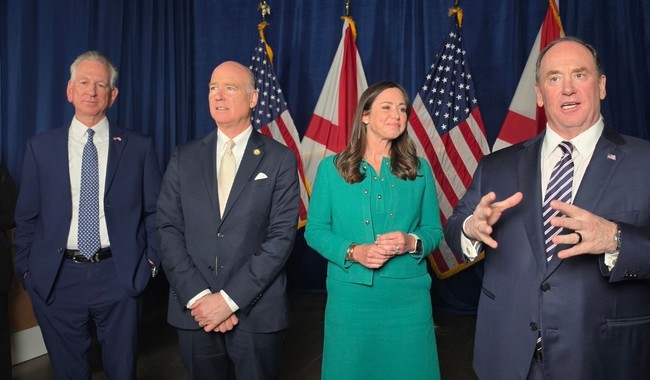
Secretary of the Navy John C. Phelan cut the ribbon on Hadrian’s new Factory 4 in Northwest Alabama, a public-private effort aimed at mass-producing submarine components as part of the administration’s Golden Fleet push; local and national Republican leaders attended, Hadrian described a multi-billion-dollar partnership with the Navy, and regional leaders framed the plant as a jobs and manufacturing revival for the Shoals area.
The new Hadrian Alabama Factory 4 opened Friday as a highly automated manufacturing center focused on submarine parts, assemblies, and finished systems. The project was announced as a public-private partnership between the Department of War and Hadrian, which the company positions as an AI-enabled industrial partner. Factory 4 is intended to accelerate submarine schedules by boosting production capacity and modernizing the maritime industrial base.
Local, state, and federal Republicans were on hand for the ceremony, including Senators Tommy Tuberville and Katie Britt, Representatives Robert Aderholt, Mike Rogers, and Barry Moore, and Senator Roger Wicker. Their attendance highlighted the political backing for a concentrated effort to rebuild defense manufacturing onshore. Officials framed the facility not just as a factory, but as a strategic investment in American industry and national defense.
Hadrian released a description of the plant that emphasized scale, automation, and the role each facility will play in the broader supply chain. The company said the Cherokee site will mass-produce components identified as major drivers of submarine schedules, and that it will be one of three facilities serving the maritime industrial base. Hadrian reported more than $1.5 billion in private capital paired with $900 million in Navy appropriations for a combined investment exceeding $2.4 billion.
Regional history and economic context were central themes for speakers, who traced a decline in local manufacturing to recent decades and touted this project as a reversal. The facility sits on ground that once housed a railcar plant that closed and moved production to Mexico, taking well-paid jobs with it. Officials stressed Factory 4 as an opportunity to bring skilled work back to Northwest Alabama and to revive towns like Muscle Shoals, Tuscumbia, Sheffield, and Florence.
Congressman Robert Aderholt, a native of the Shoals region, spoke about the personal and economic significance of the project. He tied the new plant to broader efforts to make Northern Alabama a key part of the president’s military-industrial revitalization. Aderholt also framed the work as a practical step to keep jobs in America and to strengthen the domestic workforce.
“Having grown up in northwest Alabama and being in this part of the state, it’s a real exciting day for me personally. There’s so many parts of this state and our country that sometimes have gotten left behind. But this is really going to be the factory of the future. This is really going to transform northwest Alabama, and Alabama as a whole.”
Speakers repeatedly credited the president with the vision to bring large-scale defense manufacturing back home. In his remarks, Aderholt praised the administration’s legislative work and the idea of channeling funds into rebuilding the American workforce. Local leaders presented the plant as a durable, long-term presence that will multiply regional economic activity.
“I like that President Trump had the vision to bring jobs here and to make sure that we keep jobs here. And that’s what my job is, what the job of our senators is. And, of course, we’re so happy to have the Secretary of the Navy here with us today. And so much thanks goes to President Trump having the vision of a big, beautiful bill. where we can really pump money into rebuilding the American workforce.”
Tommy Tuberville emphasized the longevity and scale of the effort, describing it as something that will outlast the current generation and deliver substantial federal investment to the region. He framed the project as a security measure for future generations in addition to an economic win. That message resonated with attendees packed into the factory floor, many standing because seats were filled.
“This is not a five- or 10-year project. Most everybody in here will be dead and gone, and they’ll still be building submarines here. I want you to think about that. They’ll still be here building submarines. There will be hundreds of billions of dollars that will be sent to Northwest Alabama for this project alone.”
Hadrian CEO Chris Power framed the partnership in human terms, saying the work ultimately supports the sailors who operate the fleet. He emphasized mission over mere corporate growth, noting the responsibility of producing gear that keeps service members safe. His comments tied the factory’s purpose directly to national defense, not just profit or scale.
“We’re surely mindful that the mission matters here because the stuff that we have constructed holds a bunch of sailors going out in dark and dangerous places right now, making sure we all get to sit here and drink a couple of beers. We can’t forget that.
“This has got nothing to do with growing the company, this has got nothing to do with capital: it is about them and what they do for us.”
Secretary Phelan described Factory 4 as Step One in reviving the maritime industrial base and reshaping how the Navy partners with industry. He framed the arrangement as a shared-risk, incentive-aligned model that protects downside while allowing upside participation. Phelan suggested more factories, ribbon cuttings, and launches will follow as the Golden Fleet effort scales.
“This is great news. This is Step One of revitalizing the maritime industrial phase of what the Golden Fleet is, which is rebuilding the fleet, revitalizing the maritime industrial base, and changing the way the Navy does business. This is really a win-win between the Navy and Hadrian. Shared risk, alignment of incentives, downside protection, and upside participation.”
As production ramps up at the 2.2-million-square-foot facility, officials estimate roughly 1,000 new jobs for the Shoals region. Community leaders and residents attended in force, signaling local buy-in for an industrial comeback. The ceremony tied economic renewal to national security in clear, direct terms, and the plant will serve as a focal point for future maritime manufacturing expansion across the country.

Add comment