
This article looks at Blue Origin’s recent New Glenn launch, what the mission carries, how reusable boosters are changing costs, and what the probes could teach us about the challenges of sending humans to Mars.
Private companies are driving the most visible leaps in spaceflight today, and Blue Origin’s New Glenn just added a significant chapter. The fifty-story rocket lifted off from Cape Canaveral carrying two identical NASA Mars orbiters, marking a major milestone for both the company and the broader commercial space sector. That success shows reusable hardware moving from theory to routine, which matters for lowering costs and expanding access to deep space missions.
The mission carried twin spacecraft named Escapade, built to study Mars’ upper atmosphere and scattered magnetic fields. The probes will not head to Mars right away; they will spend about a year near Earth at roughly one million miles out. Once Earth and Mars align next fall, the pair will take a gravity assist from Earth and begin their journey to arrive at Mars in 2027.
One of the most notable achievements of this flight was recovery of the New Glenn booster after separation, a step long championed as essential for cost reduction. Company employees celebrated as the booster landed upright on an offshore platform, and observers noted how similar this approach is to the reuse strategies pioneered by other private launch providers. Reusable boosters change the economics of exploration by letting hardware fly multiple missions instead of being discarded once per launch.
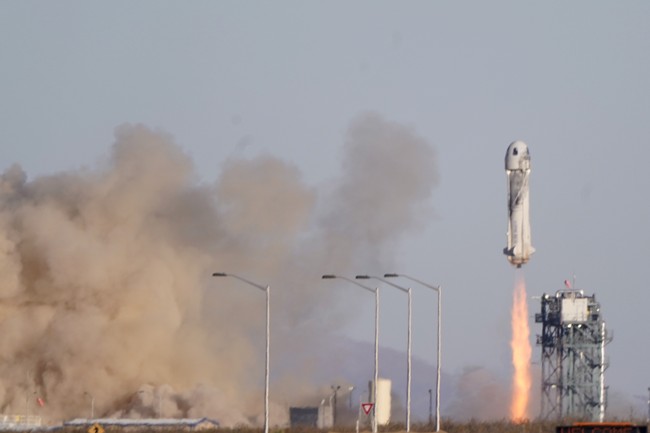
Blue Origin launched its huge New Glenn rocket Thursday with a pair of NASA spacecraft destined for Mars.
It was only the second flight of the rocket that Jeff Bezos’ company and NASA are counting on to get people and supplies to the moon — and it was a complete success.
The 321-foot (98-meter) New Glenn blasted into the afternoon sky from Cape Canaveral Space Force Station, sending NASA’s twin Mars orbiters on a drawn-out journey to the red planet. Liftoff was stalled four days by lousy local weather as well as solar storms strong enough to paint the skies with auroras as far south as Florida.
In a remarkable first, Blue Origin recovered the booster following its separation from the upper stage and the Mars orbiters, an essential step to recycle and slash costs similar to SpaceX. Company employees cheered wildly as the booster landed upright on a barge 375 miles (600 kilometers) offshore. An ecstatic Bezos watched the action from Launch Control.
The science task for the Escapade orbiters is straightforward and high value: map how Mars’ upper atmosphere and patchy magnetic fields interact with the solar wind. Those processes are directly tied to how Mars lost most of its thick, wet past atmosphere and became the cold, thin world we see today. Understanding atmospheric escape and magnetic interactions helps engineers design habitats and shielding if humans ever head there, and it clarifies the risks astronauts would face from radiation and atmospheric loss.
Data from these orbiters will inform an array of planning decisions for future crewed missions, from required shielding to the durability of life support systems. The probes’ measurements should also refine models that predict how quickly gases and charged particles are stripped from a planet lacking a strong, global magnetic field. That knowledge translates into practical mission design choices and contingency plans for long-duration surface stays.
Mars presents a set of hard constraints people can’t simply engineer away, with gravity being one of the most fundamental. Mars’ gravity is roughly 38 percent of Earth’s, and that persistent difference would shape how bodies develop, how muscles and bones respond, and how future generations might physically differ if a multi-generational colony ever emerged. Radiation and atmospheric retention can be mitigated with shielding and domes, but gravity remains an immutable environmental factor for any long-term settlement.
These probes are a sensible, measured step toward answering whether sustained human presence on Mars is practical with current and near-term tech. Before committing people and infrastructure, mission planners need accurate, in-situ data on atmospheric escape rates, local magnetic anomalies, and radiation exposure. If private launch providers continue to cut costs with reusable rockets, the economic case for seriously planning human missions strengthens, since lower launch costs reshape what architectures become feasible.
What this flight also highlights is a shifting balance in exploration: governments still fund core science, but private companies are increasingly supplying launch capability and hardware. That partnership can produce faster iteration and more resilient logistics for deep space efforts. Whether the first sustained human mission to Mars will ride a government rocket, a private vehicle, or a mix of both, this launch demonstrates that the private sector is central to the next phase of exploration.



Add comment