
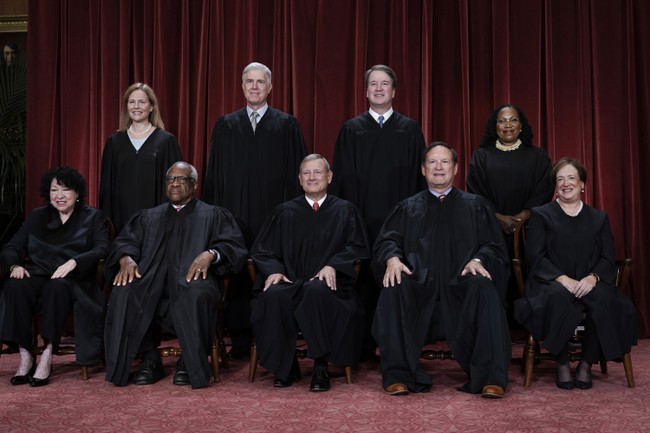
The Supreme Court’s liberal bloc is fractured, and that split risks eroding public confidence in the institution. This piece examines the differing strategies among Justices Kagan, Sotomayor, and Jackson, highlights the clashes with conservative justices, and questions whether solo dissents and public grandstanding do more harm than good to the Court’s authority.
The right often assumes the Court’s liberals act as a unified front, but reporting shows a more complicated reality. Justice Elena Kagan is described as a strategist and dealmaker, Justice Sonia Sotomayor as focused on tangible results and institutional ties, and Justice Ketanji Brown Jackson as a vocal outsider with a flair for dramatic, solitary opinions. Those differences matter because they shape how dissents are written, how coalitions form, and ultimately how the Court is perceived by the public and by the other branches.
Justice Kagan, appointed in 2010 to be a diplomat and strategist, is capable of punching hard, but she shows her frustration only in flashes. When the court rejected President Biden’s student loan cancellations in 2023, she deleted the most heated material from her dissent, I learned in my reporting. Justice Jackson aims directly at the right side of the court, accusing them of being clueless about racism, favoring “moneyed interests” and enabling “our collective demise.”
This has led to tension — between Jackson and the two senior liberals, and between Jackson and the rest of the court.
…
[Sotomayor] is now the senior liberal, assigning dissents and keeping many of the most important ones for herself. In those, Sotomayor disagrees forcefully, but she also values her long relationships at the court, people close to her say, and mostly keeps her focus on the legal judgments.
Kagan’s role is painted as cerebral and persuasive; she can lure a conservative vote and build a majority when she chooses. Sotomayor prefers outcomes she can point to and measure, and she apparently guards collegial relationships that keep the Court functioning behind the scenes. That kind of quiet deal-making is often undervalued but crucial for a nine-member body where a single defection changes the law.
The jurist who got the job had two Harvard degrees but also a history of challenging power. In 1990, when Justice Jackson was an undergraduate, she wore black instead of crimson to the Harvard-Yale football game to take a stand against a lack of full-time professors in the Afro-American studies department. “We can embarrass the university in front of the alumni,” she told The Boston Globe at the time.
As a clerk, she worked at a Supreme Court with plenty of Black building workers but where only a handful of Black lawyers had reached the elite legal apprenticeship. Later, she worked as a public defender — a representative of the accused and the shunned.
Her appointment as the first Black female justice was “a refutation of past ignominies, a long-anticipated and highly celebrated national achievement,” she wrote in her memoir. But inside the court, she was the junior justice, assigned to tasks like serving on the cafeteria committee and answering the door to the justices’ private conference room in case of a knock. In those meetings, Justice Jackson spoke only after the others, meaning that unless there was a tie, she had the least influence.
The profile traces Jackson’s path from activist student to public defender to the Supreme Court bench and notes how her junior status shaped early interactions. That backstory helps explain why she sometimes opts for solo dissents rather than coalition-building. But solo dissents can be double-edged: they highlight principle, yet they can isolate the author and reduce any practical legal effect.
The clash between Jackson and Justice Amy Coney Barrett illustrates the rift. In Trump v. Casa, the Court limited nationwide injunctions and reduced lower courts’ reach, a ruling with big practical consequences. Barrett wrote the majority opinion while Sotomayor dissented sharply, joined by Jackson, who also filed a separate, more dramatic dissent that accused the Court of imperiling the Republic.
All of this came to a head in one case in June. In Trump v. Casa, the court limited the power of lower court judges to issue nationwide rulings, in one stroke diminishing the power of the judiciary to challenge Mr. Trump. Justice Barrett wrote the 6-to-3 majority opinion. Justice Sotomayor pushed back with a full-throated dissent: “The court’s decision is nothing less than an open invitation for the government to bypass the Constitution,” she wrote. Justice Jackson joined that opinion.
But she added an even more dire solo dissent. “Eventually, executive power will become completely uncontainable, and our beloved constitutional Republic will be no more,” she wrote, and signed off “with deep disillusionment, I dissent.” It sounded like a message: I am losing faith in the Supreme Court.
Justice Barrett hit back hard, calling her argument “at odds with more than two centuries’ worth of precedent, not to mention the Constitution itself.”
Critics on the right see Jackson’s solo work as attention-seeking and potentially corrosive to institutional norms. Empirical measures of her verbosity and frequency of solo opinions tend to support that view. When a justice prioritizes public messaging over coalition-building, the Court’s ability to shape long-term doctrine can suffer.
Beyond personality critiques lies a deeper worry: institutional legitimacy. Chief Justice Roberts has often tried to steer the Court toward consensus to preserve respect for rulings across administrations. When public disillusionment grows, enforcement and compliance become trickier, and a weakened Court cannot perform its constitutional role effectively. Republicans who care about a functioning judiciary should be attentive to how internal divisions and public shows of hostility affect that balance.
That said, differences among justices are inevitable and sometimes healthy, prompting robust debate and richer opinions. The question is whether those differences will produce principled law or signal a Court at war with itself. If the latter takes hold, the damage to credibility will be hard to repair and will reverberate well beyond any single decision.


Add comment