
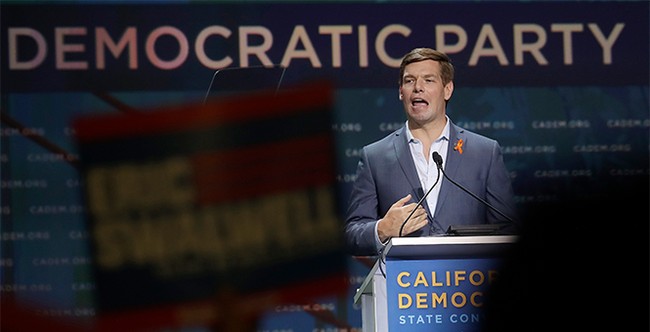
A take-no-prisoners look at Rep. Eric Swalwell and how a long career of media posturing, party loyalty, and headline-grabbing stunts boiled his public persona down to the purest form of the modern “Politician.” This piece tracks the arc from manufactured prominence to rapid fallout, noting the role of media props, party convenience, and fresh allegations in his collapse while keeping the focus tight and unapologetic.
Start with the kitchen metaphor: chefs reduce stock to concentrate flavor until only the essence remains. Swap the pot for the political press room and the bulls for elected officials, and you get a different reduction — one that concentrates ambition, vanity, and opportunism into a potent, bitter extract.
Eric Swalwell has long served as a distilled example of that extract. His rise was less about deep accomplishment and more about being useful: a pliant face on television, a predictable vote in the chamber, and a willing performer when cameras rolled.
That performative value insulated him for years. The same outlets that amplified him handed out applause lines and segments, inflating a persona with little substantive heft behind it. What mattered was the narrative he could advance for his side, not whether he had the track record or temperament to back it up.
When allegations surfaced, the reaction exposed a partisan double standard. The slogan “Believe all women” evaporated in certain corners the moment inconvenient claims pointed at a convenient ally. Suddenly, instincts shifted from automatic credence to damage control, and the party calculus became the dominant lens.
Some defenders rushed to label the story as manufactured outrage or a MAGA hit, conveniently redirecting attention to motive rather than evidence. That reflex is telling: it reveals how defense often depends less on facts than on preserving a media-friendly team member who’s useful in messaging battles.
Swalwell’s past lapses weren’t secret to those on the Hill. From the widely reported incident involving foreign influence to a pattern of overexposure and self-aggrandizement, signals were there that his judgement and boundaries were compromised. Keeping him visible mattered because he was a predictable piece of the broader strategy.
His media circuit appearances played a big role in shaping perception. A relentless diet of sound bites and pundit-friendly performances created a feedback loop: publicity bred confidence, which bred more publicity, until reality struggled to keep pace with the image.
At the same time, internal dynamics mattered. Staffers and aides who stayed quiet while they watched the show unfold carry responsibility too. If a leader’s conduct is tolerated or celebrated internally, that tolerance becomes part of the problem and not just an unfortunate byproduct.
The spectacle around Swalwell also highlights the theater of modern politics, where optics frequently outrank outcomes. He may have presented himself as a tough antagonist to opponents, but there is scant evidence he ever delivered concrete policy victories that altered the political landscape.
The Icarus metaphor fits in one sense: hubris played a role. But unlike a skilled innovator who flies too close to the sun, Swalwell’s ascent was more construction than craft — a scaffold of media attention and partisan utility rather than earned accomplishment.
As the latest allegations mount and party leaders distance themselves, the calculus is simple: convenience expires when liability increases. That’s why colleagues who once tolerated or ignored issues pivot quickly when the political cost shifts, showing how transactional loyalties can be.
In the end, the case shows how political life can refine a person into an archetype that’s easier to admire from a distance than to defend up close. When the smoke clears, voters and observers are left examining what was amplified, who benefited from the amplification, and what that says about incentives in Washington.

Add comment