

Unimpeaching the President
Our sister publication, PJ Media, recently reported:
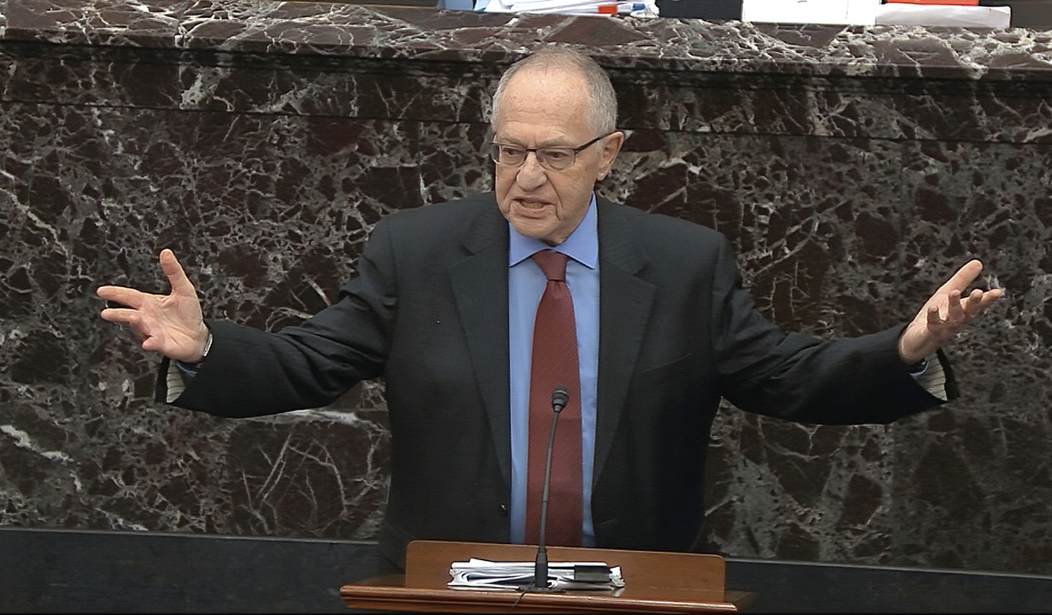
After newly declassified documents showed that an inspector general wrongly pushed an unvetted accusation from a Democrat operative who lied to launch the first impeachment of Donald Trump, legal expert Alan Dershowitz said that the president has a strong case for moving to expunge that first impeachment from his record.…Referring to an impeachment reversal, Dershowitz admitted, “It’s never been done. I don’t see any reason why it couldn’t be done. Impeachment is a quasi-judicial procedure, whether you have to go back to Congress and ask them to expunge it or go to the courts.”
For those who don’t remember, President Donald Trump was impeached in 2019 by the Democrat-controlled U.S. House:
Demoralized in the spring of 2019 when special counsel Robert Mueller’s investigation of Trump’s alleged collusion with the Kremlin to win the 2016 presidential election came up empty-handed, Democrats seized upon Trump’s July 2019 phone call with Ukrainian President Volodymyr Zelenskyy for their next attempt to remove him from office. Trump was accused of pressuring Zelenskyy to open an investigation into the activities of then-presidential candidate Joe Biden and his son, Hunter, in Ukraine, in exchange for releasing $400 million in U.S. military aid to the country that had already been approved by Congress.
The whole process was unethical and stunk of partisanship and bias:
For starters, due to a change in the House rules quietly made by then-incoming Speaker Nancy Pelosi shortly after the Democrats won back the majority in 2018, Trump was denied legal representation, the right to call witnesses, and the right to confront his accuser throughout the impeachment hearings…the whistleblower, who remained anonymous throughout the hearings for “safety reasons,” provided second-hand information to the inspector general of the Intelligence Community….(the) new files showed that investigators from the inspector general’s office “developed derogatory evidence” about the whistleblower “including that he submitted false information in his whistleblower complaint, offered hearsay to support his allegations, and had the ‘potential for bias.’”
Yet still, the president was impeached by a partisan vote, with independent and former Republican, “libertarian” Justin Amash, joining with the Democrats to give the fig leaf of bipartisanship.
SEE ALSO: ‘Flat-Out False’: Unlikely Source Calls Out Adam Schiff For Lying About Dealings With Whistleblower
Now, Dershowitz, who represented Donald Trump during the impeachment, has specifically suggested that to seek redress, “Trump (should) go straight to the U.S. Supreme Court and Chief Justice John Roberts to request a reversal of the impeachment. The defense team never got to confront the accuser with evidence that was exculpatory for the president, and now we have these new revelations to confirm how bogus the whole impeachment was.”
That is one possibility, but not necessarily the only one.
In 1834, after a year of clashes between the (now-defunct) Whig Party-controlled U.S. Senate and Democrat President Andrew Jackson, in a fight over the existence of the Bank of the United States, the Senate censured the president on March 28, 1834. The Senate party line vote was 26 to 20 to adopt the censure resolution, which stated that “the President, in the late executive proceeding in relation to the public revenue, has assumed upon himself authority and power not conferred by the Constitution and laws, but in derogation of both.”
President Jackson vociferously objected, decrying the resolution as an unconstitutional impeachment, being incorrect on the merits, and being passed by the wrong House of Congress (i.e., the Senate):
The resolution, then, was in substance an impeachment of the President, and in its passage amounts to a declaration by a majority of the Senate that he is guilty of an impeachable offense. As such it is spread upon the journals of the Senate, published to the nation and to the world, made part of our enduring archives, and incorporated in the history of the age.
In another unprecedented partisan move, the Senate responded by refusing to print the president’s message in its official Journal.
A Democrat Senate ally of Jackson then spent the next three years working to expunge the censure resolution from the Senate Journal. After winning control over the Senate in 1836, he and his fellow Democrats voted to remove President Jackson’s censure from the official Senate record:
With boisterous ceremony, the handwritten 1834 Journal was borne into the mobbed chamber and placed on the secretary’s table. The secretary took up his pen, drew black lines around the censure text, and wrote “Expunged by the order of the Senate.” The chamber erupted in Democratic jubilation and a messenger was dispatched to deliver the expunging pen to Jackson.
Based on this precedent, there is absolutely no reason that in 2026, the current U.S. House Republican majority can’t do the exact same thing. It can vote to expunge the 2019 partisan Democrat House impeachment from the official House record, based on the recently exposed evidence, which clearly establishes that the Democrat House majority was acting in an unfair, unconstitutional, and biased manner when it impeached Donald J. Trump.
So, what’s the hold-up?
Editor’s Note: President Trump is leading America into the “Golden Age” as Democrats try desperately to stop it.
Please help us continue to report on President Trump’s successes. Join RedState VIP and use promo code FIGHT to get 60% off your membership.
(function(w,q){w[q]=w[q]||[];w[q].push([“_mgc.load”])})(window,”_mgq”);
Recommended
Trending on RedState Videos
var _bp = _bp || []; _bp.push({ “div”: “Brid_75693711”, “obj”: { “id”: “6080”, “width”: “16”, “height”: “9”, “playlist”: { “id”: “0”, “mode”: “latest” }, “video_type”: “0” } });


Join the conversation as a VIP Member