
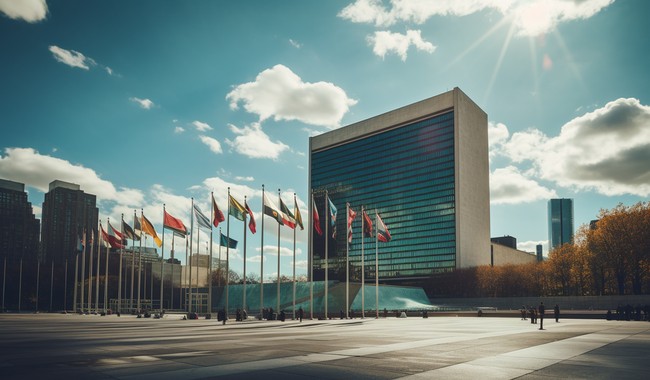
The United Nations warns it will run out of cash by July unless big contributors cough up, and this standoff has exposed a mix of real accounting headaches, self-inflicted rules, and political choices—especially from the United States under President Trump. This article walks through what’s actually happening with U.N. finances, why the agency’s own rules matter, and why Republicans see this as a chance to push back against wasteful global programs. Below I lay out the situation, quote the U.N. warnings verbatim, explain the U.S. role in the shortfall, and outline the political context driving the confrontation.
The U.N. has announced it faces imminent financial collapse and could be out of funds by mid-summer unless member states pay. That prospect would force closures of major operations, including the New York headquarters and key coordination offices that handle humanitarian crises. The fiscal picture is therefore both urgent and disruptive if payments do not arrive.
The United Nations said on Friday that it was facing imminent financial collapse and would run out of money by July if countries, namely the United States, did not pay their annual dues that amount to billions of dollars.
Senior U.N. officials said that if the cash ran out, the agency would be forced to shut down its landmark headquarters in New York by August. The U.N. Security Council, a 15-member body responsible for maintaining international peace and stability, convenes its meetings at U.N. headquarters.
It would also have to cancel the annual General Assembly gathering of world leaders held in September and shut the Office for the Coordination of Humanitarian Affairs, which responds to global emergencies like conflicts and natural disasters, it said.
The narrative pushed in many outlets frames the United States as the main culprit, but that needs unpacking. The U.S. share of arrears cited includes unpaid assessments for two fiscal years combined, and the congressional appropriations process controls when funds are actually released. Saying the United States alone “owes” the whole problem oversimplifies both law and budget timing.
The United States is responsible for about 95 percent of the money owed to the United Nations, about $2.2 billion, according to a senior U.N. official who briefed reporters on the agency’s budget crisis. That amount is a combination of the U.S. annual dues for 2025, which has not been paid, and for 2026, the U.N. official said.
Beyond timing, the U.N.’s own accounting rules create a bizarre squeeze. A rule dating back to the organization’s founding requires that if a budgeted program cannot be implemented, any unspent funds tied to it be returned to contributing members. That means the U.N. may have to refund money it never actually received because members defaulted or paid late.
The United Nations’ financial woes are largely rooted in two problems: a liquidity crisis driven by member states who either are not paying their dues or are paying late, and a financial rule, dating to 1945, that says if the organization fails to fully spend the budget, even if it’s because of lack of payment from member states, it must return the money to the states.
That double-counting logic is what Secretary-General António Guterres describes as a “double blow.” The U.N. must either return phantom cash or keep programs dormant while still being accountable for funds that never showed up. It’s an odd technicality with real operational consequences when liquidity is tight.
Guterres said a rule that the UN must return unspent money on particular programmes to members if it could not implement a budget created a “double blow” in which it was “expected to give back cash that does not exist”.
Republicans and many conservatives see the situation as partly a policy success for President Trump’s stance on international organizations. The administration has already cut ties with certain U.N.-aligned bodies and refused to support programs seen as hostile to American interests or wasteful. That posture has changed the funding landscape and left the U.N. scrambling to reconcile budgets with actual payments.
The friction is also ideological. Critics argue the U.N. spends American money on programs that run counter to U.S. interests and sovereignty, from climate initiatives to agencies accused of bias. Trump’s moves, in this view, are an attempt to end open-ended subsidies to a bureaucracy that often attacks Western policies while depending heavily on U.S. contributions.
Practical fixes exist: reform the 1945 rebate rule, tighten oversight of programs, and use appropriations to condition funding on clear outcomes. Politically, though, this crisis is a lever for those who want a smaller U.N. footprint and more targeted coalitions of aligned nations. The debate now is whether Congress and the administration will use that leverage to reshape America’s engagement or restore the status quo.
For Republicans watching, the moment is less about salvaging a bloated bureaucracy and more about forcing accountability. Whether the U.N. survives this funding crunch intact or is nudged into structural reform will depend on tough budget choices and political will in Washington, not just on pledges from New York.


The US should get out of the UN and the UN should get out of the US.
Most of the UN members oppose US policies and embrace radical terrorist countries. The UN is hostile to Israel and seeks its destruction. The UN wastes American tax dollars on inefficient ineffective programs.
It’s good time to end the US participation in UN.
Excellent points. This should be the wakeup call for the US to cut ties with the UN, save tax dollars, and take back the UN property to be put to use for better purposes,
Too bad they don’t file for bankruptcy and close up shop BEFORE July. They don’t do anything productive or positive for the world! World will be FAR better off without them!